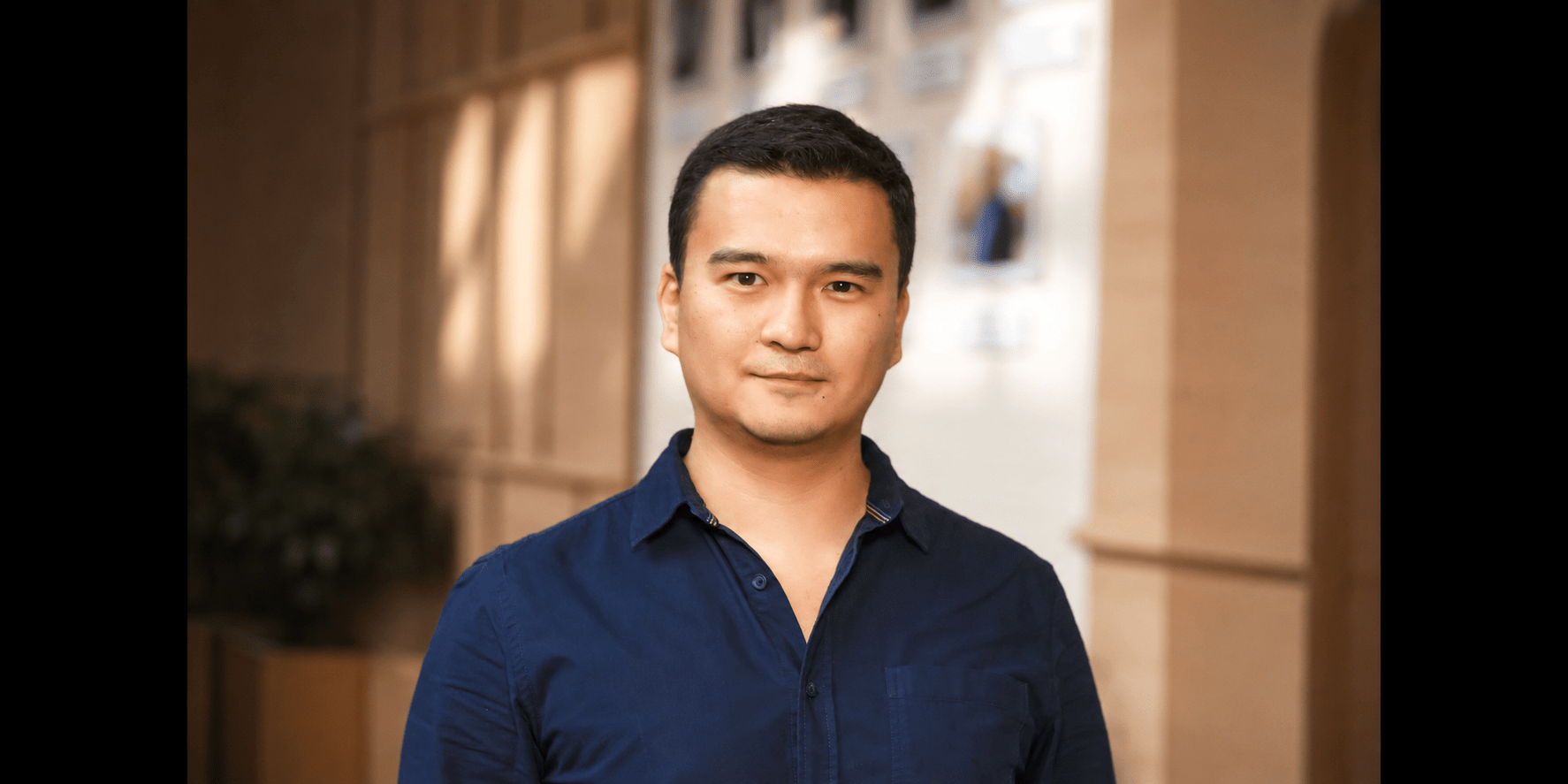
Screenwriter Yefrat Sharipov is a graduate of Kazakhstan’s Academy of Civil Aviation and the New York Film Academy (NYFA), and one of the country’s most sought-after screenwriters in recent years. He worked on the box office hit Dos-Mukasan, a film about the legendary Kazakhstani musical group often described as the local equivalent of The Beatles. He now reflects on the future of global cinema, the role of artificial intelligence, and why Kazakhstani stories can resonate far beyond the country’s borders.
In an interview with The Times of Central Asia, Sharipov discusses how engineering thinking shapes his approach to storytelling, why screenwriters must understand the inner workings of the film industry, and how technology may soon erase language barriers.
TCA: You’re a screenwriter with an engineering background who graduated from the Academy of Civil Aviation. How did that happen?
Sharipov: Honestly, it’s difficult for me to explain myself. The desire to write stories has been with me since childhood; I always knew I would never stop doing it. The need to express myself through writing appeared very early. Back in school, I was already trying to write short stories, novellas, poetry, even songs.
But when it came time to choose a profession, I decided to pursue a technical field, although I never stopped writing “for the drawer.” Later, when I entered the film industry and worked on projects in other roles, I remembered this passion and realized there was a way to apply it professionally. There was a huge demand for screenwriters. At first, it was mostly curiosity, I wanted to see whether anyone besides me would actually find my stories interesting. Gradually, things started to work out, and here I am.
TCA: What did you write about as a child?
Sharipov: About whatever fascinated me at the time. At one point, I became obsessed with Tolkien and started inventing fantasy stories with imaginary creatures. I mostly wrote for myself, though sometimes I let friends, parents, and relatives read my work. I remember my mother always praising me, and I usually got good grades for essays at school.
My friends and I even kept what we called “school chronicles,” where we humorously wrote about everything happening around us. Honestly, if I were a better speaker, maybe I would have become a stand-up comedian.
TCA: Does your technical education help you in your current work?
Sharipov: It does. Technical disciplines probably influenced the way I approach storytelling. I look at stories almost like an engineer, everything has to be structured and logical.
Before starting a film, I research the subject deeply. I don’t just read materials casually. I use an approach similar to scientific research. I gather facts, critically analyze the material, and repeatedly verify information.
TCA: So, every film becomes almost like a dissertation. But cinema is always about people. Can human beings really be approached scientifically?
Sharipov: When I worked on the Dos-Mukasan biopic, I didn’t just rely on archival material, I tried to meet personally with everyone who had witnessed those events.
As you know, Dos-Mukasan tells the story of a legendary Kazakh music group that was hugely popular in the Soviet Union. They were often called the “Kazakh Beatles” or even the “Kazakh Pink Floyd.” There was enormous public interest in the project because everyone in Kazakhstan knows their songs, and many of the musicians are still alive today. We couldn’t afford mistakes.
The director, Aidyn Sakhamanov, and I visited the band members at their homes, spoke with them for hours, and asked endless questions. He focused on some things, I focused on others.
TCA: You also studied at the New York Film Academy. How different are the teaching methods compared to Kazakhstan?
Sharipov: Since I didn’t study filmmaking in Kazakhstan, I can’t compare directly, but I think the approaches are radically different.
NYFA itself doesn’t have the highest reputation among American film schools. It’s a commercial institution designed to attract students from around the world. But it has a very strong practical approach. The school has partnerships with Warner Bros., Universal, post-production studios, and others, so you really get to see how the industry functions.
My wife and I studied there through Kazakhstan’s Bolashak scholarship program. We both majored in filmmaking. Those two years became extremely important for my career because they helped me understand not only how the industry works, but also why cinema differs from country to country.
TCA: What had a greater influence on your development as a screenwriter: formal education or self-education?
Sharipov: If we’re talking specifically about screenwriting skills, then definitely self-education.
Today, there’s an enormous amount of material available, books, masterclasses, online resources. That’s enough to understand the fundamentals. After that, what really matters is what a writer brings beyond technique. Screenwriting skills are shaped more by experience and practice than by formal education.
TCA: What additional qualities does a screenwriter need besides the ability to write?
Sharipov: In our market, a screenwriter must understand the industry and the logic of producers. You need to know how the company producing your script operates.
Kazakhstan’s market is active, but there are limitations. Budgets are modest, so you have to write within realistic production possibilities. There’s no point writing something that could never actually be filmed.
That’s where NYFA helped me a lot. We shot so many projects ourselves there that I started viewing the industry from a completely different perspective.
TCA: You’ve become successful in Kazakhstan’s film industry. Do you see yourself working in Hollywood one day?
Sharipov: Why not? I don’t want to limit myself to a single market. I’d like to write for everyone. Hollywood’s global influence is incomparable to ours.
I think new technologies will gradually erase borders, making it easier for writers to work for different markets. Ultimately, the key factor will simply be the story itself, how the dramaturgy works.
Everything else, dialogue, dialects, language nuances, I think technology will increasingly handle. Storytelling in its purest form will remain the decisive element. I believe we’ll eventually find a universal way to tell stories for the entire world.
TCA: Could Kazakhstani cinema one day become as globally popular as South Korean cinema?
Sharipov: Absolutely. We have every opportunity to replicate the success of countries like Spain with Money Heist or South Korea with Squid Game.
If we improve the quality of dramaturgy and production slightly, anything is possible. We have plenty of talented people and plenty of stories.
Of course, comedy is difficult because humor is deeply tied to mentality and culture. But other genres can absolutely work internationally. We can tell authentic Kazakh stories while making the underlying conflicts understandable everywhere.
TCA: You mentioned that technology may erase language barriers. What’s your attitude toward AI? Do you use it?
Sharipov: Of course. It’s already hard to imagine working without it. I mean, you can imagine it, but refusing to use it now would be strange.
TCA: I thought filmmakers wouldn’t admit that publicly.
Sharipov: But GPT doesn’t write scripts by itself. At least not yet and that’s a good thing.
What it does do is help structure the process, analyze topics, brainstorm ideas, and create a kind of conversational ping-pong that you’d otherwise have only with yourself. That’s especially important when you’re writing alone.
What would normally take me an entire day to mentally process can now be explored in a few hours. Large language models are getting better and better at this. It’s already become part of my workflow: open the tool, ask questions, think through problems, it helps you enter a productive creative state.
TCA: What kind of films do you watch yourself?
Sharipov: I watch a lot of films, though I wouldn’t call myself a cinephile.
Most often, I watch movies as references for a specific project. If I’m working on something, I gather dozens of references and carefully study them. You need to know what’s already been done in a genre both to avoid repetition and possibly to find inspiration or create subtle references.
At home, my wife and I watch TV series in the evenings simply to relax and disconnect. Though honestly, it’s getting harder and harder to fully switch off.
TCA: Do you ever watch a film and immediately think, “That plot turn doesn’t work?”
Sharipov: Exactly. It’s becoming harder to relax, especially when a film is bad. Then you automatically start analyzing why it failed for you.
But when a film is truly good, that professional screenwriter mode disappears and you simply absorb it emotionally. Sometimes I get deeply moved. In recent years, I’ve become extremely sentimental. I almost tear up during every film now.
TCA: What tends to move you in a film?
Sharipov: It moves me when something is written brilliantly and, at the same time, I feel sad that I didn’t write it myself.
I understand how perfectly the dramaturgy functions, and I want my own films to create those same emotions in viewers. I especially love Pixar stories, particularly those dealing with relationships between parents and children. They manipulate emotions so skillfully that all you can do is admire and learn from them.
TCA: Which recent film impressed you most?
Sharipov: One Battle After Another by Paul Thomas Anderson. It’s a great, funny film.
Taking two people with radically opposite worldviews, right-wing and left-wing, throwing them together, watching what happens, and somehow making it hilarious at the same time, that works brilliantly.
TCA: Many viewers didn’t understand why that film won Oscars.
Sharipov: Honestly, I’m surprised by how many people disliked it. It has a great story written by someone with an excellent sense of humor, beautiful cinematography, and I think DiCaprio is fantastic in it.
I’ve heard people say he was miscast or too old for the role, but I completely disagree.
TCA: Women’s stories are becoming more prominent in Kazakhstani cinema and beyond. How do you approach that in your work?
Sharipov: It’s difficult. I didn’t think about it much before.
After Dos-Mukasan came out, I remember criticism that one of the female characters, Kurmanai, ended up feeling too secondary. And it’s true, she was the only major female character, and probably we didn’t devote enough attention to her.
TCA: Maybe you needed a female co-writer?
Sharipov: Possibly.
I’m increasingly coming to the conclusion that a man probably cannot fully write a female character as authentically as a woman can. At the same time, I personally feel a strong need to explore these themes because I’m raising a daughter, and I know women still face many unresolved conflicts and problems in society that deserve attention.
I think the time of young female authors is coming.
I currently teach at ALMAU’s School of Media and Cinema, and 80% of my first-year students are women. Many of them are extremely talented. In just a few years, they’ll graduate, and I hope some of them will become my co-writers so we can develop these stories together more deeply and honestly.
TCA: What concerns young people today?
Sharipov: The themes vary, but overall, they correspond to their age. First and foremost, relationships with parents and questions about life choices.
It’s fascinating to watch how students’ focus evolves over time. In the first year, their stories are more rebellious, full of protest and coming-of-age themes. Later, they become more interested in social issues and begin trying to formulate social commentary. By the third year, their work becomes much more complex and individual. That’s when truly unique stories begin to emerge.
TCA: Do they feel very different from your generation?
Sharipov: Honestly, I don’t see some huge difference. And I definitely don’t support stereotypes about Gen Z supposedly being unable to concentrate.
On the contrary, when I think back to myself as a student, many of them seem more responsible and more focused than I was at their age.
Of course, everyone is different, but overall, they seem intelligent and thoughtful. I don’t see any radical divide between us. I think they’re fantastic. Their curiosity and enthusiasm energize you. You end up learning about topics that matter to them, and that keeps you feeling younger yourself.
Ultimately, we’ll still be making films for them in the coming years. They’ll become the core audience eventually bringing their own children to the cinema. So, we need to understand them and strengthen that connection rather than lose it.
TCA: So, you’re willing to defend Gen Z?
Sharipov: Absolutely. I strongly dislike the snobbery our generation often shows toward younger people.
I already see a new wave of filmmakers emerging. Several schools are competing simultaneously now, all with different approaches, and the industry will soon be filled with young talent.
We need to stay on the same wavelength with them.