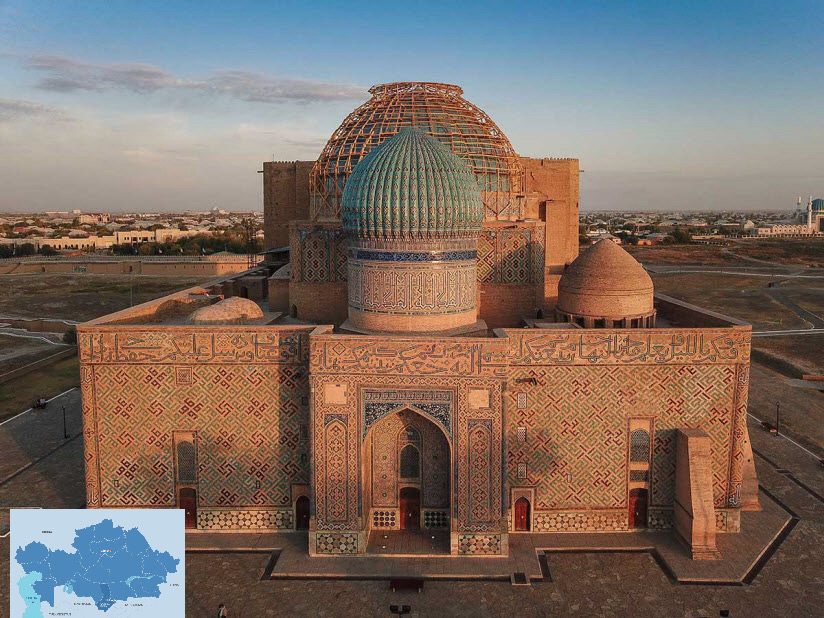
ASTANA – The Mausoleum of Khoja Ahmed Yasawi is widely regarded as one of the most important architectural monuments of the Turkic world and a spiritual treasure of Islamic civilization. Built in the late 14th century by order of Amir Temir, the complex has served for centuries as a center of Sufi teaching, spiritual education and Islamic scholarship.
The Khoja Ahmed Yasawi mausoleum. Photo credit: Kazakhtourism Click to see the map in full size. The map is designed by The Astana Times.
Yet the monument is more than an architectural masterpiece. According to researchers, its inscriptions and symbols form a coherent system of teachings on faith, self-knowledge and spiritual growth.
According to Saipulla Mollakanagatuly, head of the Yasawi Studies Research Center, the epigraphic inscriptions throughout the mausoleum are far more than decorative elements.
“If you look at the mausoleum from the west, its silhouette resembles the word ‘Allah.’ It is a unique combination of architecture and calligraphy,” he said.
A spiritual journey in stone
The mausoleum contains dozens of inscriptions in Arabic and Persian arranged across three symbolic levels – lower, middle and upper.
According to Mollakanagatuly, these levels represent a complete model of human existence. The lower level symbolizes the material world, the middle level represents faith and spiritual education, and the upper level signifies closeness to the creator.
Among the most striking elements are X-shaped compositions symbolizing eternity and the endless nature of spiritual growth. Photo credit: Rizabek Nusipbekuly
“Every inscription has been placed with a specific purpose. It is a teaching carved into stone. Understanding these texts allows visitors to appreciate the true spiritual value of the mausoleum,” he said.
The 65-meter-long complex consists of 35 rooms, including a mosque, library, mausoleum chamber, dining hall and the ceremonial Kazandyk hall. Their arrangement also carries symbolic meaning.
“The dining hall nourishes the body, while the mosque and library nourish the soul. The message is that a person should develop both physically and spiritually,” Mollakanagatuly said.
The symbolism behind the inscriptions
One of the most prominent motifs in the lower section of the mausoleum is the star-shaped geometric ornament.
While many visitors see it as decoration, Mollakanagatuly said it symbolizes the physical world and the beginning of humanity’s spiritual journey.
One of the most prominent motifs in the lower section of the mausoleum is the star-shaped geometric ornament, which symbolizes the physical world and the beginning of humanity’s spiritual journey. Photo credit: Rizabek Nusipbekuly
“The star is one of the highest symbols of the physical world. Its placement in the lower section is intentional. It shows that a person’s spiritual path begins in the material world. First, people learn the challenges of life and the laws of existence, and only then do they turn to spiritual pursuits,” he said.
The middle section contains the ideological core of the monument. Here, Kufic inscriptions repeatedly proclaim phrases such as “Allah is my Lord,” “Muhammad is my Prophet” and “Allah Akbar.”
According to Mollakanagatuly, these repetitions reflect the Islamic practice of dhikr, or remembrance of God.
“Ancient scholars said that repeating a word one hundred times allows it to settle once in the heart. These inscriptions were designed not only to be seen but also to educate spiritually,” he said.
Among the most striking elements are X-shaped compositions symbolizing eternity and the endless nature of spiritual growth.
“They reflect the eternity of Allah and the infinity of humanity’s spiritual search. A person spends a lifetime seeking knowledge, educating oneself and striving for spiritual growth. This path never ends,” Mollakanagatuly said.
The upper level of the mausoleum contains verses from the Quran, particularly passages from Surah Al-An’am, emphasizing God’s limitless knowledge and awareness of every human action.
“One verse says that even the fall of a single leaf is known to Allah. The purpose is not to instill fear but to encourage responsibility,” Mollakanagatuly said.
He believes the inscriptions remind visitors that every action carries significance and that awareness of this responsibility helps people avoid injustice and wrongdoing.
The western wall is considered the starting point of the mausoleum’s epigraphic system. Verses 59-63 of Surah Al-An’am are carved there alongside information about the construction of the mausoleum and the craftsmen who built it.
“This wall has both religious and historical significance. The walls of the mausoleum serve as both a spiritual text and a historical document of their era,” he said.
The northern facade focuses on self-discovery, a central concept in Sufi thought.
Mollakanagatuly noted that alongside invocations such as “Ya Allah,” “Ya Rahman” and “Ya Rahim,” visitors encounter sayings including “Man proposes, God disposes” and “He who knows himself knows his Lord.”
“In Sufism, self-knowledge is the central question. Only when a person understands their own limitations can they begin to comprehend the infinite power of God,” Mollakanagatuly said.
He added that the saying “Man proposes, God disposes” should not be interpreted as a call to passivity.
“It conveys the idea that people should act, strive and seek. At the same time, they must remember that the final outcome is not entirely within their control,” he said.
The eastern facade presents key declarations of Islamic belief, including “Allah is the Creator,” “Allah is Great” and “Muhammad is the Messenger,” rendered in various epigraphic styles.
“Many people see them simply as ornaments. But every inscription is a complete text. Together, they form a concise expression of the Islamic worldview,” Mollakanagatuly said.
Inscriptions on the dome emphasize the transient nature of worldly life.
“This does not mean rejecting the world. Islam does not forbid wealth. The message is that wealth should remain in a person’s hands, not in their heart,” he said.
The Taykazan and the spirit of community
At the center of the complex stands the Taykazan, a massive bronze cauldron that has become one of the mausoleum’s most recognizable symbols.
Surrounding it are inscriptions declaring that judgment belongs to Allah and that God guides humanity to the right path.
“The Taykazan symbolizes unity. Historically, water was distributed from it to visitors, representing equality and spiritual fellowship,” Mollakanagatuly said.
The wooden and metal doors of the mausoleum are also considered works of art. They bear hadiths and sayings such as “The door of the saint is the key to happiness,” “The pursuit of knowledge is the duty of every Muslim” and “Hurry to repentance.”
According to Mollakanagatuly, these inscriptions encourage people to pursue goodness, knowledge and an appreciation of time.
“Yasawi’s teaching is based on education. The purification of the heart, the cultivation of the soul, the pursuit of knowledge and service to society are reflected in every part of the mausoleum,” he said.
Mollakanagatuly believes the mausoleum should not be viewed merely as a historical monument.
“The entire inscription system forms a unified whole. The lower level symbolizes the material world, the middle level faith and spiritual education, and the upper-level closeness to the Creator. Together, they form a complete model of human life,” Mollakanagatuly said.
“The mausoleum is a spiritual program carved in stone. Its message remains as relevant today as it was centuries ago,” he added.
The article was originally published in Kazinform.