The Yomiuri Shimbun
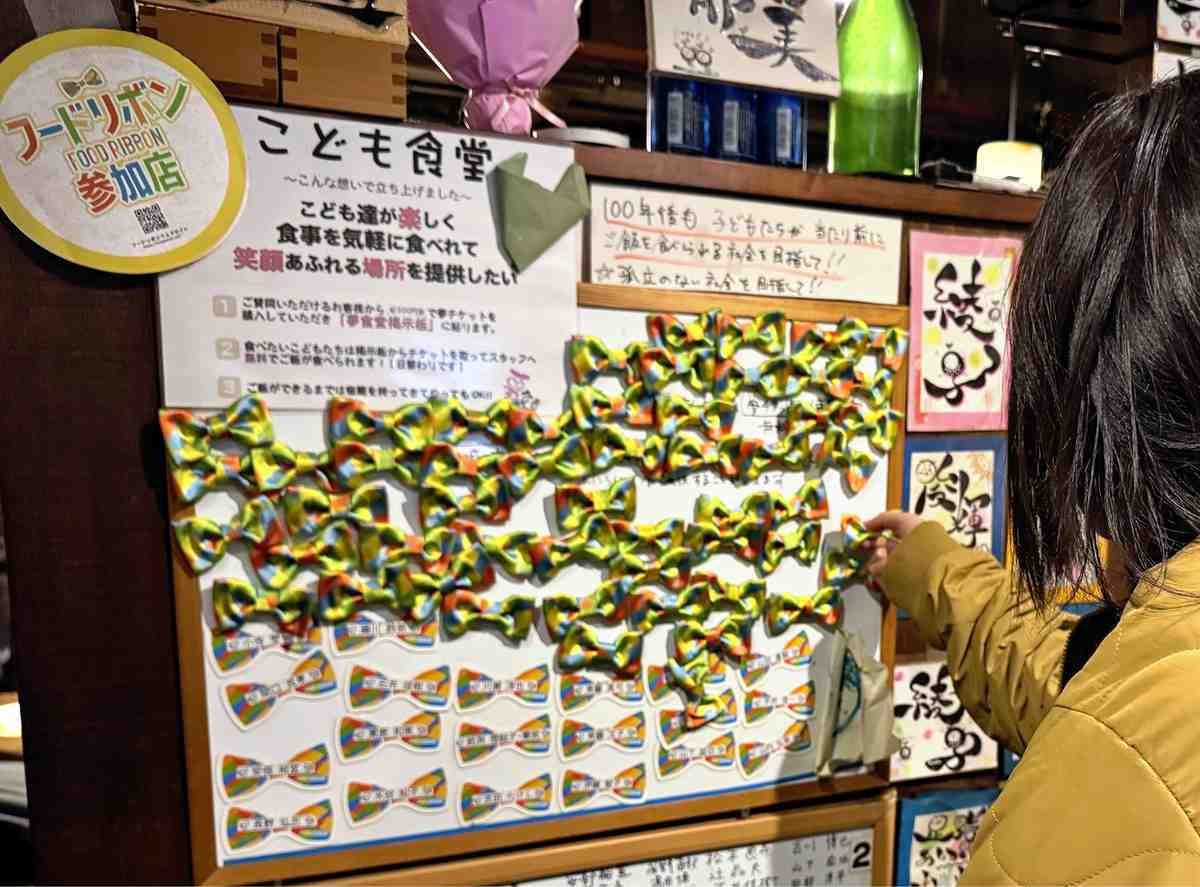
A child picks up a food ribbon at an izakaya pub in Wako, Saitama Prefecture, in December.
The Yomiuri Shimbun
By Kenichi Sumitomo and Ren Imamura / Yomiuri Shimbun Staff Writers
2:00 JST, January 30, 2026
SAITAMA — Customers at an increasing number of stores and restaurants across Japan are able to provide children with free meals through the Food Ribbon project.
Participating stores allow customers to purchase ribbons for ¥300 each. Children can then use the ribbons as free meal tickets. This opportunity for customers to show goodwill to children is available at approximately 300 establishments, which include izakaya pubs and convenience stores.
One day in December, a fifth-year elementary school boy entered Kojiro, an izakaya in Wako, Saitama Prefecture. He picked up a food ribbon posted on a whiteboard at the entrance, which he then handed to a staff member.
As he took a seat, a meal was brought to him. The meal that evening was a bowl of rice with a raw egg, pieces of deep-fried chicken and bonito flakes.
“A meal made by someone else tastes delicious,” the boy said.
As his parents work and return home late in the evening, the boy usually eats defrosted meals alone at home, he said.
Based on his parents’ suggestions, the boy began visiting the izakaya around four months ago about once a week. After eating the meal, he would spend about an hour playing games such as kendama — the Japanese version of a cup and ball — before heading home.
Koji Okubo, the 50-year-old proprietor of the izakaya, lost his mother to cancer when he was a junior high school student.
“When I felt lonely, neighbors would make meals for me,” he said. “With that in mind, I want to pass on the kindness I received to the children of today.”
Okubo enrolled in the Food Ribbon project in 2022. Some of his regular customers have purchased over ¥10,000 worth of food ribbons to date.
‘Acts of mutual support’
The initiative was launched in 2021 by Long Spoon Kyokai, which is based in Ichikawa, Chiba Prefecture.
The use of food ribbons by participating stores and restaurants form part of the association’s activities to combat child poverty and create safe public spaces for children. Each establishment has its own eligibility criteria, such as the children being elementary or junior high school students.
Nobuyuki Hashimoto, the 58-year-old representative director of the association, was initially interested in “kodomo shokudo” (children’s cafeterias), where children can eat for free, or at very little cost.
In 2019, he learned about a curry restaurant in Nara Prefecture that offered free meals to children and visited its proprietor. At the restaurant, customers would buy food tickets for ¥200 each, which children would then use to receive the free meal. Inspired by this initiative, Hashimoto developed the Food Ribbon project.
Having started with about 10 participating stores, there are now roughly 300 nationwide, from Hokkaido to Kyushu. The stores include cafes, hotels and food trucks.
Besides these establishments, more than 30 companies and organizations support the association’s operations through funding and promotional activities.
“If acts of mutual support become a matter of course, our system will no longer be needed,” Hashimoto said. “We aim to create a society where no child has difficulty obtaining a meal.”
The Yomiuri Shimbun
Naoya Ueyama holds a board explaining how the Food Ribbon initiative works at his Lawson convenience store, in Saitama City on Jan. 21.
Naoya Ueyama, 45, who operates eight Lawson convenience stores in Saitama City and elsewhere, joined the initiative in 2023 and now implements it at three of the stores. From 2 p.m. to 5 p.m. every day, a board with ribbons is sets up inside the store. The ribbons are sold for ¥300 each.
With the approval of the convenience store chain operator, Ueyama hands out rice balls and bento box meals cooked in-store to children. These are usually close to their expiration dates and thus also helps reduce food waste. He makes provisions for about 15 meals a day.
Ueyama said that on some days, all available ribbons end up being used.
“This is an act of goodwill that costs just ¥300,” he added. “I want to keep it going so that children will think, ‘Going to that store will help me get by somehow.’”