From the founding of the Franciscan Order in medieval Umbria, Italy to how the modern-day order functions, Italy News Online looks at how St Francis changed many aspects of Chritiantity.
In the early years of the thirteenth century, a young merchant’s son from Assisi began to abandon the expectations laid out for him. Giovanni di Pietro di Bernardone — known to history as Francis — had grown up in comfort. His father traded cloth, and Francis enjoyed the privileges of a rising commercial class in central Italy. He dressed well, spent freely and dreamed of becoming a knight. Yet by 1208, something had shifted. After a period of illness, captivity during a local war, and a series of religious experiences, Francis began to detach himself from wealth, status and ambition. What followed was not simply a personal conversion, but the beginning of one of the most influential religious movements in medieval Europe.
The turning point came when Francis heard the Gospel passage in which Christ instructs his disciples to take nothing for the journey — no money, no bag, no extra tunic – and to rebuild his church. Francis interpreted the instructions literally. He worked on restoring the physical church in which he received the message. He began preaching repentance, dressed in a simple tunic tied with rope, and living without possessions. His message was direct and uncomplicated: follow the Gospel, embrace poverty, and serve others. What distinguished him from earlier reformers was not only the intensity of his commitment, but the way he lived among ordinary people rather than withdrawing from society.
The request for papal approval of a new Order
By 1209, others had begun to join him. They were not monks in the traditional sense. They owned nothing, travelled on foot, worked when possible and begged when necessary. They called themselves the “Lesser Brothers” — friars minor — emphasising humility and social lowliness. Francis wrote a short rule for this small group, composed almost entirely of Gospel quotations. With around eleven companions, he travelled to Rome to seek approval from Pope Innocent III. The group’s radical poverty reportedly caused hesitation, but Francis eventually received oral approval, allowing them to preach. This moment, usually dated to 1210, marks the formal founding of what became the Franciscan Order.
The early movement grew quickly. Within a few years, small bands of friars were travelling across Italy. They preached in marketplaces and village squares rather than from monasteries. Unlike Benedictine or Cistercian monks, they did not withdraw into enclosed communities. They moved constantly, staying in huts, hospitals, or wherever they were welcomed. Their lifestyle was deliberately simple: a rough tunic, a hood, sandals or bare feet, and a rope belt with three knots representing poverty, chastity and obedience. They owned no personal possessions, and at first were discouraged even from handling money. Work — especially manual labour — was encouraged, but begging was accepted when necessary.
Their vows reflected traditional religious commitments, but with unusual strictness. Poverty meant more than personal simplicity; Francis originally rejected both individual and communal ownership. Chastity required celibacy and full dedication to religious life. Obedience bound friars to their superiors and to the Church, but also reflected Francis’s emphasis on humility. He did not seek hierarchy or prestige. The friars were to be “lesser” in every sense: socially, economically and spiritually.
Growth of the Franciscan Order
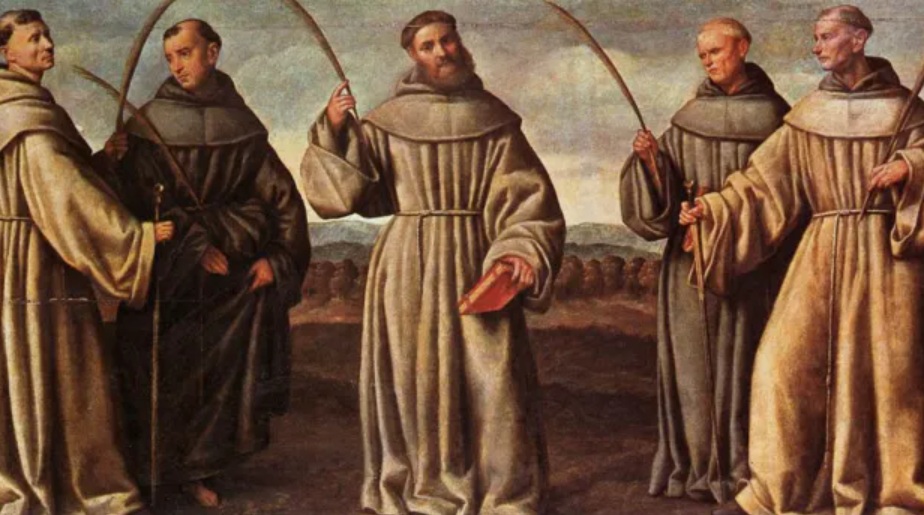
14th century Franciscan Friar
Growth was rapid. By 1221, the order numbered several thousand members. Within a decade of its founding, friars had spread beyond Italy into France, Spain and Germany. Their appeal was broad. Urban populations, expanding in the early thirteenth century, responded to preachers who lived among them rather than apart from them. The Franciscans spoke in vernacular languages, addressed everyday concerns and emphasised compassion and repentance. Their movement coincided with wider shifts in medieval religious life, including increased lay participation and devotion focused on the humanity of Christ.
The first Franciscan base was not a monastery but a small chapel known as the Portiuncula, near Assisi. This modest building became the symbolic centre of the order. Nearby, Francis repaired abandoned churches and gathered his followers.
The movement soon expanded in another direction when Clare of Assisi, inspired by Francis, founded a community of women in 1212 at San Damiano. These women, later known as the Poor Clares, adopted similar ideals of poverty and simplicity within a cloistered setting. Over time, a third branch emerged for laypeople who wished to follow Franciscan spirituality while remaining in ordinary life. This threefold structure — friars, cloistered women and lay members — helped spread Franciscan influence widely.
The Poor Clares
Francis himself remained wary of institutionalisation. He resisted property ownership and formal structures, fearing that wealth and stability would dilute the original vision. Yet as the order expanded, practical concerns emerged. Friars needed places to live, teach and organise. After Francis’s death in 1226, disagreements developed between those who wanted strict adherence to absolute poverty and those who favoured more moderate arrangements. These tensions eventually produced divisions and reforms, leading to the separate Franciscan branches that exist today, including the Friars Minor, Conventual Franciscans and Capuchins.
Influence on art and culture
Giotto fresco in the Cappella degli Scrovegni, Padua: Judas kiss
Beyond its organisational growth, the Franciscan Order influenced medieval culture in significant ways. One of their most notable contributions was to religious art. Franciscan spirituality emphasised the humanity of Christ, particularly his birth and suffering. This encouraged artists to depict religious scenes with greater emotional realism.
The tradition of the Christmas nativity scene is often linked to Francis himself, who is said to have arranged a living crib at Greccio in 1223. The emphasis on poverty, humility and everyday life shaped artistic themes in the late medieval period. Artists began to portray Christ and the saints in more recognisable settings, surrounded by ordinary people and natural landscapes. This shift contributed to the gradual movement away from abstract Byzantine styles toward more naturalistic representation.
A saint associated with environment
St Francis with birds
Francis’s relationship with nature also left a lasting mark. He referred to the sun, moon and elements as brothers and sisters, expressing a sense of kinship with creation. His “Canticle of the Sun” celebrated the natural world as a reflection of divine goodness. Stories about Francis preaching to birds or taming the wolf of Gubbio became part of his legend, whether historically precise or not.
These narratives reinforced the idea that animals and nature deserved respect. Over time, Francis came to be regarded as a patron of animals and ecology. While medieval attitudes toward animals did not change overnight, Franciscan spirituality introduced a language of compassion that influenced later religious thought.
The Franciscans also played an important role in education and intellectual life. Although Francis himself valued simplicity, the order soon produced notable scholars. Friars taught at emerging universities, including Paris and Oxford. Figures such as Bonaventure and Duns Scotus contributed to medieval theology and philosophy. This development reflected the order’s adaptation to changing circumstances. While maintaining an ideal of poverty, Franciscans became active in preaching, teaching and missionary work.
Missionaries beyond Europe
Their missionary efforts extended beyond Europe. Francis himself travelled to the eastern Mediterranean during the Fifth Crusade and met the Sultan of Egypt. Though the encounter did not lead to conversion, it demonstrated Francis’s willingness to engage peacefully across religious boundaries. Later Franciscans established missions in North Africa, the Middle East and eventually the Americas and Asia. Their emphasis on mobility made them well suited to such work.
By the late thirteenth century, the order had grown to tens of thousands of members. Franciscan friars were present in most major European cities. They preached, heard confessions, cared for the poor and served in hospitals. Their presence reshaped urban religious life. Mendicant orders like the Franciscans and Dominicans became central to pastoral care, complementing parish structures. Their preaching helped shape popular devotion, including practices such as the Stations of the Cross and meditations on Christ’s suffering.
Reforms in the Franciscan Order
Despite this success, tensions over poverty never fully disappeared. Some groups insisted on returning to the original ideal of complete renunciation, while others accepted more stable arrangements. These debates led to reforms and the eventual formal separation of different Franciscan families. Yet all retained the core elements of Francis’s vision: humility, simplicity and service.
Today, the Franciscan tradition continues in multiple branches, numbering tens of thousands of friars worldwide, along with nuns and lay members. Their presence extends across continents, engaged in pastoral ministry, education, social work and environmental advocacy. The brown habit and rope belt remain recognisable symbols, linking modern friars to the small group that walked to Rome in 1209.
The founding of the Franciscan Order was not planned as a lasting institution. It began with a handful of men seeking to live the Gospel literally. Yet the combination of radical poverty, public preaching and compassion for the poor resonated deeply in medieval society. Francis did not establish a monastery, draft a detailed constitution or accumulate resources. Instead, he created a movement defined by example. The barefoot preacher from Assisi reshaped religious life in the cities of Europe, influenced art and devotion, and introduced a language of respect for creation that still echoes centuries later.