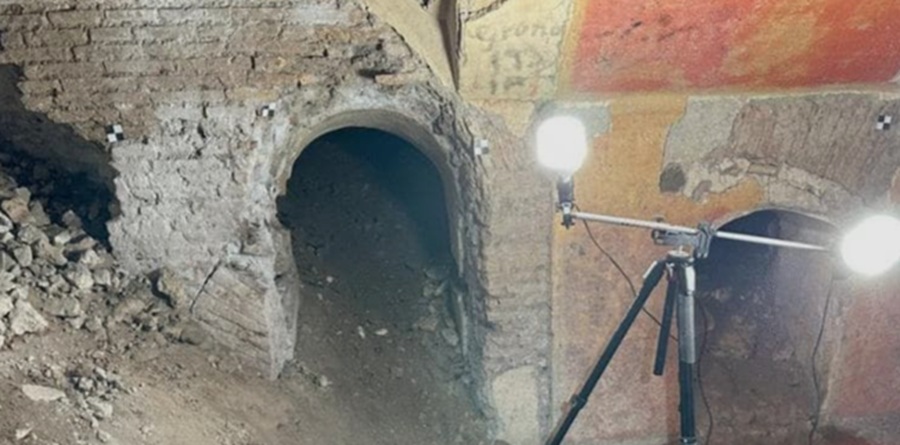
A second-century AD domus (townhouse) has been unearthed beneath the boys’ gymnasium of the Liceo Scientifico Cavour in central Rome. The dig reveals frescoes, mosaics and stucco decoration of exceptional quality.
For years, pupils at the Liceo Scientifico Cavour in Rome’s Rione Monti had insisted there was something ancient beneath the school gymnasium. The school is on via delle Carine, steps from the Colosseum and the Imperial Fora. A teacher on the staff — archaeologist Claudia Marino — chose to take the students’ persistent claims seriously and reported them to the Special Superintendency of Rome.
Excavations, financed with €350,000 of PNRR funds, began in late 2025. The results were revealed publicly on 28 May 2026 at an event held in the school’s main hall. What they found surpassed expectations.
An elite Roman residence
Restoration and excavation works brought to light ancient walls and high-quality decorative elements pointing to an upscale residence: mosaics with substantial preserved sections, traces of frescoes and stucco details that delineate the architectural character of the rooms. The signature deep red of Roman wall painting remains vivid, alongside human figures, floral motifs and elaborate stuccowork with friezes and geometric meanders extending to the vault ceilings. One room contains a black mosaic laid in large irregular tesserae — an aesthetic choice fashionable among the Roman elite. Pottery including amphorae and drinking cups has also been recovered.
The area between the Carinae and the Esquiline was central to the life of ancient Rome: Cicero, Pompey and Octavian all maintained residences in this neighbourhood. Stratigraphic analysis has allowed archaeologists to tentatively identify former owners of the property, with an inscription discovered during a nineteenth-century excavation in the same area pointing to members of the gens Umbria. The site is currently known as the Domus Liceo Cavour.
Traces of more recent visitors
The rooms did not pass entirely unnoticed in the intervening centuries. Alongside the ancient decoration, walls bear traces made by lighter flames left by amateur explorers in the first half of the twentieth century.
Only a portion of the domus has been explored so far, as it extends far beneath the school. Additional excavation may be carried out in the future. Investigations will continue in the coming months to establish the full extent of the complex and to locate any further buried rooms. Material analyses, dating and detailed study of the mosaics and frescoes will help reconstruct the functions and sequence of occupation of the domus.