Whether it is a stopping point on a journey through Le Marche or a destination in its own right, Ascoli Piceno offers one of the most coherent and atmospheric historic centres in central Italy. Built almost entirely from pale travertine stone, the city has a visual unity that is rare even by Italian standards, giving it a calm, dignified elegance that rewards slow exploration. Our quick guide to Ascoli Piceno provides you with highlights and insights into the town.
The historic centre is compact and walkable, shaped by centuries of civic pride rather than modern tourism. Towers and belfries rise above refined squares, while Roman, medieval and Renaissance layers coexist without disruption. Ascoli Piceno feels lived-in rather than staged, and its rhythms remain closely tied to local traditions, food culture and daily social life.
Brief History of Ascoli Piceno
Ascoli Piceno’s origins stretch back to antiquity. Archaeological evidence shows settlement in the area since the Neolithic period, but the city rose to prominence under Roman rule in the third century BC, when it became known as Asculum Picenum. Its strategic position along the Via Salaria, the ancient road used to transport salt from the Adriatic coast to Rome, ensured both prosperity and military importance.
During the Roman period, Asculum was a key centre in the Picenian territory and later played a significant role in the Social War against Rome. After the fall of the Roman Empire, the city passed through Lombard, Carolingian and communal phases before coming under the control of powerful families such as the Malatesta and the Sforza.
From the Middle Ages until Italian unification, Ascoli Piceno formed part of the Papal States. In the twentieth century, the city gained national recognition for its resistance activity during the Second World War. In 2001, it was awarded the Gold Medal for Military Valour for the role played by local partisans in opposing German occupation following the armistice of September 1943.
What to see in Ascoli Piceno
Piazza del Popolo
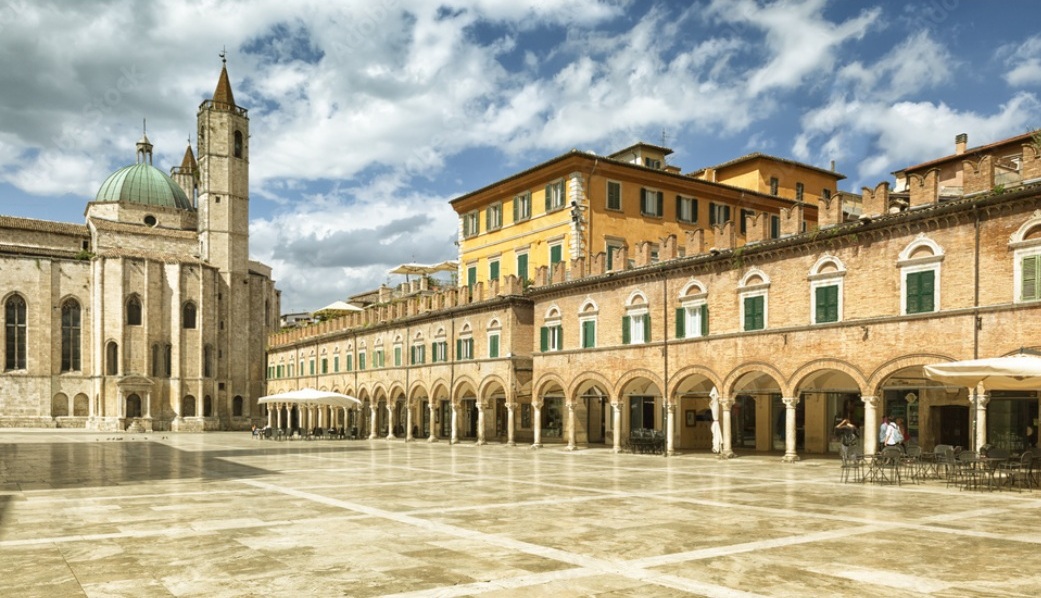
Any visit to Ascoli Piceno inevitably begins in Piazza del Popolo (main image), often described as one of Italy’s most harmonious squares. Lined with travertine arcades and historic cafés, it reflects the civic identity of the city.
Dominating one side of the square is the Palazzo dei Capitani del Popolo, with its medieval crenellated tower, long a symbol of Ascoli’s political authority.
Palazzo dei Capitani
Piazza Arringo
A short walk away lies Piazza Arringo, the city’s oldest square and religious heart. Here stands the Cathedral of Sant’Emidio, dedicated to Ascoli’s patron saint and one of the city’s most important landmarks. The cathedral blends Romanesque and later Baroque elements and houses artworks spanning several centuries, but its significance goes beyond architecture and art.
Cathedral of Sant Emedio in Piazza Arringo
Sant’Emidio is traditionally invoked as a protector against earthquakes, a belief deeply rooted in local history and devotion. According to legend, the saint miraculously guided the people of Ascoli to safety during seismic events, sparing the city from destruction. This association remains strong today, particularly in a region historically affected by earthquakes, and images of Saint Emidio are often found holding a model of the city in his hands, symbolising divine protection. The crypt beneath the cathedral, linked to the saint’s cult, remains a place of quiet reflection and popular devotion.
Piazza Arringo is also home to the Civic Picture Gallery, located in the Palazzo dell’Arengo. The collection includes works by artists such as Turner, Morelli, Pellizza da Volpedo and Adolfo De Carolis, offering insight into both Italian and European painting traditions.
Caffè Meletti
Caffè Meletti
No visit is complete without stopping at Caffè Meletti, a landmark of Ascoli’s social life since the early twentieth century. It remains a meeting place for locals and visitors alike and is the natural setting in which to try anisetta, the city’s distinctive anise-flavoured liqueur.
Other notable sites
Other notable sites include the Roman bridge of Porta Solestà, Forte Malatesta overlooking the Castellano river, the church of San Francesco and the historic papal paper mill, which today hosts museums dedicated to paper production and industrial heritage.
Things to do in Ascoli Piceno
Ascoli Piceno lends itself to unhurried exploration. Walking tours are ideal, given the short distances and the density of architectural detail. For those who prefer alternatives, bicycles can be hired from the tourist information office in Piazza Arringo, while a small tourist train offers an overview of the historic centre.
Food and wine experiences play a central role in local tourism. Cooking classes, tastings and guided visits to producers introduce visitors to regional specialities and family traditions that remain firmly rooted in daily life.
For a quieter experience, an evening walk along the Via delle Stelle offers views across rooftops and towers, particularly striking at sunset when the travertine stone takes on warmer tones.
What to eat in Ascoli Piceno: local specialities
olive all’ascolana are often served in a cone from street vendors
Ascoli Piceno’s culinary identity is closely tied to tradition and quality ingredients. The city is internationally known for olive all’ascolana, large green olives stuffed with seasoned meat, breadcrumbed and fried. Authentic versions use Ascoli olives, which hold PDO status.
Other regional staples include ciauscolo, a soft, spreadable pork sausage, and vincisgrassi, a rich baked pasta dish layered with ragù and béchamel, often described as a Marche variation of lasagne. Recipes vary by family, reflecting local pride and tradition.
Cheese-based baked goods such as pizza di formaggio and cacciannanze ascolana, a focaccia with olive oil and rosemary, are common during festive periods. For dessert, Carnival ravioli filled with sweet ricotta remain a seasonal favourite.
Meals are often concluded with a glass of anisetta, sometimes served with a roasted coffee bean, a local custom that is still widely observed.
Unusual places to see in and around Ascoli Piceno
Beyond the main sights, Ascoli Piceno offers several lesser-known places of interest. Sant’Emidio alle Grotte, a rock-cut sanctuary just outside the city walls, is one of the most distinctive religious sites in the area and further underlines the city’s deep connection to its patron saint.
Aerial view of Ripatransone
Image credit: Gionata Taddei via Marche Tourism on X.com
The surrounding territory is rich in small villages and landscapes worth exploring. Ripatransone, nearby, is home to what is often cited as Italy’s narrowest alley. Offida stands out for its Church of Santa Maria della Rocca, dramatically positioned on a rocky spur, while Grottammare Borgo Antico and Seghetti Panichi offer quieter alternatives to coastal destinations.
For nature lovers, Lake Pilato in the Monti Sibillini National Park provides a striking contrast to the city, with alpine scenery and strong links to local legends and folklore.