Almost 800,000 years ago, early humans living in the area of northern Israel were likely collecting driftwood from the ancient predecessor of the Hula Lake to regularly fuel fires, according to a new study published in the June 2026 issue of the Quaternary Science Reviews journal. The research suggests that early inhabitants of the area knew how to use environmental resources more efficiently and with greater sophistication than previously thought.
Prof. Naama Goren-Inbar of the Hebrew University of Jerusalem, one of the study’s authors, explained that for the first time, the team of Israeli and international scholars identified a large number of charcoal fragments at Gesher Benot Ya’akov, a rare find at an ancient site.
Gesher Benot Ya’akov offers the earliest evidence for the use of controlled fire outside Africa.
“Gesher Benot Ya’akov is the only site [from this period] with secure evidence of fire,” she told The Times of Israel over the telephone.
“In the past, we had identified fish teeth that had been exposed to heat, indicating that the fish was cooked, and also clusters of burnt flint fragments,” she added. “Now we have charcoals, so we have three lines of evidence.”
Get The Times of Israel’s Daily Edition
by email and never miss our top stories
By signing up, you agree to the terms
Asked whether fire had been used for purposes other than cooking, Goren-Inbar said it is probable, but the researchers have not identified any direct evidence of it.
Prof. Naama Goren-Inbar of the Hebrew University of Jerusalem. (Miriam Alster/Flash 90)
Gesher Benot Ya’akov has been excavated for several decades. The site has been dated using the Earth’s magnetic field — a constantly shifting invisible shield stemming from magnetic ore in the Earth’s core. Archaeologists found evidence testifying to the shift that occurred around 780,000 years ago.
They also identified some 20 archaeological layers, indicating that early humans had returned to Gesher Benot Ya’akov continuously for approximately 100,000 years. The site is considered an example of the Acheulean culture, based on the shapes of stone tools unearthed there.
According to Goren-Inbar, finding charcoal from such a long time ago is very rare.
“In sites that ancient, you don’t usually find charcoal, but our site is very unique because it is a wet site,” Goren-Inbar said.
Charcoal normally deteriorates over time, but in this case, the sediments of the ancient lake helped preserve it.
The researchers analyzed over 260 fragments.
Familiar flora
Previous studies focusing on the plants and seeds consumed at Gesher Benot Ya’akov in the same period documented a wide variety of species, including acorns, cereals, legumes and aquatic plants.
By analyzing the type of plants that the charcoal derives from, the scientists were surprised to see how the wood used to fuel fires included an even larger variety, such as ash, willow, grapevine, oleander, olive, oak, pistachio, and pomegranate (the study also provides the earliest evidence of pomegranate’s presence in the Levant).
“We had never found these species before,” noted Goren-Inbar. “Basically, we have many of the present-day species [of that area] already growing there three-quarters of a million years ago.”
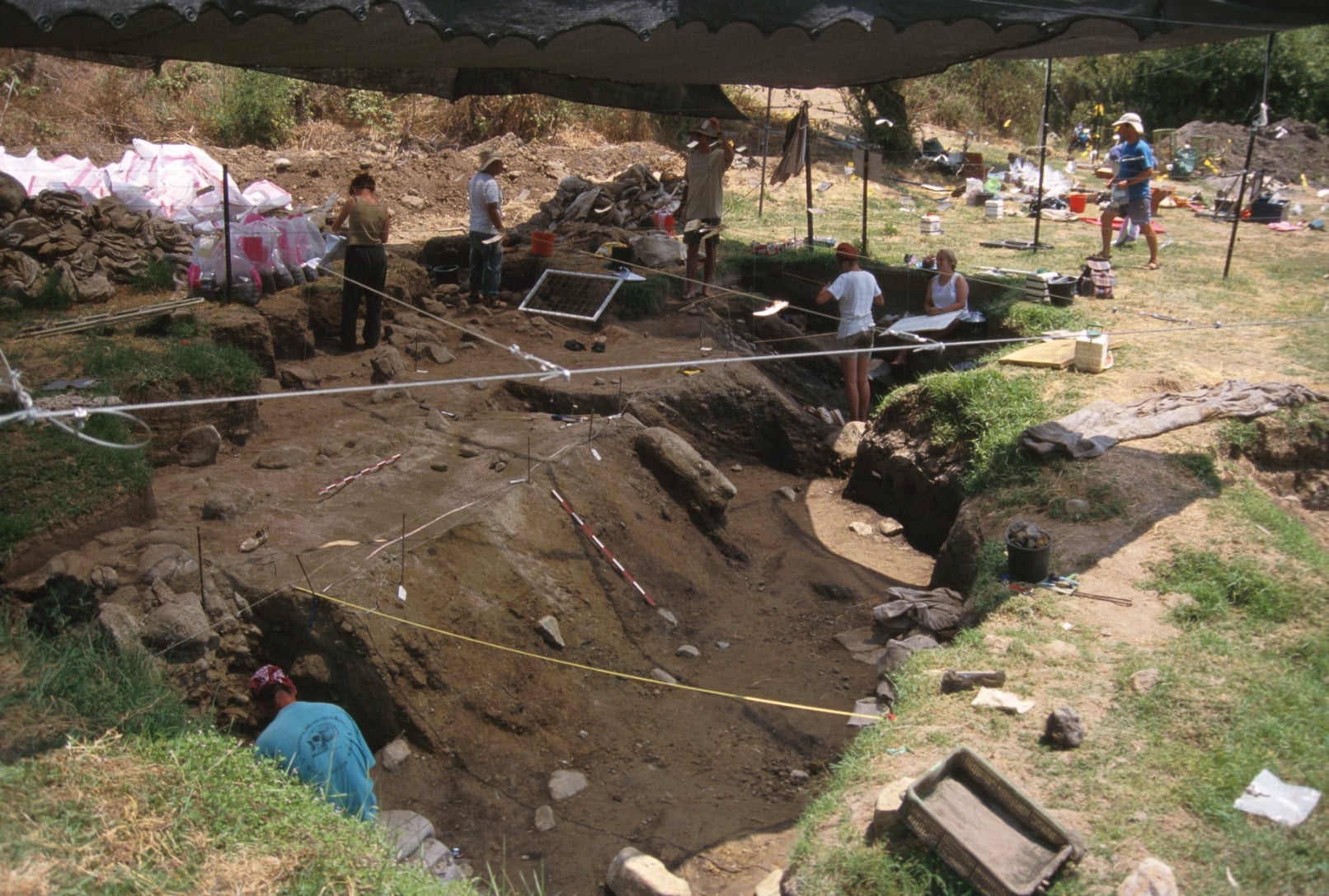
A general view of the excavation of Gesher Benot Ya’akov Acheulian site in northern Israel dating to some 780,000 years ago. (GBY Expedition)
Based on drainage patterns documented in different areas of the ancient lake, Goren-Inbar and the authors suggested that the early humans occupying the site were likely collecting fallen branches and logs deposited along the shore close to where they lived, which would have provided an abundant, readily available fuel supply. This smart choice, rather than collecting wood in other, more time-consuming ways, testifies to advanced cognitive abilities.
“In my interpretation, all the wood used as combustible for fire is driftwood that came to the lake from a system of rivers and trees that grew on the water’s edge,” she said.
The theory is also supported by the fact that, among the (non-burnt) wood remains found in the same sediments, the archaeologists identified cedar, which must have come from the Golan Mountains.
Out of Africa
The earliest evidence of fire use in prehistory was unearthed at sites in Africa dating back to some 1.2 million years ago. It would take several hundred thousand years for ancient humans to learn to light their own fire, with the most recent discoveries placing the development at around 400,000 years ago.
Gesher Benot Ya’akov stands on the Levantine Corridor, or the route out of Africa and into Eurasia taken by early humans, who could be found in northern Israel as early as 1.9 million years ago.
Usually, scholars identify those early humans as Homo erectus.
A reconstruction of a 1,600,000-year-old Homo erectus based on a fossil specimen known as ‘Turkana boy’ is seen at the Neanderthal Museum in Mettmann, Germany, on July 3, 2019. (AMartin Meissner/AP)
“We have never found human bones in our excavations,” said Goren-Inbar. “However, Homo erectus is the first type of hominin that left Africa, and in African sites, there are elements that suggest an association with Acheulean sites.”
The archaeologist explained that as additional proof of controlled use of fire, the charcoal provides further evidence of the connection between the early humans living in African prehistoric sites and those from Gesher Benot Ya’akov.
“It further roots fire as a component of the [human] culture already three-quarters of a million years ago,” Goren-Inbar said. “The discovery is very important.”
You appreciate our wartime journalism
We’re really pleased that you’ve read X Times of Israel articles in the past month.
You clearly find our careful reporting of the Iran war valuable, at a time when facts are often distorted and news coverage often lacks context.
Your support is essential to continue our work. We want to continue delivering the professional journalism you value, even as the demands on our newsroom have grown dramatically during this ongoing conflict.
So today, please consider joining our reader support group, The Times of Israel Community. For as little as $6 a month you’ll become our partners while enjoying The Times of Israel AD-FREE, as well as accessing exclusive content available only to Times of Israel Community members.
Thank you,
David Horovitz, Founding Editor of The Times of Israel
Join Our Community
Join Our Community
Already a member? Sign in to stop seeing this