ERBIL, Iraq (AP) — Two of Iraq’s most powerful Iran-backed militias said on Tuesday they would begin handing in their weapons to the authorities, a major step in the new government’s effort to rein in militias that have long operated on their own even though they were nominally under state command.
One of the groups, Asaib Ahl al-Haq, said it had formed a committee to oversee the move, inventory its fighters, weapons and equipment, and coordinate with the commander-in-chief of Iraq’s armed forces.
It cast the decision as a response to calls by Iraq’s top Shiite religious authority and the Iran-aligned Coordination Framework, the largest bloc in parliament that dominates Iraqi politics.
The second group, the Imam Ali Brigades, made a similar announcement saying the time has come “to build a strong state with full sovereignty.” It added that its aim was now to have weapons only with the state and help boost state institutions.
The war launched against Iran by Israel and the United States on February 28 has exposed the fragility of Iraq’s state institutions and their limited ability to restrain Iran-backed groups.
Get The Times of Israel’s Daily Edition
by email and never miss our top stories
By signing up, you agree to the terms
A parallel confrontation between Washington and the militias has deepened the crisis, with factions acting as an extension of Iran’s regional campaign and escalating attacks on US assets in Iraq before a tenuous ceasefire deal was reached in April.
Iraqi Muslim women hold portraits of Iran’s late supreme leader Ayatollah Ali Khamenei during a protest against US and Israeli attacks on multiple cities across Iran, in the Shiite district of Kazimiyah, in Baghdad, Iraq, on April 25, 2026. (AP Photo/Hadi Mizban)
A week ago, influential Shiite cleric Muqtada al-Sadr said his Saraya al-Salam militia, also known as the Peace Brigades, would split from his political movement and integrate into state institutions.
Under pressure from Washington, Iraqi Prime Minister Ali al-Zaidi has been working to assert state authority over weapons. Al-Zaidi, a 40-year-old banker sworn in last month, has made a state monopoly on arms a centerpiece of his program.
Iraq’s then-Prime Minister-designate Ali al-Zaidi, speaks to Iraqi lawmakers before submitting his government in Baghdad, Iraq, on May 14, 2026. (Iraqi Presidency Office via AP)
The Trump administration has warned against having any Iraqi government influenced by Iran-linked factions and has tied defense cooperation and funding to efforts to curb them.
Many Iran-backed militias are funded through the Iraqi state budget and embedded within the security apparatus, although not under the government’s control. This has drawn criticism from the US and other countries that have borne the brunt of attacks by the militias and which say Baghdad has failed to take a tougher stance on armed groups.
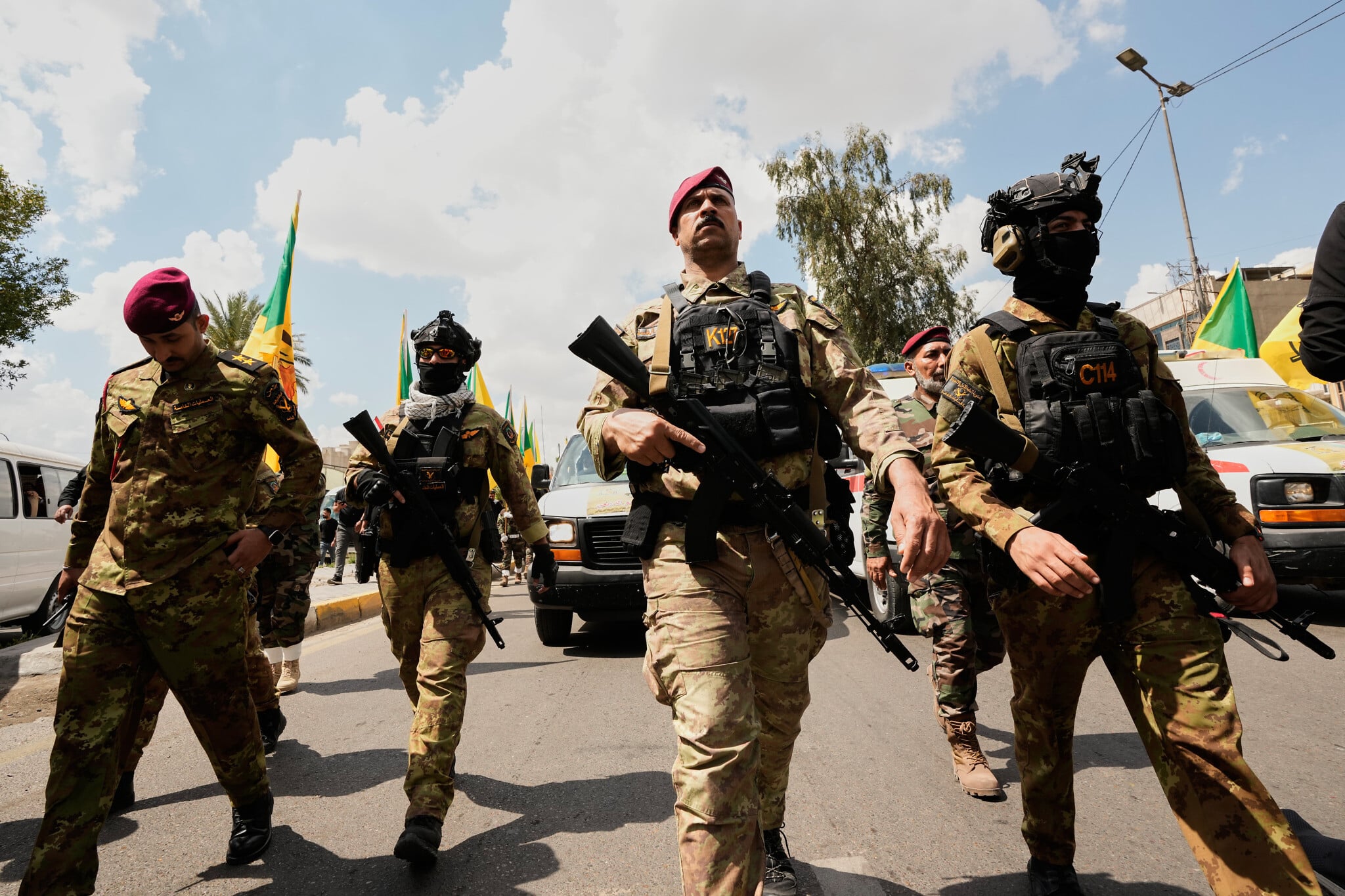
Several armed factions aligned with Iraq’s Coordination Framework have taken a different stance on efforts to bring weapons under state control. Two important groups, Kataeb Hezbollah and Harakat al-Nujaba, have rejected disarmament, tying the issue to Iraq’s sovereignty and the presence of foreign troops.
Members of an Iraqi Shiite group attend a funeral of a Kataeb Hezbollah fighter, who was killed in a US airstrike in Basra province south of Baghdad, Iraq, on April 8, 2026. (AP Photo/Hadi Mizban)
Kataeb Hezbollah welcomed moves by other factions to place weapons under state authority but said its own armed activity will continue as part of what it describes as “resistance work.”
In a recent statement attributed to its Abu Mujahid al-Assaf social media channel, the group said it would offer to coordinate with the paramilitary Popular Mobilization Forces — a state-backed umbrella of mostly Shiite armed groups — rather than surrender its arms.
The Popular Mobilization Forces was formed in 2014 to fight the Islamic State group, which at the time had seized a wide swath of Iraqi territory. Many of its groups still keep their own command and ties to Iran.
Discover Israel’s most beloved poet
She died more than four decades ago, but Leah Goldberg remains a magnetic and enigmatic figure: Israel’s most beloved poet, a powerful woman who lived with her mother and never married, who reinvented herself from the ashes of World War I through her magical writing.
You can screen ‘The Five Houses of Leah Goldberg’ June 4-11. Join The Times of Israel Community today to support our work and watch this and other outstanding documentary films in our DocuNation series.
I want to see it
I want to see it
Already a member? Sign in to stop seeing this
You’re a dedicated reader
We’re really pleased that you’ve read X Times of Israel articles in the past month.
That’s why we started the Times of Israel – to provide discerning readers like you with must-read coverage of Israel and the Jewish world.
So now we have a request. Unlike other news outlets, we haven’t put up a paywall. But as the journalism we do is costly, we invite readers for whom The Times of Israel has become important to help support our work by joining The Times of Israel Community.
For as little as $6 a month you can help support our quality journalism while enjoying The Times of Israel AD-FREE, as well as accessing exclusive content available only to Times of Israel Community members.
Thank you,
David Horovitz, Founding Editor of The Times of Israel
Join Our Community
Join Our Community
Already a member? Sign in to stop seeing this