Prime Minister Benjamin Netanyahu appeared to acknowledge he bears some responsibility for the failures that enabled Hamas’s cross-border invasion and onslaught of October 7, 2023, but claimed that “everyone” from the top to the bottom of the political, military, and security hierarchies bears responsibility as well, and the “real issue” is what has happened since that day and not what preceded it.
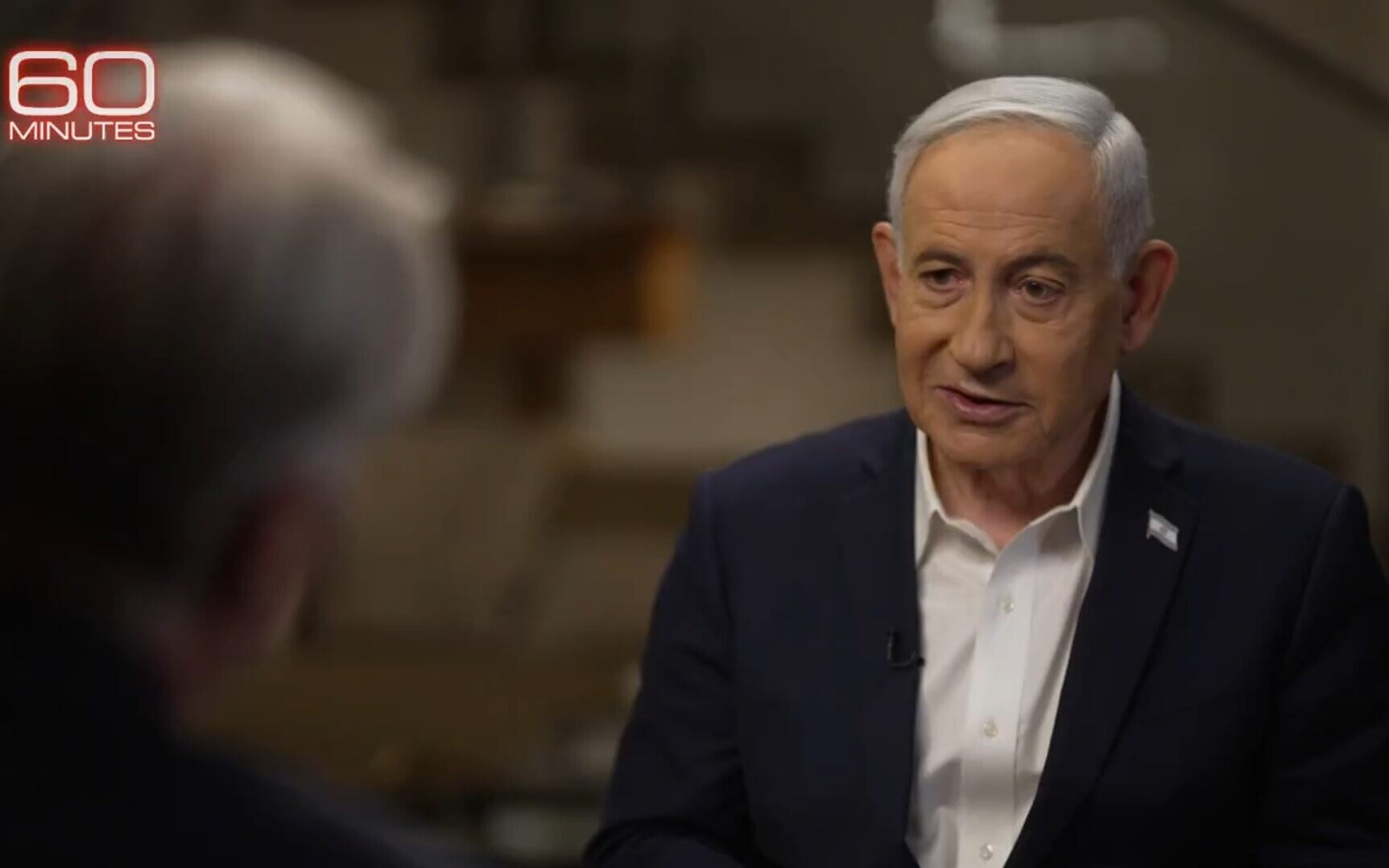
Asked during a wide-ranging interview with CBS’s “60 Minutes” how it is that all those who were in charge of security during the attack have quit or been fired except him, Netanyahu claimed some departed because their terms were up, and only one or two “claimed they took responsibility, but it’s not clear what — what does that mean, you know? What is their responsibility?”
The remarks appeared in an off-mic section of the interview that wasn’t aired on Sunday, and only in CBS’s full transcript.
“Let’s look at the political echelon, military echelon, the security echelon. Let’s look down at everyone, and everybody bears some responsibility. Yeah, from the top, from the prime minister down,” he said, going on to repeat his proposal for a politically appointed commission of inquiry instead of an independent state commission of inquiry, the country’s highest form of inquiry, which he has refused to form.
Polls have consistently indicated a clear majority of Israelis support a state commission, and Netanyahu himself backed such an inquiry into the conduct of the previous government in 2022. But the current government has steadfastly refused to consider this, and has yet to okay any inquiry, over two-and-a-half years after the deadliest day for Jews since the Holocaust.
Get The Times of Israel’s Daily Edition
by email and never miss our top stories
By signing up, you agree to the terms
“But I think the real issue is, okay, that’s up to October 7th. What about since October 7th?” he continued. “[It] was clearly my responsibility to get Israel out of this horrible noose of death that the Iranians put on us. And we did, systematically, very resolutely, go [to] each one of these seven fronts, one after the other, and roll back the tide of terror.”
A car destroyed by Palestinian terrorists is seen at Shaar Hanegev Junction near Sderot, on October 7, 2023. (Ohad Zwigenberg/AP)
Netanyahu has given periodic interviews to international media since the October 7, 2023, Hamas-led attack, while largely restricting his interviews with Israeli outlets to those that are considered openly supportive of him.
According to the Kan public broadcaster, the “60 Minutes” interview was filmed at the Jerusalem home of Netanyahu’s billionaire friend and backer Simon Falic.
‘I don’t claim perfect foresight’
Asked about a growing perception of him as hungry for conflict, Netanyahu told CBS that until October 7, he was considered “perhaps the most restrained prime minister in Israel’s history,” and that this changed after October 7.
“I was conceived as being politically tough, but militarily very restrained,” he said of his more than a decade in power in which he had bucked frequent right-wing demands to declare full-on war on Hamas, and had cast such a war as unnecessary. Numerous reports and some top security officials have said publicly that Netanyahu and his government repeatedly rejected plans to kill senior Hamas leaders.
“[This] obviously changed on October the 7th because they were gonna annihilate us. I didn’t think it was just an attack by Hamas. I saw it, as it was, an attack by the Iran axis to try to annihilate us, through a noose of death,” Netanyahu said, referring to Tehran and its terror proxies.
Netanyahu recounted how he vowed at the outset of the resulting war that Israel was going to “change this condition in which they are ganging up on us.”
Israeli Prime Minister Benjamin Netanyahu says he was once viewed as being “militarily very restrained,” but that changed after the Oct. 7 Hamas-led attack. https://t.co/zrpTgpK8qB pic.twitter.com/bRIM7nxWie
— 60 Minutes (@60Minutes) May 10, 2026
In addition to launching the Gaza war in response to October 7, Israel has since battled the Iranian-backed Hezbollah in Lebanon and the Houthi rebels in Yemen, who attacked Israel in support of Hamas.
Israel has also fought two wars with Iran, including the latest launched together with the United States in February and which is currently in the midst of a fragile-ceasefire.
However, the premier appeared to admit neither Israel nor the US foresaw the effective use Iran would make of its control of the Hormuz Strait before the recent war began.
“I don’t claim perfect foresight, and nobody had perfect foresight. Neither did the Iranians,” Netanyahu said when asked about a New York Times report that he had predicted that Tehran would be too weakened by the US-Israeli airstrikes to choke off the strategic waterway.
Netanyahu was also asked about a New York Times report that he had told a gathering of top US officials in the White House situation room on February 11 that a joint Israeli-American operation could collapse the Islamic Republic.
The premier called that “false,” but went on to say that he merely didn’t note that outcome as definitive.
US President Donald Trump, right, shakes hands with Prime Minister Benjamin Netanyahu during a news conference at Mar-a-Lago, in Palm Beach, Florida, December 29, 2025. (Alex Brandon/AP)
“We both agreed that there was uncertainty and risk involved,” Netanyahu said, quoting US President Donald Trump as having said that there was danger in action, but bigger danger in not acting.
Asked if it is possible to topple the Iranian regime, Netanyahu said, “I think that you can’t predict when that happens. Is it possible? Yes. Is it guaranteed? No. But I can tell you it’s like bankruptcy, you know? It… proceeds gradually and then it falls.”
The premier added that he doesn’t know when or if the Iranian regime will fall, but said that if that happens, it would mean the end of its network of proxies, including Hezbollah, Hamas and the Houthis, since it is the “scaffolding” keeping them afloat.
A tanker, left, and a car carrier are anchored at sea in the Gulf of Oman near the Strait of Hormuz, as seen from the coast near Khor Fakkan, United Arab Emirates, May 1, 2026. (AP/Fatima Shbair)
The prime minister also said he believes Iran’s Supreme Leader Mojtaba Khamenei is alive, despite the fact that he has not been seen or heard publicly since he was appointed to succeed his slain father in early March.
Asked for his opinion about the physical condition and operational influence of the younger Khamenei, Netanyahu said, “I think he is alive. What his condition is, it’s hard to say, you know? He’s holed up in some bunker or in some secret place.”
The premier said Mojtaba is “trying to exert his authority,” but assessed this authority to be less than that wielded by predecessor Ali Khamenei.
A mourner holds a poster depicting Ayatollah Mojtaba Khamenei, right, the successor to his late father Ayatollah Ali Khamenei, left, as supreme leader, during the funeral procession for senior Iranian military officials and civilians killed during the U.S.-Israel campaign in Tehran, Iran, March 11, 2026. (AP/Vahid Salemi)
Multiple reports have suggested that the Iranian leader was seriously injured in a strike on the opening day of the war.
‘We’ve not done well on the propaganda war’
Netanyahu also said he intends to wean Israel off all US military aid within a decade, repeating remarks he made to The Economist earlier this year.
When asked by CBS about polls showing rapidly collapsing support for Israel among Americans, particularly the younger generations, since the war in Gaza began, Netanyahu attributed it to social media and to effective disinformation campaigns waged by states he does not name.
The premier touted the many steps he said Israel has taken to get civilians in Gaza and Lebanon out of harm’s way during the war, but said campaigns against the Jewish state on social media have been very effective.
Sixty percent of US adults have an unfavorable view of Israel, and 59% have little or no confidence in Netanyahu to do the right thing regarding world affairs, according to a Pew survey conducted in March. Both percentages were up seven percentage points from a year earlier.
Anti-Israel protesters demonstrate near a memorial for the one-year anniversary of the October 7 Hamas terror onslaught, on October 7, 2024, in New York City. (Alex Kent / GETTY IMAGES NORTH AMERICA / Getty Images via AFP)
Netanyahu said deteriorating support for Israel in the United States “correlates almost 100% with the geometric rise of social media,” and that several countries, which he did not identify, have “basically manipulated” social media in a way that “hurt us badly,” though he said he personally does not believe in censorship of social networks.
“Israel is besieged on the media front, on the propaganda front, and we’ve not done well on the propaganda war,” he conceded. “We have to fight back against these lies, this propaganda, with the only weapon we have. It’s the truth. I’m trying to do that now and will try to do that in a much greater effort because we’ve left the battlefield to our enemies.”
The premier downplayed a series of recent documented anti-Christian incidents that caused international outcries as isolated “aberrations” whose perpetrators have been punished, or in which the error has been rectified, touting Israel’s shared values and history with Christians and Christianity.
The remarks on Christianity were also in a section of the interview that wasn’t aired and only appeared in CBS’s full transcript.
Netanyahu was asked about the recent incidents that damaged Israel’s relations with Christians — including Latin Patriarch of Jerusalem being initially denied access to the Church of the Holy Sepulchre on Easter amid Iran war restrictions, an IDF soldier smashing a Jesus statue in Lebanon, and an attack on a nun in Jerusalem’s Old City — and that some see as a “trend line of hostility to Christians.”
An IDF soldier smashes a statue of Jesus in southern Lebanon, in an image uploaded to social media on April 19, 2026. (X/used in accordance with Clause 27a of the Copyright Law)
Netanyahu replied by calling that “one of those incredible fabrications,” saying Israel is the only place in the region where Christians have “thrived,” while in neighboring Arab countries “they’ve been squished, squashed, sometimes massacred.”
He claimed that while the West Bank Palestinian city of Bethlehem, Jesus’s birthplace, was 80% Christian when Israel controlled it, since it has been controlled by the Palestinian Authority, it has become “20% Christian, 80% Muslim.”
Asked if the series of incidents is all anomalies, the prime minister said: “These are not only anomalies. These are things that go contrary to our ethos, to our respect for Christianity.”
“But when that happens, okay, that guy, that soldier who did that, who, you know, violated — not violated but tore down a crucifix, he’s in jail. That guy who attacked a nun, he’s on trial,” he explained.
A man kicks a nun in the Old City of Jerusalem on April 28, 2026. (Screenshot/Israel Police)
Regarding Pizzaballa, who was denied entry amid sweeping closures of Jerusalem’s holy sites due to gathering limits during the war with Iran, Netanyahu claimed he “intervened immediately and opened the doors,” even though it took four days from the time the cardinal was blocked from reaching the church for Palm Sunday Mass until he was allowed to hold a limited prayer there.
“Israel is the one country in the Middle East that protects Christians, that values Christians, that embraces Christianity. We have common roots. We appreciate them. There’s an attempt not only to falsify our common history but also to falsify current events, to seize on these, you know, these aberrations, and pretend that this is Israeli policy. That’s ridiculous,” he concluded.