After a two-week halt due to the Iran war, parliamentary debate was set to resume Sunday with the coalition looking to push through a number of controversial bills this week, prompting harsh pushback from the opposition, which accused the government of underhandedly trying to further its agenda under the cover of war.
The legislation set to return to the Knesset’s wartime agenda includes bills that would overhaul the media market, split up the role of the attorney general, and establish a politically appointed panel to probe the failures of October 7, 2023.
The opposition condemned the decision to resume work on the coalition’s legislative agenda during wartime, with Opposition Leader Yair Lapid on Saturday evening publicly accusing Knesset Speaker Amir Ohana and “all the extremists” in the coalition of not caring that Israel is at war.
“While the entire country is standing together, the coalition is promoting its extremist agenda and stealing money for political purposes,” Lapid said in a statement.
Similarly, former prime minister Naftali Bennett, Prime Minister Benjamin Netanyahu’s main rival in the upcoming election, called the decision to renew work on the legislation “a punch in the stomach of IDF fighters and the public in a time of war.”
Get The Times of Israel’s Daily Edition
by email and never miss our top stories
By signing up, you agree to the terms
And lawmakers from Yair Golan’s The Democrats party sent a letter to Knesset legal adviser Sagit Afik “urgently demand[ing] that work on legislation unrelated to the war be suspended.”
Opposition Leader Yair Lapid at a faction meeting at the Knesset in Jerusalem, on March 9, 2026 (Yonatan Sindel/Flash90)
Holding such discussions under wartime restrictions, which limit the number of guests who can visit the Knesset, would exclude important stakeholders from the debates and “constitutes a fundamental legal flaw that undermines the integrity of the legislative process and is extremely unreasonable,” the lawmakers alleged.
They demanded “the cancellation of all committee discussions scheduled for this week in the Knesset on legislative proposals that do not fall under the category of ‘war requirements’ or the state budget.”
All Knesset discussions and votes were suspending following the outbreak of hostilities on February 28, as the opposition rallied behind the war, with parliamentary activity — limited to discussions on war-related legislation, budgetary matters and necessary meetings of the Foreign Affairs and Defense Committee — only resuming several days later.
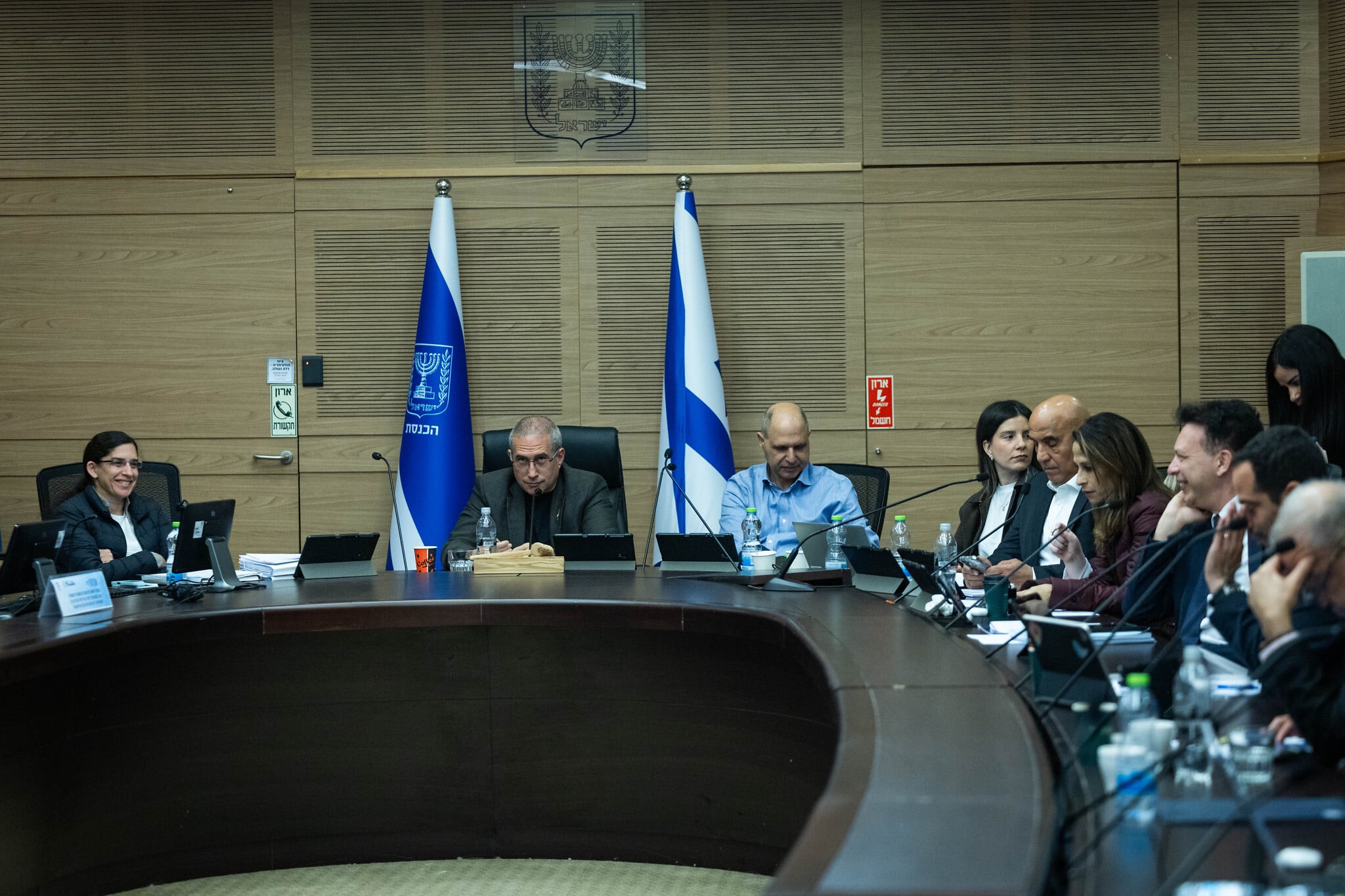
However, on Thursday, Knesset Speaker Amir Ohana’s office announced plans to increase the amount of activity at the Knesset, paving the way for renewed discussion of controversial legislation.
Prior to Ohana’s announcement, the government appeared to be making some efforts to remove contentious legislation from the agenda, with Netanyahu and Finance Minister Bezalel Smotrich stating that they would be shelving several unpopular proposed economic reforms as well as a contentious bill intended to exempt yeshiva students from military conscription.
Knesset Speaker Amir Ohana at a plenum session held in a reinforced area of the Knesset in Jerusalem, March 11, 2026 (Oren Ben Hakoon/FLASH90)
But even then, despite calls from both sides of the aisle to set aside partisan politics for the duration of the conflict, the first days of the war saw the government advance sectoral interests, leading the opposition to accuse it of continuing to advance a partisan agenda during wartime while the opposition rallied behind the war effort and “put politics aside.”
One of the major bones of contention since the outbreak of the war was the government’s decision to approve over NIS 5 billion ($1.6 billion) in discretionary coalition funds for Haredi institutions, West Bank settlements and other party priorities in the 2026 state budget last Tuesday.
Coalition funds are money allocated in the budget-planning process based on agreements struck between the parties during coalition negotiations over the formation of the government.
Also continuing on partisan lines were the coalition’s efforts to advance legislation extending a temporary measure that added the pro-government Channel 14 to Idan Plus, the free-of-charge broadcast distribution platform, and opposition criticism of the transfer of additional powers from the position of interior minister, now vacant, to Netanyahu.
Prime Minister Benjamin Netanyahu, right, and Finance Minister Bezalel Smotrich issue a joint statement from Jerusalem, March 10, 2026. (Screenshot/GPO)
“When more people need assistance, there is no welfare minister. When hospitals are preparing to handle difficult events, there is no health minister. I call on the prime minister to stop this absurdity and to appoint ministers to ministries who will work around the clock,” Blue and White chairman Benny Gantz declared last Monday.
There is currently no interior minister. The health and welfare ministries are currently headed by Tourism Minister Haim Katz. Experts have argued that the lack of full-time dedicated ministers has significantly harmed the government’s ability to function for the good of the country’s citizenry.
The disagreements at the heart of the government’s judicial overhaul agenda also resurfaced, with Heritage Minister Amichay Eliyahu launched a public attack on Attorney General Gali Baharav-Miara, who, for her part, had called on the High Court of Justice to approve petitions to remove National Security Minister Itamar Ben Gvir from his position.
The bickering intensified over the course of last week, with Communications Minister Shlomo Karhi on Monday accusing Lapid’s Yesh Atid party of collaborating with terror supporters in an effort to bring down the government after two of the party’s MKs voted in favor of an Arab-backed no-confidence motion in the government.
Communications Minister Shlomo Karhi addresses the Knesset, February 9, 2026. (Noam Moskowitz, Office of the Knesset Spokesperson)
After the vote, a party spokesman asserted to The Times of Israel that the two lawmakers had supported the motion “by accident,” insisting that “the faction’s position is not to vote in favor of no-confidence motions during the conflict with Iran.”
In a public address last Wednesday evening, Lapid went even further in his criticism, calling into question Netanyahu’s ability to successfully handle the war and its aftermath.
“The war cannot end with us replacing one Khamenei with another, and the nuclear facilities have not been destroyed down to the last of them,” he said.
“The war cannot end with the prime minister once again promising us that he has ‘eliminated all threats forever,’ as he promised us last June, which did not happen, or with a ‘total victory’ as we were promised in Gaza, which did not happen.”
You appreciate our wartime journalism
We’re really pleased that you’ve read X Times of Israel articles in the past month.
You clearly find our careful reporting of the Iran war valuable, at a time when facts are often distorted and news coverage often lacks context.
Your support is essential to continue our work. We want to continue delivering the professional journalism you value, even as the demands on our newsroom have grown dramatically during this ongoing conflict.
So today, please consider joining our reader support group, The Times of Israel Community. For as little as $6 a month you’ll become our partners while enjoying The Times of Israel AD-FREE, as well as accessing exclusive content available only to Times of Israel Community members.
Thank you,
David Horovitz, Founding Editor of The Times of Israel
Join Our Community
Join Our Community
Already a member? Sign in to stop seeing this