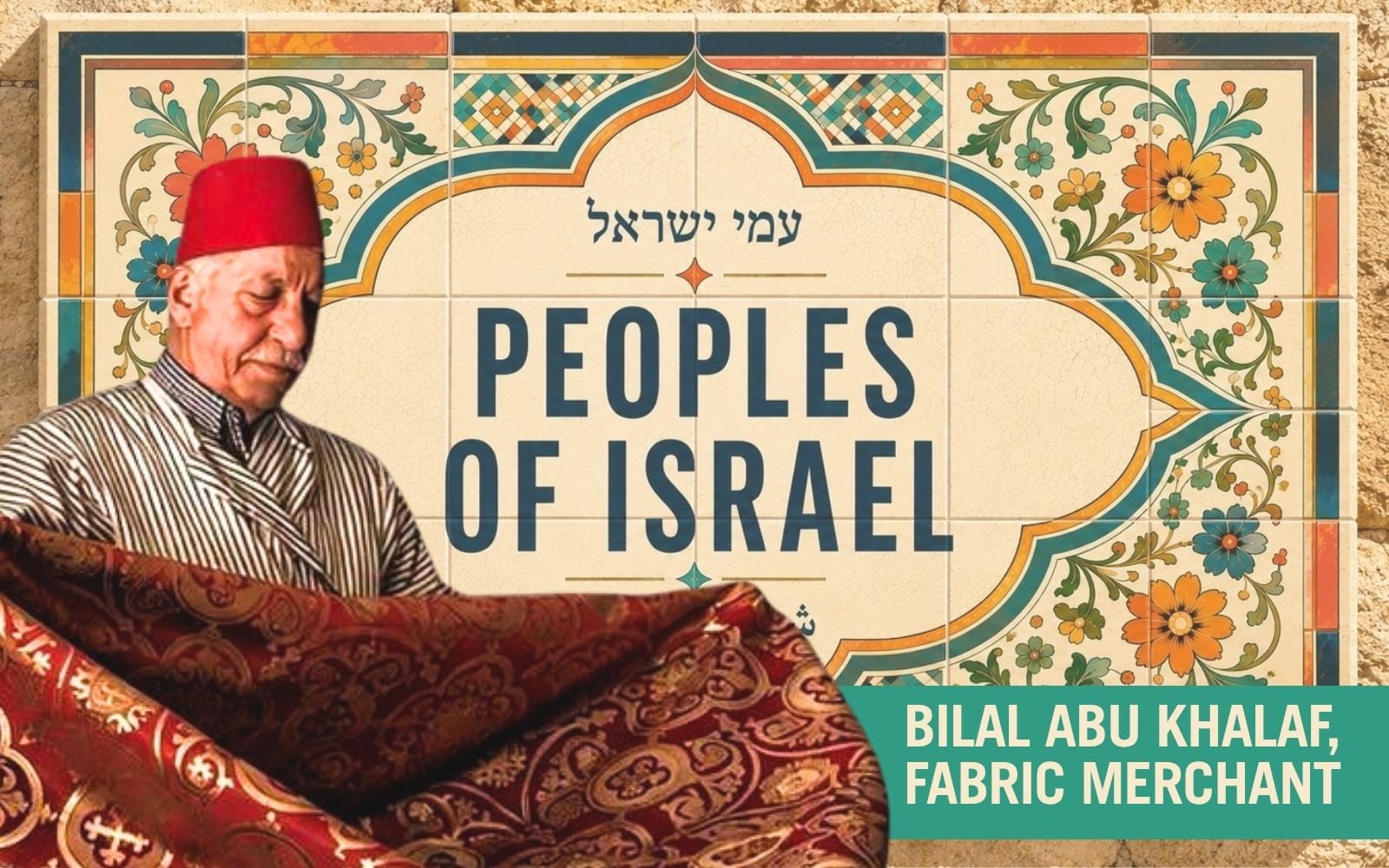
Bolts of Syrian silk, soft as a butterfly’s wing, are stacked in a shop tucked deep inside Jerusalem’s Old City. Bilal Abu Khalaf, a third-generation fabric merchant, has spent most of his life surrounded by textiles.
“Fabric is like the sea,” he says, unfurling a shimmering bolt of red silk threaded with 14-karat gold. “It is always flowing and connects people.”
Abu Khalaf’s family traces its roots in Jerusalem back centuries to Kurdish soldiers who came to the city with Saladin. After studying political science at Ain-Shams University in Cairo, Abu Khalaf returned home and joined the family business.
Decades later, he still works in the same crowded stone alleys of the Old City, where merchants, pilgrims, clergy, tourists, and local residents pass through daily.
Inside his shop in Jerusalem’s Muristan market, near the Church of the Holy Sepulcher, shelves overflow with striped cloth favored by Haredi (ultra-Orthodox) Jewish customers, lavishly embroidered textiles and fabrics destined for church vestments, and brightly colored material for traditional Palestinian dresses.
Over time, Abu Khalaf says he began to see the store as more than a business.
“I wanted my shop to connect the three religions,” he says. “To make peace in my store.”
Bilal Abu Khalaf holds up a photo of how traditional Sephardic and Yemenite Jews dressed in the Old City of Jerusalem a century ago, May 2026. (Sarah Tuttle-Singer)
The clientele reflects the complexity of Jerusalem itself: Christian clergy come searching for liturgical fabrics in specific colors tied to the church calendar — red for Christmas, purple for Easter, green for days of fasting, and white for baptism. Religious Jewish customers seek out materials that comply with Jewish laws prohibiting the mixing of wool and linen. Muslim families shop for scarves, fabric, and household textiles.
He recalls moments when rabbis, priests, and imams struck up conversations while shopping side by side. The store has supplied fabric used for vestments for Pope Benedict XVI, former Sephardic chief rabbi Ovadia Yosef, and even Steven Tyler of Aerosmith.
WATCH the full episode here:
Abu Khalaf speaks passionately about textiles themselves. Some of his most prized fabrics come from Syria, including the silk woven with 14-karat gold thread. He explains the techniques behind traditional weaving, describing fabrics constructed diagonally, as well as horizontally and vertically, to create more intricate textures.
“It is art fabric,” he says, holding up a shimmering piece decorated with horsemen from Saladin’s army.
Silk woven with 14-karat gold depicting Saladin’s army shimmers in Bilal Abu Khalaf’s shop in the Old City of Jerusalem, May 2026. (Sarah Tuttle-Singer)
Abu Khalaf also takes pride in being part of a family business. Just as he inherited the shop from his father, his son will one day carry it forward.
“When my son finishes university, he will be the fourth generation,” Abu Khalaf says.
The history of Jerusalem also lies physically beneath the shop.
During renovations years ago, Abu Khalaf uncovered the remains of the Church of Santa Maria Maggiore, which was damaged centuries ago in an earthquake. Instead of covering the ruins after the Israel Antiquities Authority finished excavating the site, he installed a glass panel in the floor so visitors could look directly down at the stones below.
Outside the shop, meanwhile, the economic realities facing Old City merchants have become increasingly difficult.
Tourism has struggled since the coronavirus pandemic and Israel’s ongoing state of war since October 7, 2023, leaving many businesses dependent on visitors facing long periods of quiet.
“Jerusalem is crying from the people,” Abu Khalaf says, then clarifies what he means: The city is suffering because people aren’t visiting.
“We need the people to come,” he says. “We love visitors.”
Bilal Abu Khalaf displays fabric in his shop in Muristan Square, 2026. (Sarah Tuttle-Singer)
Even amid the uncertainty, Abu Khalaf still finds humor in the steady flow of conversations passing through the store.
Recently, a group of Jewish visitors asked him whether trains might someday run again between Israel and Syria.
“Yes,” he replied with a wry smile. “Netanyahu and Herzl will discuss it.”
The visitors looked confused.
“Not Jewish Herzl,” he explained with a laugh. “Arab Herzl. Ahmed al-Sharaa — the new leader of Syria — has a beard like Herzl. We Arabs sometimes call him Herzl as a joke.”
Inside Abu Khalaf’s store, conversations about religion, politics, history, and daily life unfold constantly among shelves of fabric and thread and the various people who visit.
For Abu Khalaf, that exchange — more than the merchandise itself — has become the real purpose of the shop and his life’s work.
“Many times I mix here Christian with the Jewish,” he says with a smile. “And still now they are friends.”
We can’t do this work alone.
The war with Iran has been draining for all of us in Israel. But when I heard about a high casualty incident – ballistic missile impacts in Arad and Dimona that left nearly 200 people wounded – I drank a cup of coffee, packed a bag, and headed south.
There, I spoke with Shilgit, the head of an after-school program for underprivileged youth. Standing outside her destroyed center, Shilgit said it was a miracle that no children were hurt and spoke about the community coming together in the hours since.
As a Times of Israel reporter, I’m committed to telling stories of resilience like Shilgit’s. But my colleagues and I can’t do this alone. If you value work like this, please consider joining our reader support group, The Times of Israel Community. Your financial support is essential to keep real human reporting like this going.
— Stav Levaton, military reporter
Yes, I’ll join
Yes, I’ll join
Already a member? Sign in to stop seeing this