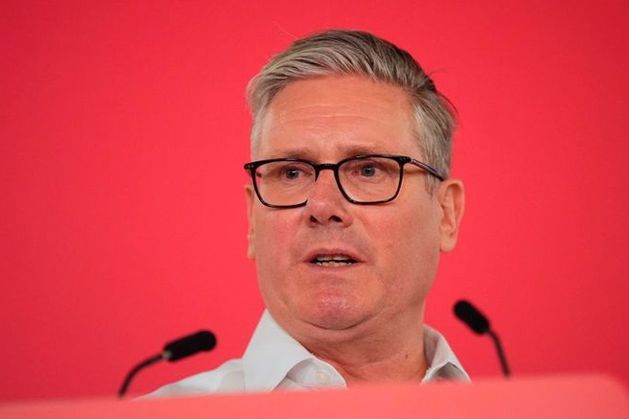
A defiant Keir Starmer has clung on to power – for now – after four ministers quit his government and more than 90 Labour MPs called for him to go amid deep divisions within the party.
Another 100 MPs signed a letter supporting him to stay on, urging the party to work together “to deliver the change the country needs” and warning: “This is no time for a leadership contest.”
Without a direct challenger, the embattled prime minister refused to go as he called on his would-be rivals to put up or shut up. Confronting cabinet members on Tuesday morning for the first time since last week’s disastrous local election results, he made it clear that someone needs to challenge him if they want him removed.
Instead, Mr Starmer plans to plough ahead with Wednesday’s King’s Speech, with the state opening of parliament and a pledge to “deliver on the promise of change”.
A bruising day in Westminster for the prime minister began with all eyes on health secretary Wes Streeting, whose supporters had started a cascade of demands for Mr Starmer to quit on Monday evening.
It is understood that supporters of former deputy prime minister Angela Rayner are poised to move if Mr Streeting declares his candidacy.
Meanwhile, there was speculation that an MP may stand aside to allow a by-election for Greater Manchester mayor Andy Burnham – who was spotted arriving in London to meet Labour MPs – to make a return to the commons and challenge Mr Starmer.
But in a dramatic moment, Mr Starmer insisted he would not be moved, and the only way to try to oust him was a direct challenge.
He told his most senior ministers: “As I said yesterday, I take responsibility for these election results and I take responsibility for delivering the change we promised. The past 48 hours have been destabilising for the government, and that has a real economic cost for our country and for families.
“The Labour Party has a process for challenging a leader and that has not been triggered. The country expects us to get on with governing. That is what I am doing and what we must do as a cabinet.”
While loyalists came out of the weekly cabinet meeting to give their support to the beleaguered prime minister, others, including Mr Streeting, left without comment. Home secretary Shabana Mahmood and foreign secretary Yvette Cooper had been among those on Monday evening advising Mr Starmer to quit. But the home secretary insisted yesterday that she would not resign from the cabinet and is “cracking on with the job”.
Deputy prime minister David Lammy warned that “navel-gazing” within Labour would only benefit Nigel Farage and Reform UK. He reiterated his “full support” for Mr Starmer and urged colleagues calling for him to go to “take a breath”.
“It’s been 24 hours now, and nobody has come forward to put themselves forward in the processes that exist in the party. No one seems to have the names to stand up against Keir Starmer, and for those who are suggesting that he should stand down, they should say which candidate would be better,” he said.
Defence secretary John Healey also threw his weight behind Mr Starmer: “More instability is not in Britain’s interest. Our full focus now must be on dealing with immediate economic and security challenges.”
Technology secretary Liz Kendall, business secretary Peter Kyle, welfare secretary Pat McFadden and housing secretary Steve Reed also stood by the Labour leader as they faced the cameras on Downing Street. Mr Kyle said Mr Starmer was showing “really steadfast leadership”, while Mr Reed said the prime minister had his “full support”.
The desire not to have an argument means we rarely make an argument
But Mr Starmer was hit with a series of ministerial resignations, the most high-profile being safeguarding minister Jess Phillips, who was responsible for tackling violence against women and girls (VAWG).
In a stinging resignation letter, Ms Phillips, an ally of Mr Streeting, said: “I think you are a good man fundamentally, who cares about the right things; however, I have seen first-hand how that is not enough. The desire not to have an argument means we rarely make an argument, leaving opportunities for progress stalled and delayed.”
She was soon followed by another junior minister, Alex Davies-Jones, and then Zubir Ahmed, another close ally of Mr Streeting, who said there was “a lack of values-driven leadership at the centre” of Mr Starmer’s government.
Earlier, devolution minister Miatta Fahnbulleh quit with a warning: “We have not acted with the vision, pace and ambition that our mandate for change demands of us.”
Ms Fahnbulleh is seen as an ally of another senior minister, energy secretary Ed Miliband, who was also notable in his failure to come out in support of the prime minister.
David Maddox and Kate Devlin
©UK Independent