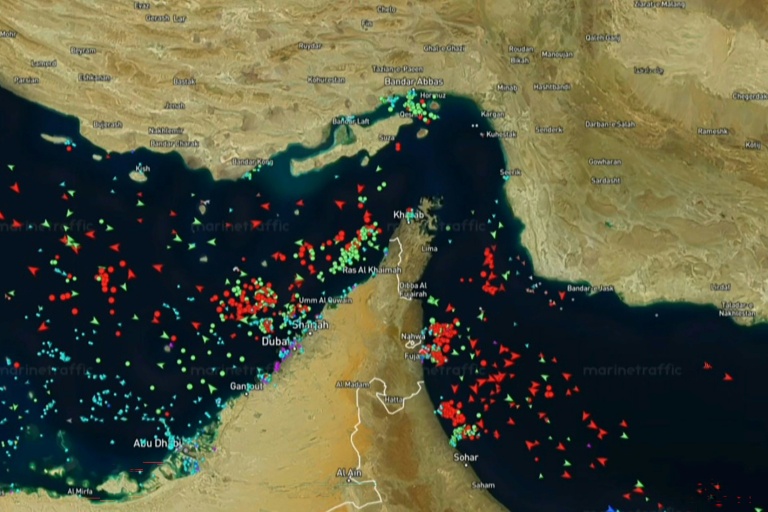
Baghdad (IraqiNews.com) – The ongoing disruption in the Strait of Hormuz is doing more than slowing maritime traffic. According to Iraqi economic expert Manar Al-Obaidy, it is fundamentally redrawing trade routes across the Middle East, shifting commercial activity away from the Gulf and toward the Eastern Mediterranean.
In an analysis of first-half 2026 trade data, Al-Obaidy argues that the crisis has accelerated changes in global supply chains, creating new winners while exposing structural weaknesses in Gulf economies—particularly Iraq, whose economy remains heavily dependent on oil exports passing through the strategic waterway.
According to Al-Obaidy’s analysis, trade between China and several Gulf countries has fallen sharply during the first six months of 2026. Trade with Iran declined by 60%, while Iraq recorded a 55% drop. Saudi Arabia also experienced a significant decline of 48%, reflecting the growing reluctance of shipping companies and importers to rely on routes exposed to security risks in the Gulf.
At the same time, countries positioned along alternative Mediterranean trade corridors have seen remarkable gains. China’s trade with Syria surged by 281%, while trade with Jordan increased by 30%, Egypt by 25%, and Turkey by 10%.
The figures suggest that companies are increasingly redirecting cargo through safer maritime and overland routes rather than relying on the Strait of Hormuz.
Al-Obaidy believes the changes extend beyond a short-term shipping crisis. He argues that the current trends raise broader questions about whether global trade is entering a long-term transition toward new East-West logistics corridors.
While security concerns remain the immediate driver, businesses may continue using alternative routes even after tensions ease because they provide greater predictability and lower geopolitical risk. That shift could permanently alter regional trade patterns, even if it comes with higher transportation costs.
For Iraq, the consequences extend far beyond reduced shipping volumes. The country depends on oil exports for more than 90% of government revenue, with most crude shipments traditionally passing through the Strait of Hormuz. Any prolonged disruption directly affects public finances, budget planning, and the government’s ability to fund salaries and infrastructure projects.
However, Al-Obaidy warns that a second, potentially more serious challenge is emerging. As Asian buyers diversify their energy supplies, China and India could increasingly source crude from Africa and South America instead of relying as heavily on Gulf producers. If that trend continues, Iraq risks losing market share in some of its most important export destinations.
The shift also threatens Iraq’s broader ambition of becoming a regional logistics hub. As cargo increasingly flows through Mediterranean ports and neighboring countries, Iraq risks being bypassed in emerging trade networks.
That could reduce opportunities to expand non-oil exports, attract logistics investment, and strengthen its position as a transit corridor linking Asia and Europe. Without strategic adjustments, the country could find itself marginalized in both energy markets and regional trade.
Despite the risks, the changing trade landscape also presents Iraq with opportunities if policymakers act quickly. Accelerating the Development Road Project could position Iraq as a major land bridge connecting the Gulf with Turkey and Europe, offering an alternative to vulnerable maritime routes.
Expanding rail infrastructure, modernizing border crossings, and improving customs efficiency would strengthen Iraq’s competitiveness as regional supply chains evolve.
At the same time, investing in the ports of Umm Qasr and Al-Faw, together with logistics zones and industrial parks, would allow Iraq to capture greater value from transit trade rather than relying almost exclusively on oil exports.
Diversifying export markets and encouraging domestic manufacturing would also reduce the country’s exposure to external shocks, while expanding renewable energy and natural gas production could lower dependence on imported fuel and strengthen long-term energy security.
Al-Obaidy’s analysis suggests that the Strait of Hormuz crisis is more than a temporary geopolitical dispute. Instead, it may represent the beginning of a broader realignment in global trade, one that favors flexibility, diversified transport corridors, and resilient supply chains.
For Iraq, the message is clear. The country cannot control regional conflicts, but it can decide how it responds to them. Whether Iraq emerges stronger or becomes increasingly vulnerable will depend on how quickly it adapts its infrastructure, diversifies its economy, and positions itself within the new geography of international trade.