Your support helps us to tell the story
From reproductive rights to climate change to Big Tech, The Independent is on the ground when the story is developing. Whether it’s investigating the financials of Elon Musk’s pro-Trump PAC or producing our latest documentary, ‘The A Word’, which shines a light on the American women fighting for reproductive rights, we know how important it is to parse out the facts from the messaging.
At such a critical moment in US history, we need reporters on the ground. Your donation allows us to keep sending journalists to speak to both sides of the story.
The Independent is trusted by Americans across the entire political spectrum. And unlike many other quality news outlets, we choose not to lock Americans out of our reporting and analysis with paywalls. We believe quality journalism should be available to everyone, paid for by those who can afford it.
Your support makes all the difference.Read more
A Philippine charity that began with five women clearing a vacant lot in Manila in 1998 has been named a finalist for the 2026 Earthshot Prize, the environmental award founded by Prince William, for its work preventing plastic and organic waste from reaching landfills, waterways and the ocean.
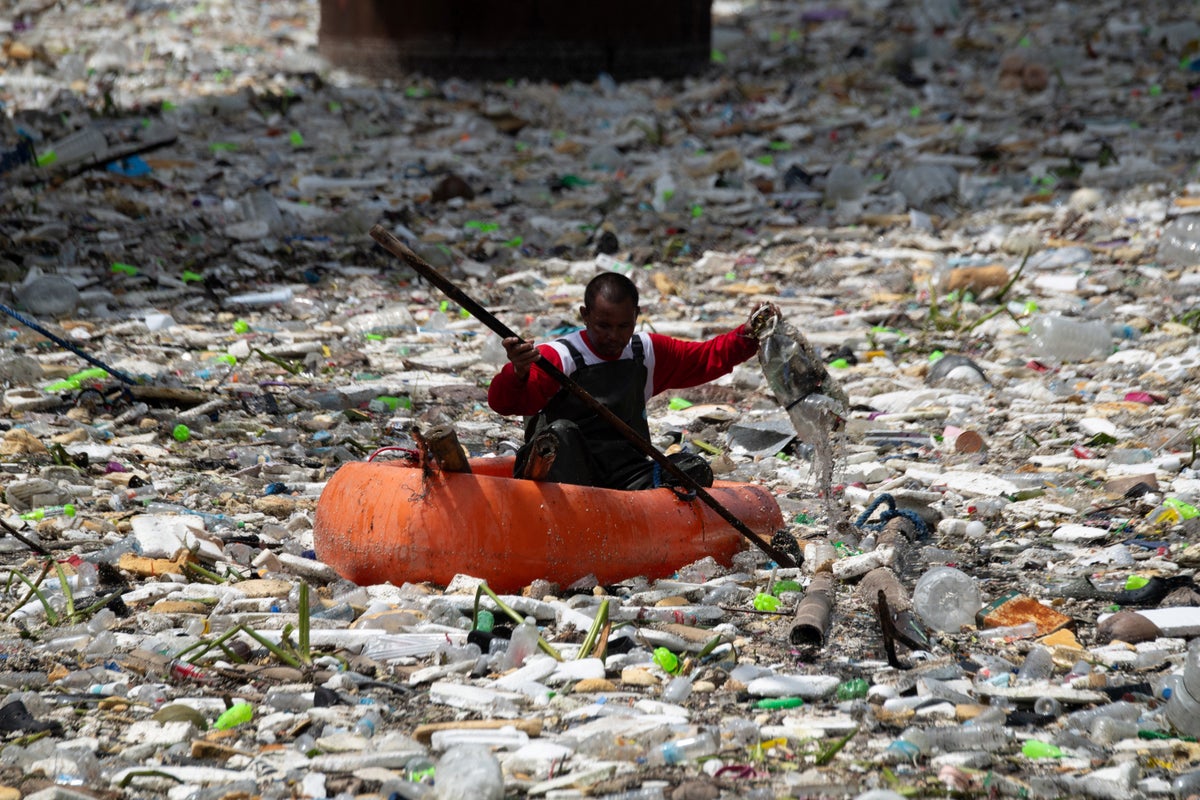
The Philippines produces more ocean plastic than any other country on earth, and its rivers continue to choke under thick layers of plastic. The Pasig, which runs through Manila, is among the most polluted waterways in the world and every storm season brings images of plastic washing over shorelines and clogging flooded streets across the capital.
Mother Earth Foundation has spent about three decades building an answer to that crisis, an effort that has now brought it close to the award. The organisation has been turning ordinary villages into working models of a waste system.
“We manage the waste where it is generated,” Sonia Mendoza, the foundation’s co-founder and chair, tells The Independent. “The people are made responsible for the waste that they generate.”
Workers on a plastic boat collect rubbish from a river in Paranaque City, suburban Manila, Philippines (AFP/Getty)
Mendoza says the model built by her foundation can be replicated not just across the Philippines, but in other Asian cities suffering from uncontrollable plastic pollution.
At the heart of the plastic problem in developing countries, Mendoza points out, is the sachet, an economical way for people to buy smaller quantities of liquid products, like shampoo and kitchen supplies.
Some 855 billion plastic sachets are discarded globally each year, primarily across the developing regions of Asia, Africa, and the Middle East.
The Philippines uses 164 million such sachets per day, according to a study by the Global Alliance for Incinerator Alternatives, based on data supplied by Mother Earth, and about 70 per cent of Filipinos lack adequate access to disposal facilities in the first place.
“They are not recyclable and they are not compostable,” she says. “Most of them are not collected because they have no value for junk shops. So most of them end up in waterways.”
In August, a nine-day spell of rain left many Philippine rivers covered entirely in plastic, with barely any water visible, as workers struggled to pick up whatever they could.
It is a persistent problem: every storm that hits the country overwhelms drains already clogged with rubbish. “Because of these not very systematic waste management systems of municipalities, storms and the wind carry this waste to the rivers, and then, of course, it will go to the ocean,” Mendoza says.
A ‘river warrior’ collects plastic waste from San Juan river in Manila, Philippines (Getty)
Mother Earth has partnered with sari-sari stores – which are small community shops found in nearly every village – to sell everyday items such as soy sauce, vinegar and cooking oil in bulk rather than in single-use plastic packaging.
Since January 2024, Mendoza says, 40 such stores have diverted more than 671,000 pieces of plastic waste, including 288,000 sachets, by encouraging customers to bring their own containers.
“It was already the custom in the Philippines and many Southeast Asian countries,” she says. “When I was a little girl, I used to bring my container to a store to get sugar, cooking oil.”
One flagship store in Malabon, on the outskirts of Manila, now features a vending machine, donated by Mother Earth, to dispense goods for a five-peso coin provided the customer brings their own container.
A refill store in Barangay Potrero, Malabon, where local residents buy goods in bulk rather than in single-use sachets (Mother Earth)
The same approach of adapting the system to people’s habits is how Mother Earth has built an entire model city, Mendoza explains.
In San Fernando, a city of nearly 350,000 people north of Manila, the foundation has worked with the local government since 2012 to divert 89 per cent of the waste away from landfills, the highest rate in the Philippines. The national figure is far lower, Mendoza says, because the waste collection system is centralised despite the law requiring it to be handled at the village level.
“They follow the system of the US and Europe. They have big trucks going around households, but some communities are very dense and they have very narrow roads, so the trucks cannot go there,” she notes. “So the waste of those people remains uncollected.”
Even where households do separate their rubbish, she says, collection trucks routinely combine it into a single mixed load, undoing the work at source.
Mendoza says 63 per cent of the waste in San Fernando is composted or otherwise processed to stop it generating methane, while 30 per cent is recyclable sent to a facility for materials recovery. What is left for the landfill, she says, is a residual portion, made up largely of single-use plastic that can’t be recycled or composted at all.
“You prevent this plastic waste from being brought by storms, by the water and wind, to the rivers where they will finally be brought to the ocean,” she says.
Sonia Mendoza founded Mother Earth Foundation with four other women in 1998 (Mother Earth)
Getting San Fernando to its current diversion rate involved training waste collectors, rather than residents directly, to teach households how to sort their rubbish.
“It’s very hard to get the homeowners or the housewives to attend a meeting because they have many things to do in the household,” Mendoza says.
“So what we do, we train the waste collectors, and they go house-to-house collecting the properly segregated waste.”
Unsorted waste in areas where her organisation works is simply left uncollected until residents comply, she says, and the model relies on small, low-cost vehicles, pushcarts, pedicabs, motorised carts that can easily get into the narrow lanes rather than large municipal trucks.
However, the workers who collect and sort the segregated material by hand are largely not recognised or paid fairly. “They are the unsung heroes here,” she says. “Without them, our system would not work.”
Mendoza says her foundation has worked with waste pickers to shape what she calls the Magna Carta of Waste Workers, a bill that standardises their working conditions and sets out protections including hazard pay, health insurance and job security.
“It’s now pending in our senate, and we have been following it up,” she says.
A waste worker sorts recyclables by hand in Manila (Mother Earth)
The plastic problem isn’t just a Philippines problem. The world now produces more than 400 million tonnes of plastic a year, according to the UN Environment Programme, up from just two million tonnes in 1950. Even when villages find solutions to manage their own plastic waste, the rubbish can flow in from other places.
Mother Earth says they are trying to push further upstream, towards the companies making that packaging.
Working with GAIA Asia Pacific and the global Break Free From Plastic movement, it has developed a “waste assessment and brand audit” methodology, now used internationally, that records not just the type of plastic found in a clean-up but the brand responsible for producing it.
Bulk refill jars at a store where customers bring their own containers to buy vinegar, coconut oil and other everyday staples by the millilitre, rather than in single-use sachets (Mother Earth)
The audits have named 10 companies as the top plastic polluters in the Philippines. However, naming and shaming hasn’t helped control the waste.
“Right now, they are also doing something about it, but most of it is greenwashing, sad to say,” Mendoza says, describing companies claiming to be “plastic negative” while sending packaging to cement kilns to be burned as fuel.
“For us, that’s not really the solution. They had to really reduce or stop the production of this problematic plastic packaging.”
Negotiations over a global cap on plastic production have repeatedly failed at the UN. They are now set to resume next year.
Mendoza attended the negotiations on a Global Plastics Treaty in Busan, South Korea, as a delegate, only to see the proposal for a cap on plastic production collapse under objections from oil-producing nations.
“Nothing happened in the Pacific stream in Busan two years ago and then also in Amsterdam,” she says. Oil companies are increasingly turning to plastic production as renewable energy cuts into the demand for fuel, she notes, adding the shift will make the fight over a production cap even harder in future talks.
An artwork in front of the UN Offices in Geneva in 2025 (AFP/Getty)
Mendoza says her priority remains pushing for a low-waste system in the villages as far as it can currently go.
“It can’t still be zero waste, it’s low waste now because of the plastic packaging that is being produced,” she says.
“If they put a cap on that, then maybe we can have a true zero-waste system, where everything can be composted, everything can be recycled. We keep on advocating also the use of reusable bags, as we do for reusable cloth bags, then we advocate the use of tumblers and bottles instead of bottled water. This is really the fastest and most economical way to solve the waste problem, not a machine, or a facility, or a technology that’s very expensive.”
Mother Earth’s ambition is to see 90 per cent of Philippine cities running zero-waste systems by 2030. Mendoza has high hopes the Earthshot recognition would help take the model beyond the Philippines, building on work already underway through a Zero Waste Academy that has trained participants from Tanzania, Indonesia and Vietnam.
“It can turn over a Philippine scale into a global scale,” she says, “and it can create a replication in Southeast Asia and other countries.”