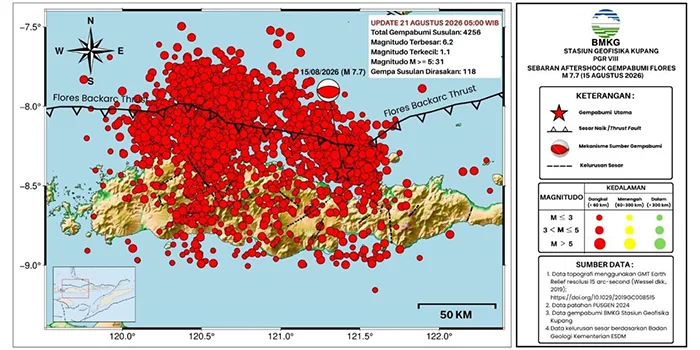
Jakarta, IO – The Meteorology, Climatology, and Geophysical Agency (BMKG) reported that aftershock activity following the M7.7 mainshock in Flores, East Nusa Tenggara (NTT), reached 4,258 events as of 5am WIB Friday. Of the total incidents, 118 tremors were directly felt by residents, with 31 earthquakes registering a magnitude above M5.0.
BMKG earthquake and tsunami director Wijayanto projected that this sequence of aftershocks will likely continue for the next three to four weeks. He noted that the initial phase of the aftershock sequence still exhibits a complex temporal pattern that has yet to stabilize.
“Aftershock activity during the first few days remained relatively high and has not yet shown a significant decay pattern. The number of earthquakes per 24 hours was recorded at 704 events on the first day, rising to 746 on the second day, followed by approximately 668, 649, and 627 events from the third to fifth days, before climbing back to 802 events on the sixth day,” Wijayanto said Friday (21/8/2026).
Based on BMKG monitoring, the aftershock sequence has triggered several significant ground motions with intensities ranging from Modified Mercalli Intensity (MMI) scale IV to VI, which were strongly felt by local residents. BMKG recorded strong tremors at 11.17pm WIB Wednesday with a magnitude of M5.6, and at 5.45am WIB Thursday measuring M5.8. Another significant earthquake struck on the same day at 9.47am WIB with a magnitude of M5.8, causing further structural damage to affected buildings and bridges while triggering landslides at several locations.
Read More: Prabowo Hosts Independence Day Ceremony Personnel In Hambalang
Relocation results indicate that the aftershocks are not distributed homogeneously, but rather form distinct clusters. The primary cluster is situated around the M7.7 source zone north of Nagekeo, stretching along the alignment of the Flores Back-arc Thrust. Meanwhile, a secondary aftershock cluster has emerged in the western section of the main source zone, specifically north of Manggarai regency.
Daily seismicity data reveal dynamic shifts in focal activity over time. During the first four days following the mainshock, earthquakes were evenly distributed across all clusters from east to west. However, on the fifth and sixth days, seismic activity shifted and concentrated its energy in the western cluster, while the eastern cluster began a gradual decline in intensity.
BMKG continues to operate a 24/7 real-time monitoring system. The agency has urged affected residents to remain calm and disregard unverified rumors, while advising the public to avoid buildings with cracks or earthquake-induced damage and to remain vigilant against potential aftershocks. (est)