Want to bookmark your favourite articles and stories to read or reference later? Start your Independent Membership today.
Join today
Already a member?
Log in
Your support helps us to tell the story
From reproductive rights to climate change to Big Tech, The Independent is on the ground when the story is developing. Whether it’s investigating the financials of Elon Musk’s pro-Trump PAC or producing our latest documentary, ‘The A Word’, which shines a light on the American women fighting for reproductive rights, we know how important it is to parse out the facts from the messaging.
At such a critical moment in US history, we need reporters on the ground. Your donation allows us to keep sending journalists to speak to both sides of the story.
The Independent is trusted by Americans across the entire political spectrum. And unlike many other quality news outlets, we choose not to lock Americans out of our reporting and analysis with paywalls. We believe quality journalism should be available to everyone, paid for by those who can afford it.
Your support makes all the difference.Read more
Authorities have evacuated 167 psychiatric patients from a hospital in South Kalimantan as toxic haze from Indonesia’s wildfires worsened, with over 170,000 cases now recorded of respiratory illnesses since August.
Officials are preparing to move the patients to an off-site facility should the smoke around the hospital prove impossible to control, the Jakarta Post reported.
The respiratory cases, ranging from mild coughs to pneumonia, come as Indonesia battles wildfires that have burned for weeks.
More than 40,000 of the cases involve toddlers.
Forest fires have blanketed parts of Indonesia, as well as neighbouring Malaysia and Singapore, in toxic smog for weeks now, pushing air quality indices into “unhealthy” territory.
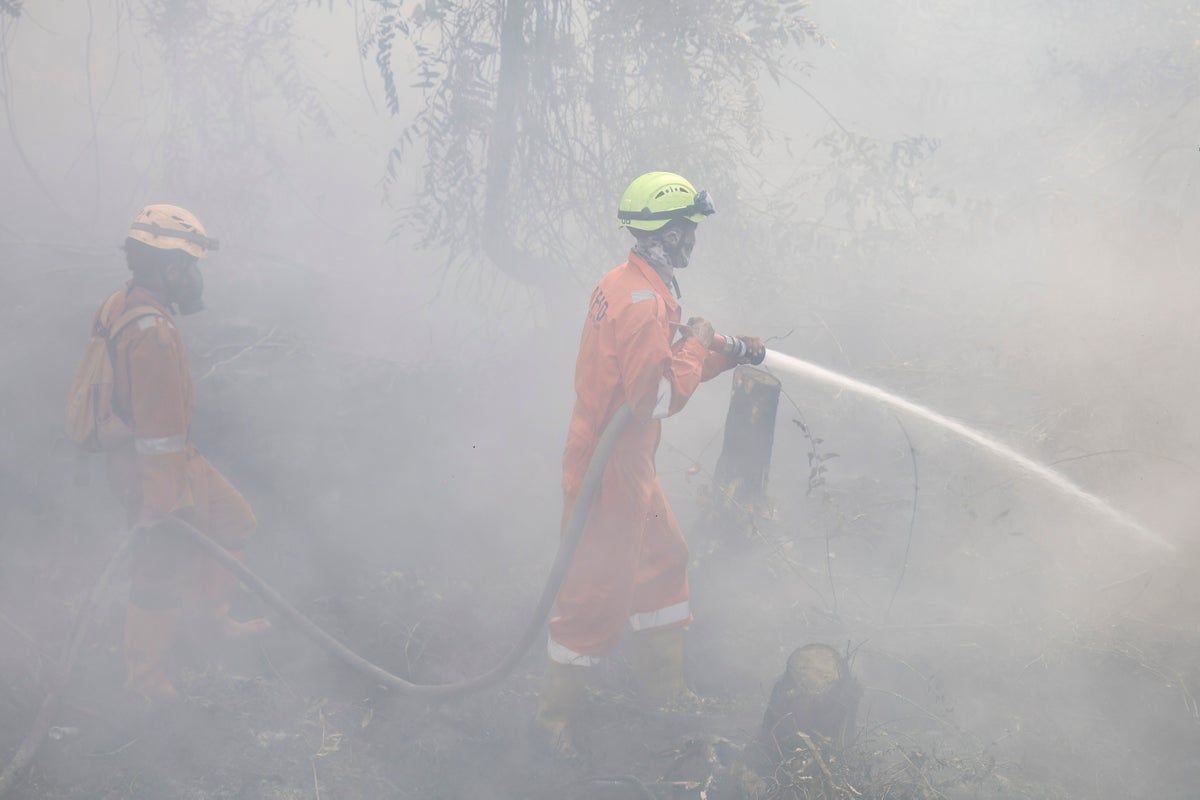
Indonesia has deployed more than 54,000 personnel and dozens of aircraft for water bombing over Borneo and Sumatra, though authorities say the vast territory and difficult peatland conditions have made the fires hard to extinguish.
“From the air to the ground, all forces continue to move,” Indonesia’s cabinet secretary Teddy Indra Wijaya said on Monday.
“Everything is being done to extinguish the fires, reduce the impact of the smoke, and, most importantly, protect the public from the threat of forest and land fires.”
This year’s fires have been intensified by a so-called “Godzilla” El Nino, which has fuelled extremely dry conditions during Indonesia’s usual July-to-October dry season. The independent forest monitoring platform Nusantara Atlas had detected around 734,000 hotspots across the country as of Wednesday, more than 30 per cent higher than in 2019, one of Indonesia’s worst wildfire seasons.
Since January, at least 895,657 hectares of land, nearly six times the size of Greater London, have burned.
Local farmer Adi Pangestu walks across a makeshift bridge over a canal to check his palm oil plantation as wildfires burn the area in Sungai Putri, a wildfire-affected peatland area, in Ketapang regency, West Kalimantan province, Indonesia (Reuters)
The number of people suffering wildfire-related respiratory illnesses had more than doubled to 113,336 by 9 September, up from 50,891 on 1 September, according to the health ministry’s figures.
The toxic smog has also affected wildlife, including critically endangered orangutans. Late last month, an Indonesia-based wildlife foundation shared footage of an orangutan writhing on the ground on a palm oil plantation in West Kalimantan, one of the hardest-hit provinces. The animal, found by a farmer, was rescued and treated for hypoxia but later died.
Indigenous and civil society groups in West Kalimantan filed a class action lawsuit last week against the central government and local administrations, accusing them of deliberate negligence over their handling of the fires.
“This is a disaster that occurs every year,” the group’s lawyer, Glorio Sanen, said in a statement. “This recurring pattern proves our view that the defendants knew about the potential haze disaster and the risks of disaster from forest and land fires.”
Indonesia has carried out several rounds of cloud-seeding operations in recent weeks, some conducted with members of Japan’s Self-Defense Forces who arrived in Borneo earlier this month to assist with firefighting.
In the Malaysian state of Sarawak, one of the worst-affected areas outside Indonesia, authorities launched a five-day cloud-seeding operation earlier this month, partly aimed at boosting water levels at hydropower dams ahead of a severe dry spell forecast for October.
“October might be hotter and drier,” Sarawak’s deputy premier, Douglas Uggah Embas, told reporters. “We want to increase the water levels as much as possible while we still can.”
The haze has reached as far as parts of the Philippines, where officials have urged residents to stay indoors, and Singapore, where authorities have begun issuing daily haze advisories.