Your support helps us to tell the story
From reproductive rights to climate change to Big Tech, The Independent is on the ground when the story is developing. Whether it’s investigating the financials of Elon Musk’s pro-Trump PAC or producing our latest documentary, ‘The A Word’, which shines a light on the American women fighting for reproductive rights, we know how important it is to parse out the facts from the messaging.
At such a critical moment in US history, we need reporters on the ground. Your donation allows us to keep sending journalists to speak to both sides of the story.
The Independent is trusted by Americans across the entire political spectrum. And unlike many other quality news outlets, we choose not to lock Americans out of our reporting and analysis with paywalls. We believe quality journalism should be available to everyone, paid for by those who can afford it.
Your support makes all the difference.Read more
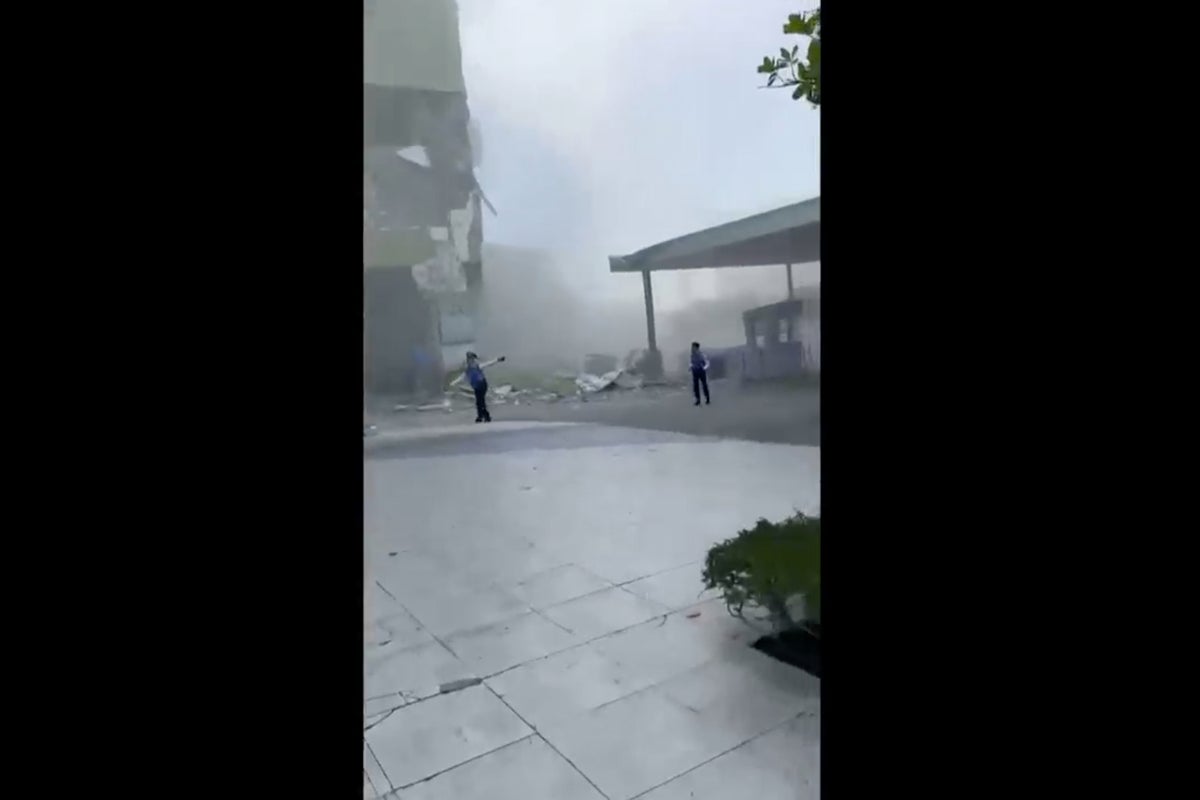
A magnitude 7.8 earthquake shook part of the southern Philippines early Monday, causing damage in a key coastal city, knocking down power and sparking a tsunami warning on some regional coasts.
People were urged to go to higher ground. There were no immediate reports of casualties, and it was not clear if people were trapped or injured in the collapse of a small building in General Santos city. The coastal city of more than 700,000 people is a commercial hub on the island of Mindanao known for its tuna processing industry.
The epicenter was 13 kilometers (8 miles) southwest of General Santos and had a depth of 10 kilometers (6.2 miles), according to the Philippine Institute of Volcanology and Seismology. It struck at 7:37 a.m.
The Pacific Tsunami Warning Center said tsunami waves up to 3 meters (10 feet) were possible on some coasts of the Philippines. Waves up to 1 meter (3 feet) were possible on some coasts of Indonesia and Malaysia.
“We advise people to evacuate to higher grounds or go further inland,” Teresito Bacolcol, the head of the Philippine institute, warned people living in coastal areas.
Smaller sea changes were possible in Taiwan, Japan, Guam, Papua New Guinea and several island nations and territories in the western Pacific. There was no threat to Hawaii, the PTWC said.
DZRH radio station in Manila reported that the small commercial building where its provincial branch was located partly collapsed and staffers dashed to the ground floor without injuries. It wasn’t clear if other people were trapped in the rubble of the four-story office building due to the quake, which struck before office hours.
Residents also felt the earthquake tremors in north-central Indonesia, and tsunami waves up to 18 centimeters (7 inches) were recorded on some coasts of North Sulawesi and North Maluku provinces.
Aftershocks up to 6.5 magnitude followed, the U.S. Geological Survey said. It measured the original quake at 55 kilometers (34 miles) deep. Variations in measurements by different agencies are common in the immediate aftermath of an earthquake.
The Philippines, one of the world’s most disaster-prone countries, is often hit by earthquakes and volcanic eruptions due to its location on the Pacific “Ring of Fire,” an arc of seismic faults around the ocean. The archipelago is also lashed by about 20 typhoons and tropical storms each year.