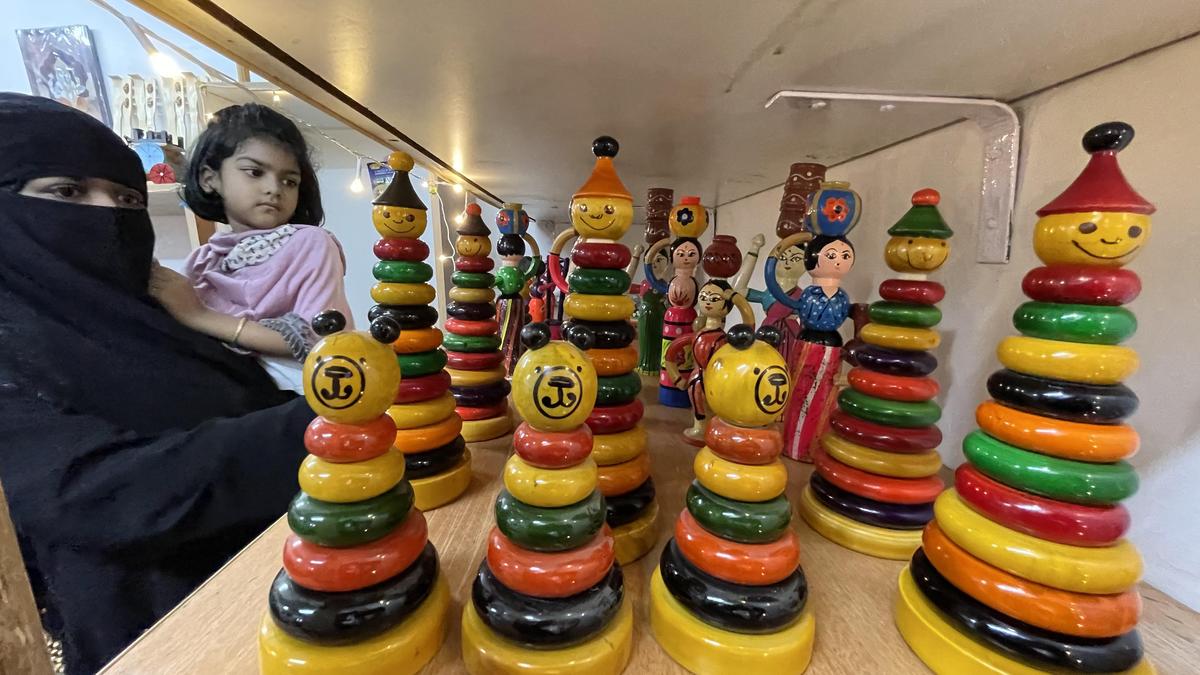
If there was ever a town defined by toys, it would be Channapatna. Those signature dolls, rocking horses, key chains, and spinning tops in glossy red and sunny yellow evoke this ‘Land of Toys’.
Located over 60 km from Bengaluru, Channapatna in Bengaluru South district is where toys that are a staple in Karnataka’s households come from. The town’s identity was shaped by artisans who took up the craft generations ago. However, what sustained large sections of the town back then, is even today being carried forward largely by a rapidly aging set of artisans, with very few from the younger generation continuing the work. They are moving to cities to pursue courses and jobs they see as more secure.
With reduction in skilled labour, Kinnal toys face production challenges.
| Photo Credit:
KIRAN BAKALE
A life in toy making
“I started this work when I was in class 6. I am 58 now. I have two daughters, and they have pursued diplomas. It is not that daughters can’t or don’t learn the art. The problem is the younger generation don’t see how sustainable this work can be,” says Krishnappa M., brushing away wood dust settled on his shirt.
While working to the rhythm of songs on the radio, what the artisans are most careful about are their mobile phones. Wrapped tightly in plastic covers and placed on a ledge away from the machines, they are kept safe from dust and paint. The men themselves, however, work without masks, gloves or any other safety gear.
“I have no formal education, and that is why I am sticking to this. Any design or drawing you give me on paper, I can turn into a toy with a finishing that nobody else can match,” added the artisan, who earns about ₹650 per day.
With reduction in skilled labour, Kinnal toys face production challenges.
| Photo Credit:
KIRAN BAKALE
“See this,” he says, showing a clown he made as a Rolly Polly doll. “No matter how much you throw it down, it keeps coming back. This design was inspired by Dr. Rajkumar’s song Aadisi Nodu, Bilisi Nodu. That song made me think of the movement, the balance, and how it could feel alive. But the younger generation… they don’t have the creativity, and they don’t want to tire themselves with the thinking process. Who will carry this forward?” he rues.
Learning the craft
Channapatna in Bengaluru South district is where toys that are a staple in Karnataka’s households come from.
| Photo Credit:
Ravichandran N
“We all learned the craft when we were children, because that’s the age when you can really grasp the techniques, the precision in shaping, polishing, and finishing wood,” says B. Venkatesh, who runs a manufacturing unit employing five people, including Krishnappa.
He adds that it is not that children now should not go to school. “But in areas like this, where craft has a legacy, schools could incorporate craft programmes or community initiatives to give children exposure. When they see that it is a viable career, and that skill has value, some might choose to continue it.”
Channapatna in Bengaluru South district is where toys that are a staple in Karnataka’s households come from.
| Photo Credit:
Ravichandran N
He adds that modern tools such as e-marketing and digital promotion could expand the reach of these crafts, making revival more feasible than ever if the support system were in place.
Venkatesh recalls that during Indira Gandhi’s tenure as Prime Minister, craft councils were established across the country to revive traditional arts and support artisans. “Those centres were more than classrooms. They taught skills, created jobs, and ensured that the craft would survive from one generation to the next. They were about sustaining livelihoods while keeping cultural practices alive. Without them, the continuity breaks.”
Children previously learned by observation and practice, gradually picking up precision, patience, and finishing techniques. Today, with schools focused on academics and rote learning alone, there is no opportunity for early learning, he argues.
Middlemen and Market
Even when artisans produce high-quality toys, market systems often prevent them from earning fairly. Venkatesh explains that a large portion of the profit never reaches the makers themselves. “A toy that costs the manufacturer ₹200 might sell for ₹700 in the market, but we end up getting just ₹200. Middlemen take the rest. Airport stalls or the ones at railway stations, exhibitions, even government-led sales channels, none of these benefits the artisan directly,” he says.
He suggests a model that would both secure income for artisans and ensure quality products reach institutions. “For example, the Shishu Palana Kendras in Karnataka need thousands of toys every year for children. Why can’t the government buy directly from the artisans?” he asks. These toys are made with vegetable dyes, safe for children, and crafted to a level of detail that mass-produced toys can never match. If each kendra were allocated a budget, even ₹10,000 per centre, the benefit would go straight to the maker, and the art would reach children consistently. Right now, tendering systems and intermediaries distort everything, he says.
Channapatna toys were among the first handicrafts to be showcased under the One Station One Product scheme, which was announced in the Union Budget for 2022–23. A stall was set up at KSR Bengaluru railway station, one of the good opportunities for people outside the town to see and buy these wooden creations. However, artisans say the initiative has done little to benefit them directly. Most sales have been tied to tenders, which only those who can afford the upfront costs can access. Many argue that instead of letting middlemen take the advantage, the government should work closely with them, minimise overheads, and ensure earnings reach the people who actually make the toys.
Moreover, while social media has brought some visibility and a partial revival of traditional toys within corporate circles, the shortage of skilled artisans remains a bottleneck. Many artists say they are often forced to reject orders because there aren’t enough hands to make them.
Crafting solutions
For any revival plan to succeed, they argue, artisans must have a voice in designing solutions. “If the government really wants this craft to survive, they should form a dedicated team that includes at least two experienced artisans. Government officials cannot decide what will work on their own. The revival must come from people who live and breathe this craft,” says Shanthamma Kumari, who has been making wooden whistles for 32 years, each topped with a unique face.
Competition from cheap, mass-produced toys from China has added another layer of pressure. “The production there is massive and the toys are bright and appealing. People often buy them because they are cheap and colourful. But the finishing, the quality, none of that matches what we do here,” says Abdul Ali, who has been in the trade for 25 years with his brother Mohammed.
“It is hard to convince young people to stay here. They want to move to bigger cities, to jobs that promise security and a better lifestyle,” says Mohammed, whose son studied BCom and works in Bengaluru. “Even if you add up his daily income, it’s similar to what someone could earn here. But the allure of the city is stronger.”
Beyond the craft
Ismail Pasha, 23, whose father and grandfather continue to make Channapatna toys, is now working with a major automobile manufacturing hub in Hosur. He says the decision was driven by uncertainty and the physically demanding nature of the craft.
“If my father falls sick and cannot work for a day, the income stops. In my job, that does not happen,” he said, pointing to the security his current job offers — annual bonuses, paid leave and provident fund. “One can’t escape from doing hard work anywhere. But here, there is no surety about growth or support from the government,” he said.
Marketing, or the lack of it, also shapes perceptions. Go anywhere in Karnataka, and Mysore Silk is advertised everywhere, even though prices start at ₹20,000. Channapatna toys, by contrast, have no marketing or advertisement. This makes it hard for the younger generation to see that the craft can offer more than just labour-intensive work, artisans lament.
Financial barriers
Kouser Pasha, who has spent over four decades in the trade, remembers a time when artisans had some measure of institutional support.
“Earlier, there was insurance coverage of up to ₹1 lakh, and a few other forms of assistance. Today, nothing is there.” He points out that beedi workers receive better protection and facilities. “For us, even getting a loan is a struggle. Most artisans come from economically weak backgrounds and have little formal education. When we approach banks or departments, they ask for documents and guarantees that are simply out of reach.”
Venkatesh also adds that interest rates of around 11% make it difficult for small workshops to sustain or expand. He suggests that lowering rates to 4–5% and ensuring support reaches artisans directly could help individual artisans and strengthen the craft as a whole.
The consequences of these economic pressures are visible across the town. Pasha, who is the eldest among all artists, estimates that nearly 75% of the people in the community have left the craft. “I have two sons with degrees. They work in Bengaluru. My brother is still in toy making, but his daughters didn’t take it up. In our neighbourhood. Many manufacturing units today have only machines and no people. Revival can happen but only if government actually steps in and include our suggestions,” he said, pointing to the unit where work continues with fewer people.
Yet, demand for Channapatna toys persists. Pasha notes that whenever artisans travel to exhibitions outside Karnataka, the toys sell out. Here in Channapatna, the lack of skilled hands remains a constraint.
Challenges at Kinnal
The pressures facing Channapatna echo nearly 350 km away in Kinnal of Koppal district, a GI-tagged toy-making cluster in North Karnataka. Here, artisans grapple with a shortage of Polki wood, valued for its softness and ease of carving, and an acute lack of skilled hands, limiting production despite steady demand.
Access to raw materials has become a major limitation only recently. Polki wood allowed for finer and quicker carving, while alternatives like teak are harder and more time-consuming to work with. With stricter forest regulations, artisans now rely on intermediaries to source wood from nearby villages such as Gangavati. This has increased costs and complicated supply.
Even when wood is available, Santosh Chitragar, who returned to the craft after studying design and 2D animation in Bengaluru, says skilled hands are increasingly difficult to find. The craft demands patience, particularly during finishing and detailing. As fewer people are willing to invest the time required, artists often cannot take on orders despite steady demand.
Long-term courses
Santosh is sharply critical of government-run training programmes, which he says are far too short to be effective. Most courses last around 25 days. “You cannot learn this craft in that time. It takes at least six months to a year for a learner to even begin working independently, understand finishing, and develop consistency. Short-term programmes may introduce the idea of toy-making, but they fall well short of equipping trainees with the skills needed to produce finished pieces of quality or sustain themselves through the craft.”
He also calls for formal recognition through diploma or certificate courses. “Treating toy-making as a skilled profession rather than an informal activity could help change how younger people view it. Such courses would not only provide sustained training over a year or more but also give learners a qualification that holds value beyond the workshop.”
New markets
Even as the larger question of who will make these traditional toys next remains unanswered, artisans in both Channapatna and Kinnal are adapting to survive.
Moving beyond traditional dolls and ritual objects, they are applying the same skills to home decor, corporate gifts, wedding and birthday hampers, and customised institutional orders. The shift, these artists say, has helped them reach new consumers and sustain demand, even as the hands that carry the craft forward continue to grow fewer.