“When the rest of India fasts (for Navratri), Bengalis feast (for Durga Puja).”
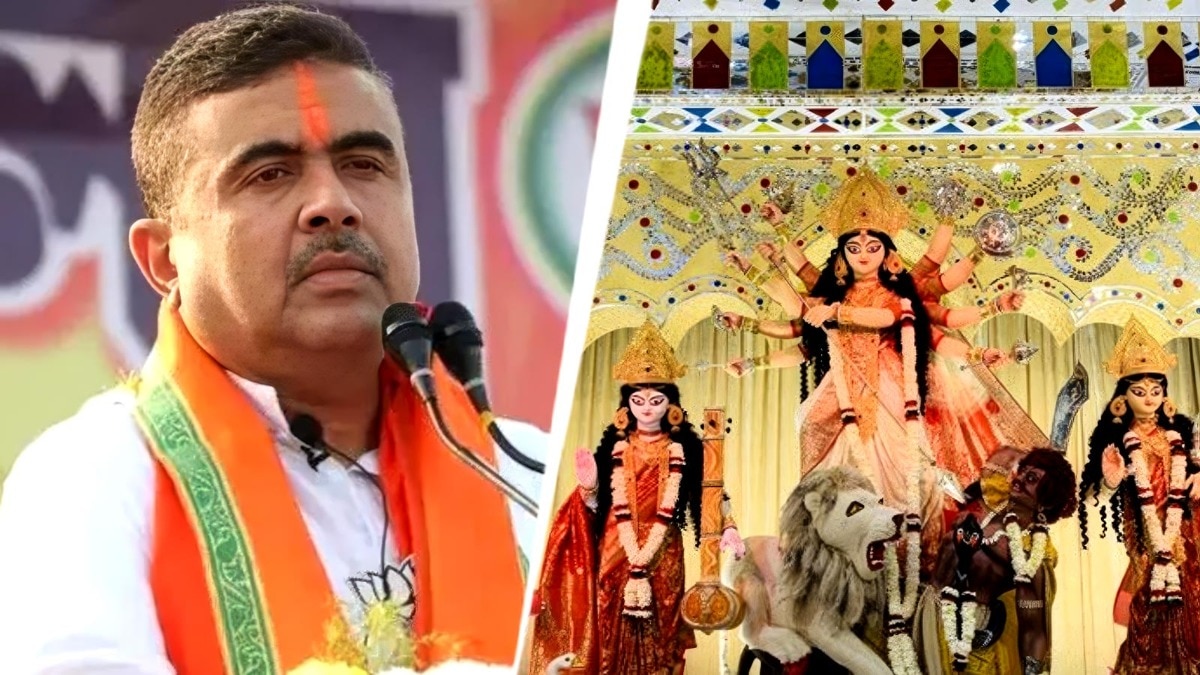
Three years ago, Instagram Reels and images with this message went viral ahead of Durga Puja. That was when West Bengal stood at a crossroads. Although the Trinamool Congress looked comfortable in power, the BJP was spreading its wings, while several other Hindu right-wing outfits were making inroads into the social and cultural space. Many Bengalis, for the first time in their lives, were encountering a Navratri-versus-Durga Puja debate. Many argued that Durga Puja had lost its religious essence after decades of Communist and Trinamool Congress rule, while some even questioned whether feasting on non-vegetarian dishes when several non-Bengali citizens were observing strict vegetarianism during Navratri was appropriate.
In this context, the Instagram catchline was an attempt by Bengalis to counter the uncomfortable questions that had been spreading across several social media platforms. It wasn’t a powerful statement, but it reflected a socio-cultural practice and loosely underlined a political undercurrent that many failed to read.
The Bengal unit of the BJP might have been among those who failed to read it. Fulfilling a longstanding quest, the party finally came to power in 2026, pushing the Trinamool Congress to the margins of Bengal’s politics.
Four months in power, the BJP does not face a significant political threat on the ground. After a two-way split in the party, the TMC is nowhere near challenging the BJP at this moment. The Congress does not have organisational strength, and the Left is largely surviving on its past glory. For the moment, the BJP seems to be the invincible force in Bengal’s political arena.
Nonetheless, the reality is far removed from this perception. Despite its political advantages and grassroots penetration across West Bengal, a sense of unease is slowly taking root in Bengali society about the ruling party. It is not overtly political, but it touches something that shapes the socio-cultural and political life of the state.
The consumption of non-vegetarian food has long been embedded in Bengal’s civilisational and cultural history, and it is suddenly being subjected to jibes from several prominent right-wing organisations and leaders. The BJP might have to pay for it, as people hardly distinguish between these organisations and the saffron party.
To understand this contradiction, we need to look at two things: the political scenario in Bengal and the BJP’s rise as an unprecedented force, and the growing discomfort beneath that political dominance.
WHAT’S COOKING IN BENGAL’S KITCHEN?
Unimaginable scenes unfolded after the election results were declared on May 4 in West Bengal. The Trinamool Congress, once seen as invincible in Bengal, was not only reduced to just 80 Assembly seats of the total 294, compared with the BJP’s whopping 208, but also witnessed a rapid decline amid a wave of factionalism.
The first blood was drawn by Ritabrata Banerjee, the present Leader of the Opposition in the Bengal Assembly. Accusing the Trinamool Congress of alleged signature forgery when the party nominated veteran leader Sovandeb Chattopadhyay as the Leader of the Opposition, Ritabrata, along with Sandipan Saha, lodged a complaint that led to an investigation by the Bengal CID. The Trinamool Congress soon expelled the two leaders. However, instead of resolving the crisis, the decision deepened it. The majority of the TMC MLAs, including staunch Mamata loyalists like Firhad Hakim and Madan Mitra, as well as leaders like Aroop Biswas and Anubrata Mondal, soon joined Ritabrata, and the faction now claims to represent the real Trinamool Congress.
As a rebellion was unfolding inside the party in Bengal, led by someone who had once hailed Mamata Banerjee as one of the strongest Leftist leaders in the country, a parallel split was being orchestrated in Delhi. Twenty of the party’s 28 elected MPs, led by Kakoli Ghosh Dastidar, another Mamata Banerjee loyalist, announced their merger with the obscure Tripura-based Nationalist Citizens Party of India (NCPI) and also extended their support to the ruling NDA coalition.
Somewhere, the developments made Suvendu Adhikari smile. Not because the NCPI is supporting the NDA coalition, or because a leader with almost zero mass connect had become the Leader of the Opposition, but because he knew that these developments would keep Mamata Banerjee busy, barely allowing her to focus on taking the opposition against the BJP government to the streets. And four months after the BJP came to power, the script is playing out almost perfectly.
Until the Trinamool symbol and bypoll candidates row, Mamata Banerjee was barely seen on the ground, appearing increasingly detached and addressing her supporters mostly through Facebook Live. Her nephew, after he was egged and attacked in West Bengal’s Sonarpur, is busy with foreign trips for his treatment, while the rest of the apparatus is occupied either criticising the Ritabrata faction or fighting court cases.
So, in the grand Bengal political kitchen, the TMC is cooked. The Left is still confused about whom to consider its primary enemy — the Trinamool, both the Mamata and Ritabrata factions, or the BJP — while the Congress simply does not have the ground-level strength to present itself as a viable alternative to the BJP. It seems, therefore, to be a complete win-win situation for the BJP.
And there comes the twist.
THE RISE OF DISCOMFORT OVER NON-VEGETARIAN FOOD
Eggs have become a serious matter in Bengal politics after May 4.
First, the highly nutritious food item was thrown at Abhishek Banerjee, and later, at a section of TMC leaders accused of corruption and extortion. But transcending mere political rivalries, eggs soon became a point of contention between the ruling BJP, the feeble opposition forces and civil society when Chief Minister Suvendu Adhikari announced that midday meals in schools across the Kolkata Municipal Corporation (KMC) area would be served by ISKCON. The meals would be vegetarian, with eggs dropped from the menu.
As the decision triggered a political storm, the Suvendu government was quick to course-correct. In the first week of August, the West Bengal government announced that it would provide eggs to students twice a week through a separate government scheme, alongside the vegetarian midday meals prepared by ISKCON.
The discomfort with non-vegetarian food had begun to take root. It only deepened after some other incidents.
A VEGETARIAN DURGA PUJA?
A large pandal, built around a theme reflecting some of the socio-economic and political problems of modern times, stands illuminated. Inside sits a large idol of Devi Durga. Outside, a long row of food stalls waits, serving mouth-watering egg, chicken and mutton rolls, along with a host of other non-vegetarian delicacies. A long queue of people moves towards the stalls, not merely to fill their stomachs, but to indulge in a culinary tradition that has become inseparable from Bengal’s biggest festival.
What has been a celebrated tradition during Bengal’s Durga Puja for decades could come under threat this year. The theme-based pandals and the feast of non-vegetarian food have drawn the ire, first from the Vishva Hindu Parishad (VHP), a Hindu right-wing organisation affiliated with the Rashtriya Swayamsevak Sangh, and then from Dhirendra Krishna Shastri, the head of Baba Bageshwar Dham.
In an appeal to the people of Bengal, the VHP urged them not to compromise with the religious essence of Durga Puja and also asked people not to sell non-vegetarian food items in and around the pandals. The remarks triggered a massive controversy, with many Bengalis criticising the organisation and the Suvendu government over the statements.
Although the VHP later made a volte-face, saying that its advisory did not mean to restrict people from practising their food preferences, Dhirendra Shastri, popularly known as Baba Bageshwar, called upon Bengalis to avoid non-vegetarian food during Navratri. He even described non-vegetarian food as dirty and used the term pakhandi (religious hypocrites) for those who eat non-vegetarian food during Navratri.
“I am appealing to the Hindus of Bengal that during Navratri, even if you don’t keep the idols of the Goddess, do not sell non-veg near the idols,” said Shastri.
A political storm spread like wildfire. Several content creators, internet users, opposition leaders and even some BJP lawmakers openly criticised Baba Bageshwar. The BJP quickly distanced itself from his comments, with the party’s state president Samik Bhattacharya saying that he would eat mutton on the day of Nabami, the second-last day of Durga Puja.
Although the BJP has not made any direct remark on people’s food choices, the statements by the VHP and later Baba Bageshwar could hurt the party, especially at a time when the municipal elections are approaching.
The discomfort with non-vegetarian food had begun to take root. It would subsequently deepen through a handful of other incidents.
WHY NON-VEG MATTERS IN BENGAL?
On Vijaya Dashami, before the immersion, many Bengali families offer a pair of puti macch (swamp barb) or ilish (hilsa) to Devi Durga.
I heard an interesting story from my grandmother while growing up. Once, Devi Durga came to her maternal home and had a grand feast. On her last day, before returning to her in-laws, her mother asked her what she would like to have as her last meal. As Devi Durga was suffering from indigestion, she asked for rice and puti macch.
Since then, it has become a tradition to offer that fish. In Bengali families, there is a saying: “Barir meyeke macch na khaiye bidaye janate nei (Do not send our daughter to her in-laws without feeding her fish).”
It is a mythological story. However, what is documented is Swami Vivekananda’s remarks about non-vegetarian food. The monk, who once ate the ‘prohibited’ fowl cutlet, wrote in his book Prachyo and Paschatta, “Oi buro Shiv domru bajaben, Ma Kali patha khaben, ar Krishna banshi bajaben — ei deshe chirokal (Old Shiva will keep playing the damru, Maa Kali will eat the sacrificial goat, and Krishna will keep playing the flute — that is how it will always be in this country).”
Even his guru, Swami Ramakrishna Paramahamsa, said, “If one can keep one’s mind steadfast upon God after partaking of beef or pork, these things are as good as Havishyanna [pure sanctified food]. But vegetables eaten by a man engrossed in worldliness are no better than pork or beef.”
For Bengalis, the consumption of non-vegetarian food goes far beyond a mere dietary preference. From everyday conversations to literature, cinema and music, food — particularly fish and meat — has been woven into Bengal’s cultural imagination for centuries. It is part of what gives Bengali identity its distinct character.
Perhaps that is why the remarks made by Baba Bageshwar, and the appeal made by the VHP, triggered a major storm across the state, with people opposing him cutting across party lines. The Congress filed a complaint against Baba Bageshwar. Some Congress party members even protested by hitting his picture with shoes. The CPI(M) also criticised Baba Bageshwar, while some BJP legislators and spiritual gurus too opposed his remarks.
It is undeniable that the BJP came to power with a huge majority, a mandate that even some of the party’s most ardent supporters might not have anticipated.
Yet, in the four months since taking office, governing Bengal has been far from a cakewalk. The controversy over hawker evictions, protests over delays in receiving benefits under the Annapurna Scheme, the absence of any major investment announcements and, now, the comments over the consumption of non-vegetarian food have all given the opposition and civil society reasons to question the new government.
Over the past few years, Bengal has witnessed several silent political undercurrents that eventually dented Mamata Banerjee’s electoral prospects. It may be too early to draw a parallel, but history can repeat itself if the BJP fails to recognise the cultural sensitivities that define Bengali society — particularly when larger Hindu organisations begin commenting on people’s food choices.
While the BJP has no political rival strong enough as of now, it has invented one by being seen on the wrong side of the veg-non-veg debate.
And for the BJP, the problem isn’t necessarily that it is asking or not asking Bengalis to give up meat. It isn’t. Its problem is that, in Bengal, the distinction between the BJP and the larger Hindu-right ecosystem is becoming irrelevant to ordinary people.
– Ends
Published By:
Akash Chatterjee
Published On:
Sep 20, 2026 10:00 IST