
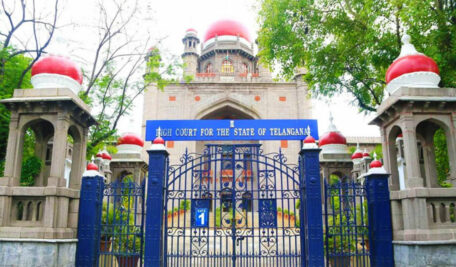
The Telangana High Court set aside a single judge’s order directing re-evaluation of TGPSC Group-I Mains, ruling no systemic failure or malpractice was proven. The bench upheld the Commission’s evaluation process and declared the examination results valid
Published Date – 5 February 2026, 10:40 PM
Hyderabad: A Division Bench of the Telangana High Court comprising Chief Justice Aparesh Kumar Singh and Justice GM Mohiuddin on Thursday delivered a common judgment allowing a batch of writ appeals filed by the Telangana Public Service Commission (TGPSC) and successful candidates, setting aside the earlier order of the learned single judge which had directed re-evaluation or re-conduct of the Group-I Mains examination.
The batch of appeals arose out of the judgment dated September 9, 2025, wherein the single judge had set aside the final marks list and general ranking list issued under Notification No.02/2024.
Appearing for the TGPSC, Advocate General A Sudarshan Reddy and Senior Counsel S Niranjan Reddy submitted that the learned single judge had exceeded the permissible limits of judicial review. They argued that there was no proof of systemic failure, mass malpractice or mala fides to justify interference with a large-scale recruitment process conducted by a constitutional authority.
Senior counsels S Muralidhar, D Prakash Reddy and Gopal Sankaranarayanan, appearing for various sets of successful candidates, contended that the Commission had adopted a fair, uniform and non-discriminatory method of evaluation. They submitted that issues relating to hall tickets, examination centres and multiple evaluations caused no prejudice to candidates and that mere statistical variations could not be a ground to annul the entire examination.
Opposing the appeals, Senior Counsel M Surender Rao, along with Senior Counsel B Rachna Reddy and G Vidya Sagar, appearing for the unsuccessful candidates, supported the order of the learned single judge. They argued that the Commission failed to maintain transparency and fairness in the conduct and evaluation of the Group-I Mains examination and had deviated from the notified procedure. According to them, the alleged irregularities justified directions for re-evaluation or fresh conduct of the examination to protect the legitimate expectations of candidates.
After considering the rival submissions, the Division Bench held that judicial interference in large-scale recruitment examinations is permissible only when grave and proven irregularities exist which vitiate the entire selection process. The Bench found that the writ petitioners had failed to establish any systemic failure, mala fides, mass malpractice or prejudice sufficient to warrant cancellation of the examination or re-evaluation of answer scripts.
The Court observed that the Public Service Commission, being a constitutional authority, is entitled to evolve its own fair and non-discriminatory procedure for evaluation, and that courts should exercise restraint in interfering with such processes. The Bench noted that mere allegations, suspicions or statistical variations, without proof of widespread illegality, cannot form the basis for nullifying a recruitment process involving thousands of candidates.
On the issue of multiple evaluations and moderation, the Bench held that the method adopted by the Commission, including third evaluation in limited cases, could not be termed arbitrary or illegal.
It further held that the learned single judge erred in issuing alternative directions for re-evaluation or fresh examination in the absence of demonstrable systemic irregularity. Consequently, the Division Bench set aside the impugned common order of the learned single judge, upheld the validity of the Group-I Mains examination and the results declared by the Commission, and allowed all the writ appeals. The connected writ appeal filed by certain writ petitioners seeking cancellation of the examination was dismissed.


