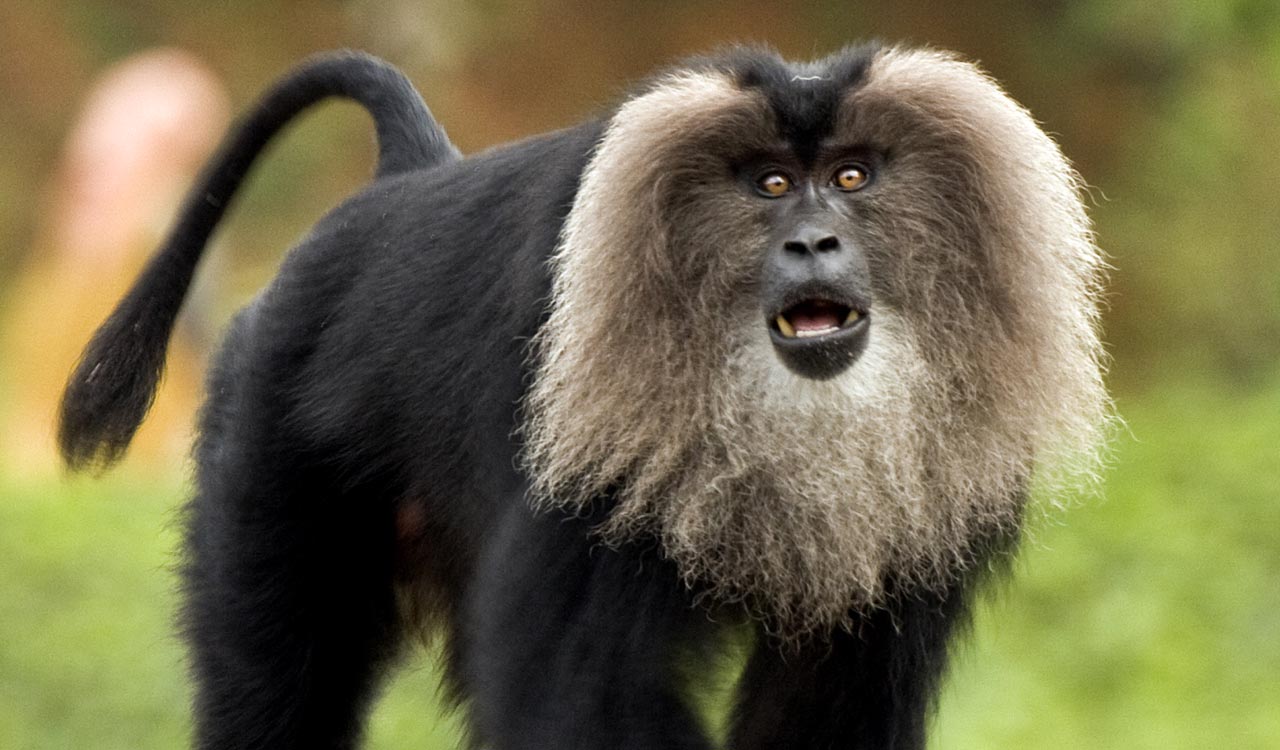
A 40-year study in the Western Ghats has warned that lion-tailed macaques living in private forest fragments face rising extinction risks despite increasing numbers. Researchers say infrastructure growth, habitat fragmentation and human disturbance threaten the long-term survival of the species.
Published Date – 4 March 2026, 03:23 PM
Photo: Lion-tailed macaque by N A Nazeer (Wikimedia )
Hyderabad: The endangered Indian lion-tailed macaque is undergoing a worrying and dangerous shift in the Western Ghats. A landmark study spanning 40 years by geneticists from Hyderabad and University of Mysore has revealed a strange paradox. While the macaque numbers have increased in private forest fragments, they are actually facing a higher risk of long-term extinction due to infrastructure such as roads, power lines and other disturbances.
The findings, titled ‘Four decades of population monitoring in Anamalai Hills, Western Ghats and Perspectives for Management and Conservation’, were recently published in the journal Mammalian Biology and have highlighted a troubling trend.
The species has remained demographically stable within protected government forest reserves. However, the study gave a ‘Red Alert’ for those living in non-protected areas such as private tea and coffee estates, which are human-dominated habitations and could lead to the eventual decline of the species.
The study, led by Dr G Umapathy from Hyderabad-based Centre for Cellular and Mobile Biology (CCMB) and researchers from the University of Mysore, monitored 37 groups of macaques across the Anamalai Hills. The research group tracked nearly 800 individuals and compared monkeys living in ‘Protected Areas’ such as tiger reserves to those living in ‘Non-Protected Areas’ such as private tea and coffee estates.
Surprisingly, the groups in unprotected private forests were often larger than those in the deep protected forests. However, researchers clarified that physical growth is not a sign of health. Instead, easy access to human food such as garbage and crops has caused their numbers to rise unnaturally fast.
The population surge, however, has come at a cost. The primate populations in non-protected areas are being affected by three major silent threats including high-speed vehicles on roads that cut through private tea and coffee estates, electrocution and habitat fragmentation. As forests shrink, the monkeys are forced into crowded spaces, increasing the risk of diseases and preventing young males from moving between groups, which is essential to maintain genetic diversity.
The researchers warned that rising numbers do not tell the full story because macaques are ‘canopy specialists’ and live almost entirely in the treetops. The loss of forest canopy will be devastating.
While populations in protected national parks remain stable and demographically healthy, the seemingly ‘successful’ groups in private estates are far more vulnerable to sudden long-term extinction. The demographic structure in the wild is balanced, whereas the fragmented groups face an uncertain future due to human disturbance, researchers said.
Study recommendations to protect lion-tailed macaques:
• Immediate and proactive conservation management of lion-tailed macaque
• Install artificial canopy bridges over roads so monkeys do not have to come to the ground
• Plant native fruit trees so that isolated forest patches can be connected
• Food from human sources is not a substitute for food directly from trees
• Enforce speed limits in wildlife crossing zones to prevent road accidents
• Limit entry of tourists in sensitive macaque habitats
• Local buildings must be ‘monkey-proofed’ to prevent their entry in search of food
• Local authorities must explore buying back narrow strips of private estates to create green corridors