Image courtesy: X/@Neiphiu_Rio In 1976, a small group of women in Nagaland came together with a practical idea: use traditional weaving to earn an income while keeping their community’s distinctive attire alive. They had their looms, their weaving skills and a shared plan to help more women become financially independent.Five decades later, the Chakhesang Women Welfare Society (CWWS) has grown into a community organisation working across weaving, skill development, food processing and other livelihood activities. It has trained more than 20,000 women and young people and helped form 586 self-help groups and joint-liability groups. As it marked its 50th anniversary on November 21, 2026, the society also signed a new partnership aimed at expanding opportunities for women entrepreneurs.As reported by Mokokchung Times, the society began by promoting traditional Chakhesang shawl weaving among women in Phek district. Its work gradually expanded beyond textiles as it looked for ways to involve more women in income-generating activities.
From traditional shawls to a wider livelihood network
The Chakhesang community is one of Nagaland’s recognised Naga tribes. Its traditional shawls are known for their distinctive patterns, colours and motifs, each carrying cultural significance. As the number of women involved in weaving increased, the society established the Chakhesang Women Multipurpose Cooperative Society to manage orders, production and market connections. This allowed weavers to concentrate on making products while the cooperative handled the business side.The range of products has also grown. Along with traditional shawls, women now make bags, aprons and curtains. The society runs a training centre in Pfutsero, where women receive instruction in weaving and tailoring.According to an earlier report by The New Indian Express in March this year, Executive Director Nezelü Nyekha said around 60,000 Chakhesang women were associated with the initiative, directly or indirectly. She explained that the organisation had added small-scale entrepreneurial activities over the years to reach more women. The society also works with women involved in food-based confectionery and food processing. Many of the women combine weaving or other small businesses with farming.The earnings vary according to the type of work and product. Nyekha told The New Indian Express that women making premium shawls could earn between ₹30,000 and ₹40,000 a month, while other weavers earned around ₹15,000. A regular shawl generally sells for ₹2,500 to ₹3,000, with specially made pieces costing more.
Chakhesang shawls receive GI recognition
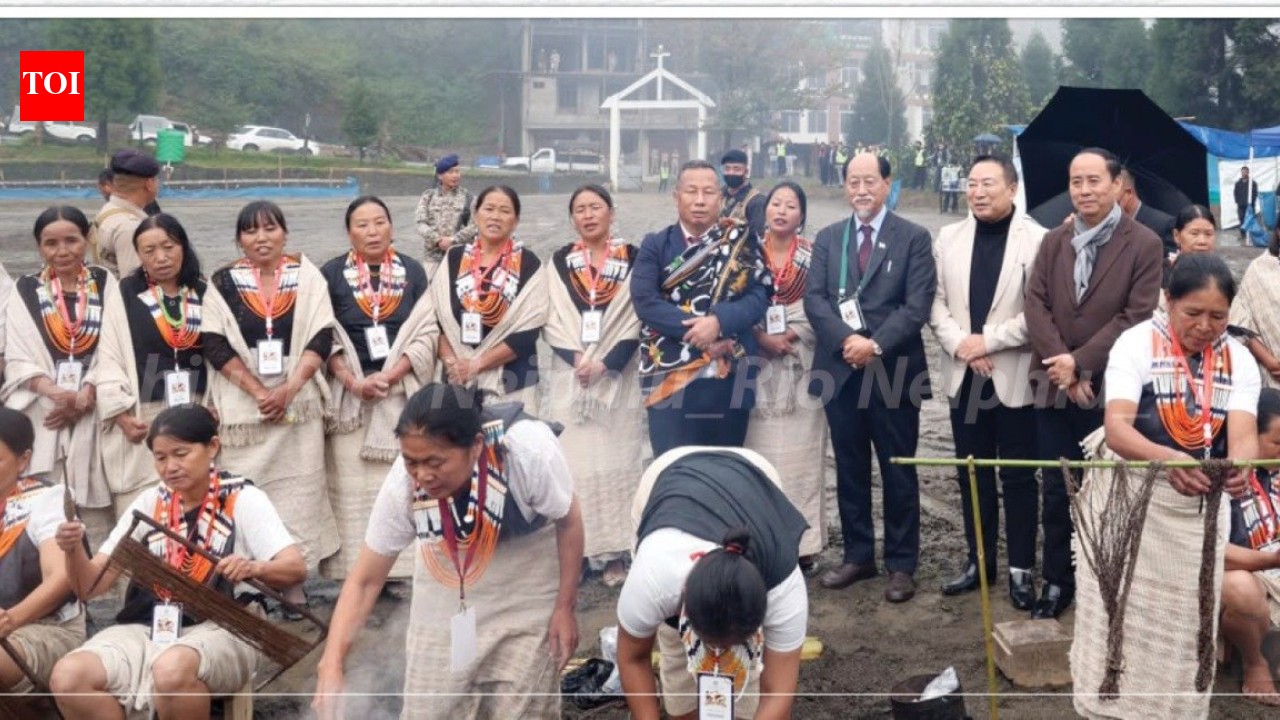
The Golden Jubilee celebrations at T Chikri, Pfutsero, in Phek district brought together community representatives and government officials, including Nagaland Chief Minister Neiphiu Rio.
One of the society’s important milestones came in 2017, when Chakhesang shawls received Geographical Indication (GI) registration. The official Geographical Indications Registry lists the Chakhesang Women Welfare Society as the applicant for the registered product. The registration, dated October 24, 2017, recognises the shawls’ geographical identity and helps protect their name and reputation.The society has also received support for improving traditional handloom production. A project titled ‘Socio-Economic Upliftment of Tribal Women Through Improvement of Handloom Weaving and Commercialisation of GI Shawls,’ funded by the Department of Science and Technology, began in 2019. The project had a budget of ₹52.8 lakh, according to the India Science, Technology and Innovation portal.
A new partnership on the society’s 50th anniversary
The Golden Jubilee celebrations at T Chikri, Pfutsero, in Phek district brought together community representatives and government officials, including Nagaland Chief Minister Neiphiu Rio. According to the Nagaland Department of Information and Public Relations, Rio attended the November 21 event, unveiled the Jubilee monolith and released the society’s Golden Jubilee souvenir. He praised the organisation for preserving traditional practices and indigenous knowledge across generations.The anniversary also marked the signing of a Memorandum of Understanding between CWWS and the Association of Lady Entrepreneurs of India (ALEAP), Hyderabad. The agreement is intended to promote women’s entrepreneurship in Nagaland and other Northeastern states.As reported by Mokokchung Times, the partnership will cover entrepreneurship training, technical guidance, capacity building, enterprise development and market access. The proposed areas of cooperation include food processing, agriculture, handloom, handicrafts, textiles, bamboo, cane and organic products. It also envisages support for common facility centres, incubation facilities, enterprise clusters and access to institutional finance and government schemes.For CWWS, the new agreement adds an enterprise-development focus to work that began with traditional looms in 1976. Its next phase will involve helping more women turn their skills and local products into businesses with wider markets.