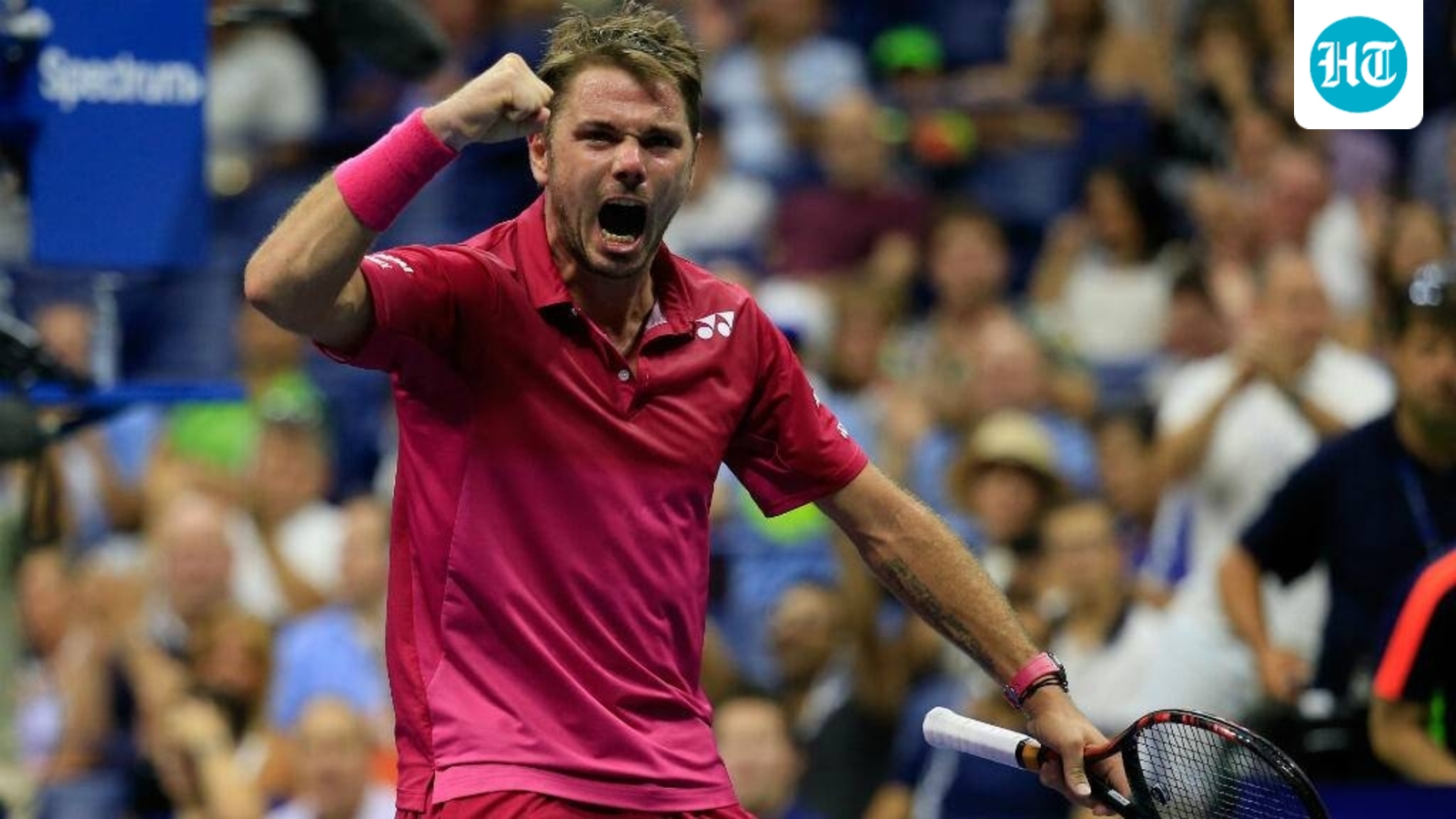
The city of Basel had planned a farewell week for Stan Wawrinka. On Sunday, he visited FC Basel for their match against Grasshoppers and was presented with a jersey bearing the number 3, representing the three Grand Slam titles he won. The following day, an artist spray-painted a giant portrait of him live, while a singer performed Lucky at an emotional farewell ceremony that lasted more than an hour. The tournament director called him “the Sylvester Stallone of tennis”. Video messages from Roger Federer, Andy Murray, Martina Navratilova and John McEnroe added to the occasion.
Stan Wawrinka’s professional career came to an end in Basel on Tuesday
On Tuesday, the party came to an end. Drawn against Jiri Lehecka in the opening round of his final professional tournament, Wawrinka went down 5-7, 6-7(2).
As the final shot sailed long, his backhand betraying him and drifting beyond the tramlines, Wawrinka broke down in tears. It was a shot he had made look effortless in his prime: a thunderous, almost artistic stroke, the one that had mesmerised tennis fans across the globe. Perhaps it was fitting that the shot that had defined his career also marked its end.
“I’m sad,” he said, “but I’ve got a smile on my face.” At 41 and ranked 151st in the world, Wawrinka bid farewell to the sport at the same tournament where he made his debut as an 18-year-old wild card in 2003.
And he had every reason to smile. Wawrinka ended his career with 16 titles, including three majors, in an era dominated by the Big Three — Novak Djokovic, Rafael Nadal and Federer. He never became world No. 1; his career-high ranking was No. 3. But he dared to challenge the sport’s dominant forces and, at his peak, repeatedly got the better of them.
To understand the significance of that achievement, consider the numbers. Federer, Nadal and Djokovic won 66 of the 81 Grand Slam titles contested between 2003 and 2023, accounting for more than 80% of the majors during that period.
Before 2014, Wawrinka, had lost 14 consecutive matches against Djokovic. Against Nadal, he was 0-12 and had never taken a set off the Spaniard. Against his Swiss compatriot Federer, he had suffered 11 straight defeats. In all, he had beaten the three only three times across more than 40 meetings, with none of those victories coming against Nadal. He had also won only twice against players ranked in the top two.
He knew where he stood. Even after winning the French Open in 2015, he acknowledged the gulf between himself and the Big Three: “I’m not as strong as them, they are winning everything.”
The script changed over the next three seasons. Eight of his 12 career wins against the Big Three came between January 2014 and September 2016, and the breakthrough began at the 2014 Australian Open.
Wawrinka, who won 11 consecutive title matches between 2014 and 2016, was arguably the second-best player on tour. Only Djokovic, with six majors, won more Slams than Wawrinka’s three. Wawrinka also won more than Murray, who claimed two majors during that period, and Nadal, who won one. Federer did not win a major in those years, his previous triumph having come at Wimbledon in 2012.
Wawrinka finished each of those three seasons ranked No. 4. He also established himself as a formidable opponent for the elite, beating top-10 players nine times in 2013, eight times in 2014 and nine times in 2015.
Despite the accolades, Wawrinka resisted being grouped with the “Big Four”. Murray and the others, he argued, had maintained their consistency for a decade.
Djokovic disagreed, saying, ” Wawrinka deserves to be in the mix”. The overall numbers might not have put him alongside the sport’s most consistent champions, but he kept turning up to spoil their plans.
The backhand
No story about Wawrinka would be complete without his one-handed backhand. It was heavy and powerful, and yet it retained an elegance. Djokovic called it “probably the best one-handed backhand on the tour”.
The shot arrived at a time when the one-handed backhand was increasingly viewed as a dying art. In 2014, The New York Times Magazine ran an elaborate graphic that wondered whether Wawrinka might save it.
Comparisons with Federer were inevitable. Federer could slice, flick, scoop and redirect with his backhand, making it particularly dangerous when he varied his shots. Wawrinka’s was more often a finishing move.
Perhaps the finest example came in the 2015 French Open final against Djokovic. In the third set, Djokovic struck a sharply angled cross-court backhand that would have beaten most players. Wawrinka chased it beyond the doubles alley and whipped his own backhand around the net post, landing the ball in the corner, and leaving Djokovic mystified.
In 2017, when Federer was back in the Grand Slam conversation after defeating Nadal in the Australian Open final, he credited changes to his backhand for his return to the top. The shot had become a more aggressive weapon, better equipped to handle Nadal’s heavy topspin — a challenge Wawrinka had already shown could be overcome with power and attacking intent, notably at the Australian Open and in Rome in 2015.
When the body gave way
Wawrinka maintained his peak until around the middle of 2017. Federer ended his bid for a second Australian Open title in the semi-finals that year, while Nadal beat him in straight sets in the French Open final. It was his fourth and last Grand Slam final and the only one he lost.
A knee injury ended his season, and by 2018, he had fallen as low as No. 263.
There were flashes of his old form as he reached three Slam quarters between 2019 and 2020, but the knee, then his left foot, made a sustained return hard. Yet, he refused to walk away, and set a record for most tour-level wins after turning 40: 12.
Stan says goodbye
Wawrinka’s retirement announcement in early 2026 was distinctive: an acrostic poem shared on social media that spelt out the words “Passion” and “Dream”, capturing the journey that had defined his career.
At 41, he leaves the sport knowing he gave it everything. His tattoo, quoting Samuel Beckett, captures that journey best: “Ever tried. Ever failed. No matter. Try Again. Fail again. Fail better.”
There is one more stop. On December 19, he is scheduled to attend a farewell evening in Geneva with Federer, Murray and Gael Monfils, reportedly billed as “One Last Backhand”.