
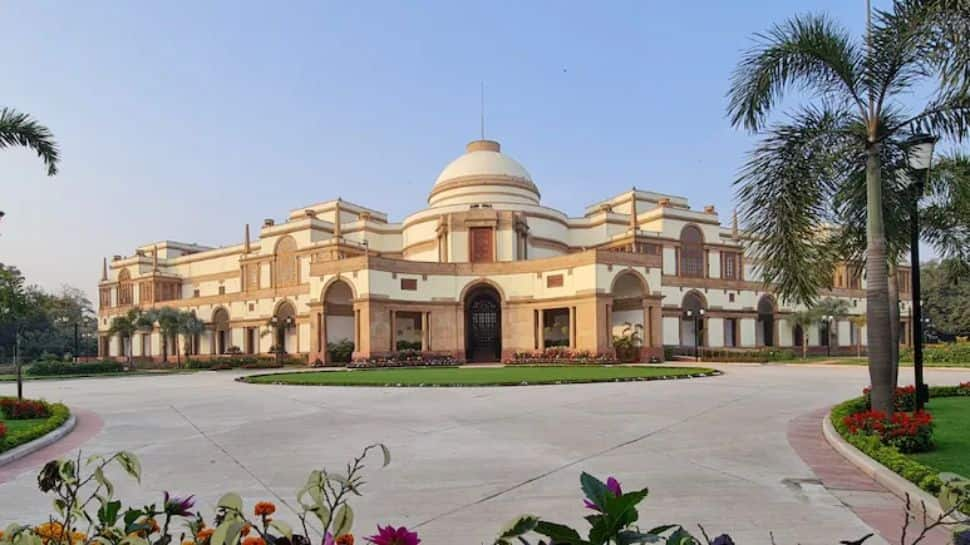
New Delhi: The capital’s iconic Hyderabad House at 1, Ashok Road is set to host Russian President Vladimir Putin for bilateral talks, banquets and other formal engagements. The building carries a rich legacy and was built by the richest man on the planet. Its domes, hallways, staircases and courtyards, once designed to impress an empire, today form the backdrop for decisions that influence global affairs.
Long before global leaders walked through its domed halls, the last Nizam of Hyderabad, Mir Osman Ali Khan, ruled over a kingdom so wealthy that legends claimed he owned pearls enough to fill entire swimming pools and palaces spread across erstwhile Deccan like scattered jewels. When the British shifted India’s capital to Delhi from Calcutta, the Nizam sought a presence in the new city that matched both his fame and his self-image.
A Request That Stunned The British Govt
Add Zee News as a Preferred Source
As the new capital’s layout was being formalised, the princely states wanted their signatures on the imperial map. Their interest pleased the Viceroy, who viewed their presence as a sign of loyalty to the new capital. But Khan had a request that even the British found extravagant. He wanted a prized plot in the Princes’ Park, close to the Viceroy’s House itself. That proximity was unacceptable to the imperial authorities, so only five princely states were allotted land three kilometres away, around the statue of King George V. These were Hyderabad, Baroda, Patiala, Jaipur and Bikaner.
Among these select five, only the Nizam of Hyderabad and the Gaekwad of Baroda hired the legendary architect Edwin Lutyens to design their Delhi residences.
Awarded a distinguished 21-gun salute and enjoying an unprecedented “exalted” status in British India, the Nizam hoped Lutyens would create a palace comparable in grandeur to the Viceroy’s House. The British refused such parity, so the government insisted that all princely palaces would need official design approval.
Therefore, Lutyens included only a single architectural echo of the Viceroy’s House, a central dome, but gave the Nizam a residence unlike any other in Delhi.
The Birth Of A Butterfly-Shaped Palace
The Hyderabad House emerged in a butterfly-shaped plan, with its sweeping wings opening along the surrounding roads and its entrance aligned with the approach road on the hexagon.
Lutyens borrowed this layout from his 1903 creation, which was Papillon Hall in Leicestershire. The result was a residence that instantly overshadowed every other princely palace in the capital.
Its construction cost a staggering 200,000 pound in the 1920s, which would equal roughly 1.4 million pound or Rs 170 crore in 2025. The house perfectly mirrored the Nizam’s immense wealth, which at that time made him the richest man on earth. Even without matching the scale of the Viceroy’s House, the Hyderabad House carried a presence that very few structures in Delhi could rival.
Thirty-Six Rooms, An Architectural Symphony
The Hyderabad House has 36 rooms and features courtyards, arches, stairways, fireplaces and fountains. Its design blends European style with a touch of Mughal elements.
Known for major public buildings, Lutyens made sure that the Hyderabad House stood apart from its neighbours such as the Jaipur House and the Patiala House.
Its centrepiece is a grand dome rising above an entrance hall, with symmetrical wings extending at precise 55-degree angles. The palace occupies 8.2 acres close to the India Gate. The circular foyer and the first-floor hallway feature striking rhombic marble floor patterns. Round arches, paired with rectangular openings, rise to the height of the impost, an element inspired by Rome’s Pantheon, where Lutyens had spent time in 1909.
The first-floor windows, which combine rectangular and round arches, were inspired by the Uffizi’s view over the Arno in Florence. One of the most curious corners of the palace was the zenankhana (women’s section), a circular court with 12 or 15 rooms.
After touring the section, Lord Hardinge famously said that each room was “the size of an ordinary horsebox with only one window close to the roof”. He described a row of tiled bathrooms with only taps for hot and cold water, adding that the water streamed directly onto the women since “there seemed to be no means of mixing the hot and cold water, as it pours on to the ladies”.
A Jewel In Delhi’s Imperial Setting
Between 1921 and 1931, the Hyderabad House became the most magnificent princely palace in New Delhi that surpassed only by the Viceroy’s House. Its architecture was crafted to impress, to make a statement and perhaps to stir a tinge of envy among those who passed by.
The Nizam’s diamond mines, including the legendary Jacob Diamond, funded the construction, turning the palace into a symbol of his loyalty to the British Raj as well as his autonomy. Ironically, despite its splendour, Khan himself visited only on rare occasions.
A Twist In Destiny After 1947
After India won independence, the future of the Hyderabad House changed dramatically. The princely states were being integrated into the Indian Union, and Hyderabad, ruled by a Muslim monarch over a Hindu-majority population, resisted the merger until Operation Polo in September 1948. Late
In the years that followed, the Hyderabad House saw very little use by the Nizam’s family.
The property came under government control, likely through transfer or donation, though detailed documentation was never made public.
By the early 1970s, as India’s diplomatic needs expanded, the palace transitioned fully into the hands of the central government. In 1974, the Ministry of External Affairs took charge and redesignated it as the venue for state banquets and official receptions.
The India Tourism Development Corporation (ITDC) managed its upkeep and hosted events at international standards, giving the palace a new diplomatic life.
From Royal Residence To Power Address
Over the decades, the Hyderabad House has become the prime minister’s principal state guest venue. Presidents, prime ministers, monarchs and dignitaries from around the world have walked through its doors.
Bill Clinton, George W. Bush, Gordon Brown and Vladimir Putin have all attended major state functions here, along with countless foreign ministers and global policymakers.
Its central location, proximity to key ministries and its ability to host the most sensitive VVIP meetings made it indispensable to India’s evolving foreign policy.


