By Simrin Sirur
A group of former forest officials, conservationists, and researchers have censured the National Board for Wildlife (NBWL) and a statutory body under it for approving development projects within protected areas with “scant ecological and scientific evidence” and “no application of mind.”
A public interest litigation filed by the group in the Delhi High Court says the Standing Committee under the NBWL approved 97% of projects between 2014 and 2026, indicating a lack of “processual rigour” which led to the diversion of at least 95,724 hectares of forest land. The allegation comes amid a spate of changes made to national environmental norms to favour the “ease of doing business” — a stated goal of the incumbent BJP government.
The petitioners include four retired Indian Forest Service officers, led by Prakriti Srivastava as well as eminent conservationists like M.K. Ranjitsinh, who played an instrumental role in drafting the Wildlife Protection Act, India’s primary wildlife protection law.
The petition alleges the National Board for Wildlife, chaired by the Prime Minister, and its Standing Committee, chaired by the Union Environment Minister, acted with “total disregard of its (sic) constitutional duties and in violation of the very intent and purpose for which they were statutorily created.”
A representative of Bhupender Yadav, Union Environment Minister and chairperson of the NBWL Standing Committee, declined to comment.
The National Board for Wildlife was created in 2003 under the Wildlife Protection Act to advise central and state governments on issues pertaining to wildlife. These include setting up national parks and sanctuaries, carrying out impact assessments of projects on wildlife, and reviewing the progress of wildlife conservation in the country.
The law makes it mandatory to seek permission from the NBWL for diversions within protected areas. A government provision made it possible for the NBWL to delegate its tasks to a Standing Committee — a smaller body of experts and officials — under its supervision.
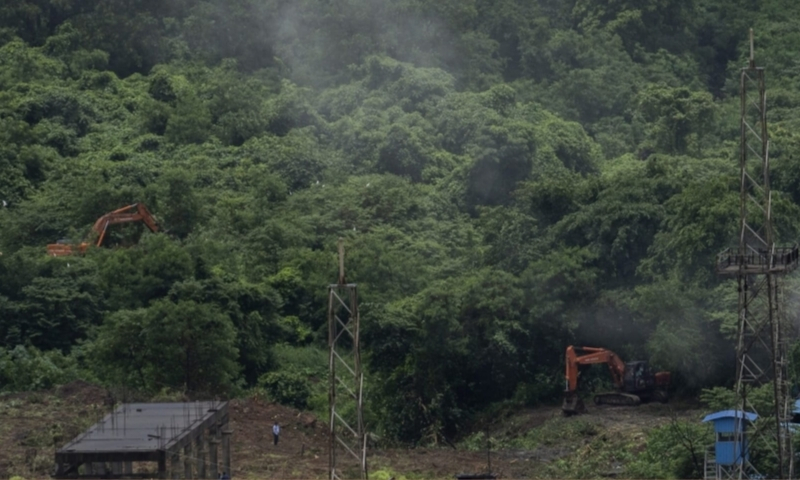
Agricultural fields alongisde a sacred forest in Meghalaya. A PIL filed in the Delhi High Court says the Standing Committee under the NBWL approved 97% of projects between 2014 and 2026, leading to the diversion of 95,724 hectares of forest land. Representative image. (AP Photo/Anupam Nath)
However, the petition filed in the Delhi High Court, obtained by Mongabay India, says the National Board for Wildlife rarely meets, leaving the Standing Committee to make decisions without oversight.
Between 2012 and 2025, the NBWL met only once. The Standing Committee, on the other hand, met 55 times between 2014 and 2026 and considered 2,186 project proposals requiring forest diversions, approving 97% of them.
Mridhu Tandon, an independent consultant and member of the IUCN’s World Commission on Protected Areas, tracked the SC-NBWL’s project approvals in a report for the Legal Initiate for Forests and Environment (LIFE) in 2019. Most approvals pertained to linear infrastructure, like roads, railways, and transmission lines.
“The deliberations recorded for linear infrastructure proposals are strikingly similar across projects, even when they involve different protected areas with distinct ecological characteristics,” she told Mongabay India, adding, “This is largely because there is little discussion of the biodiversity values of the protected area or of the specific impacts that the project is likely to have on those values.”
The NBWL Standing Committee held its 91st meeting on 9 July, where it considered over 100 projects.
“The proposals were appraised on the basis of their ecological impacts, importance for public welfare and national development, and the adequacy of mitigation measures to ensure conservation of wildlife and their habitats. The Standing Committee reiterated the Government’s commitment to conservation of wildlife and wildlife habitats while facilitating sustainable development,” a press release issued by the Union Environment Ministry says.
“Illegal” constitution and diversions
As of March 2025, India has 1014 notified protected areas covering approximately 5.32% of its total geographical area. The rapid approvals to divert these areas or denotify them altogether reflects the “shoddy and hurried assessments,” done by the Standing Committee, the petition says.
In some cases, approvals were given to projects despite strong opposition from conservationists and even state government bodies. The SC-NBWL approved the Ken-Betwa river linking project even though it will lead to a 10% submergence of the Panna Tiger Reserve and National Park, where tiger populations were revived after much difficulty. The Park’s director had opposed granting approval to the project, but the SC-NBWL “ignored all the concerns and recommended the project,” says the petition.
The Committee also approved the denotification of Galathea Bay in Great Nicobar Island, a well established leatherback sea turtle nesting site, which is now cleared for the development of a transshipment port. The development of Great Nicobar Island has drawn global criticism for the threats it poses to endemic biodiversity and unconnected tribes inhabiting the island. According to the petition, the SC-NBWL does not have the statutory powers to denitrify protected areas.
“Minutes recording the proceedings of the SC-NBWL’s meetings, and the recommendations given therein, mostly do not even mention the impact that these denotifications and reductions will have upon the wildlife and the habitats,” says the petition.
A 2018 guiding document for the SC-NBWL, prepared by conservationist T.R. Shankar Raman and published by the Union Environment Ministry, ecmphasised an approach that prioritised prevention of linear intrusions, followed by realignment, and mitigation as the last resort. “Despite providing a strong scientific basis for decision-making, the study appears to receive little consideration during deliberations on linear infrastructure proposals,” said Tandon, adding, “Discussions on whether alternative alignments or designs were adequately examined are largely absent from the committee’s deliberations.”
The petition also raises concerns about conflict of interest in the Standing Committee’s decision making. While the NBWL’s membership includes five non-governmental conservation organisations and ten conservation experts, the Standing Committee, which meets more frequently and makes decisions about diversions, includes just one NGO — the World Wildlife Fund (WWF) India.
A Malabar giant squirrel ends up as roadkill in the Anamalai Hills in Tamil Nadu. Representative image by P. Jeganathan via Wikimedia Commons (CC BY-SA 4.0).
The Committee, constituted in March, currently includes Yadav as chairperson, the Additional Director General of Forests, Ramesh Pandey, as member secretary, four serving officials from the central and state environment ministries, a representative from the Wildlife Institute of India, and two retired IFS officers. One of them, Soumitra Dasgupta, is a Director of the International Big Cat Alliance, a government-led global conservation initiative.
“There is no voting on matters, and often the chairperson makes unilateral decisions, thus rendering the expertise and diversity of views within the committee — and outside it — redundant,” the petition says.
The serving Committee was notified by the Union Environment Ministry in violation of the Wildlife Protection Act, the petition says, which stipulates that the Standing Committee be constituted by the NBWL. “This shift to a nomination by the Central Government is not only illegal, but also shows that the SC-NBWL lacks autonomy,” says the petition.
The Delhi High Court has reportedly sought a response from the Union Environment Ministry and other respondents within four weeks. The matter will be heard next on 18 September.
Need for accountability
Between 2012 and 2013, a sub-committee drafted rules and protocols on the functioning of the Standing Committee, but these rules were rejected, resulting in the Committee “functioning in an arbitrary, non-transparent, and ad hoc manner, without proper inputs and the necessary application of mind and detailed discussion of every proposal,” says the petition.
Instead of the cancellation of clearances, the petitioners are demanding guidelines be put in place to ensure the SC-NBWL follows a robust governance process. Decisions to divert, denotify, or “rationalise” protected area boundaries should be justified in writing “as to how the proposal is necessary for the improvement and better management of wildlife… and is in full accordance with the provisions of the WLP Act,” says the petition.
It also says the NBWL should order more impact assessments by experts of projects.
“The committee’s deliberations should explicitly consider the ecological significance of the protected area proposed for diversion, and assess how the project may affect its biodiversity values,” said Tandon, adding, “Where SC NBWL considers proposals affecting internationally designated sites, its deliberations should explicitly examine these convention-specific requirements to ensure that decisions remain consistent with India’s international obligations.”
This article is republished from Mongabay under a Creative Commons license. Read the original article here.