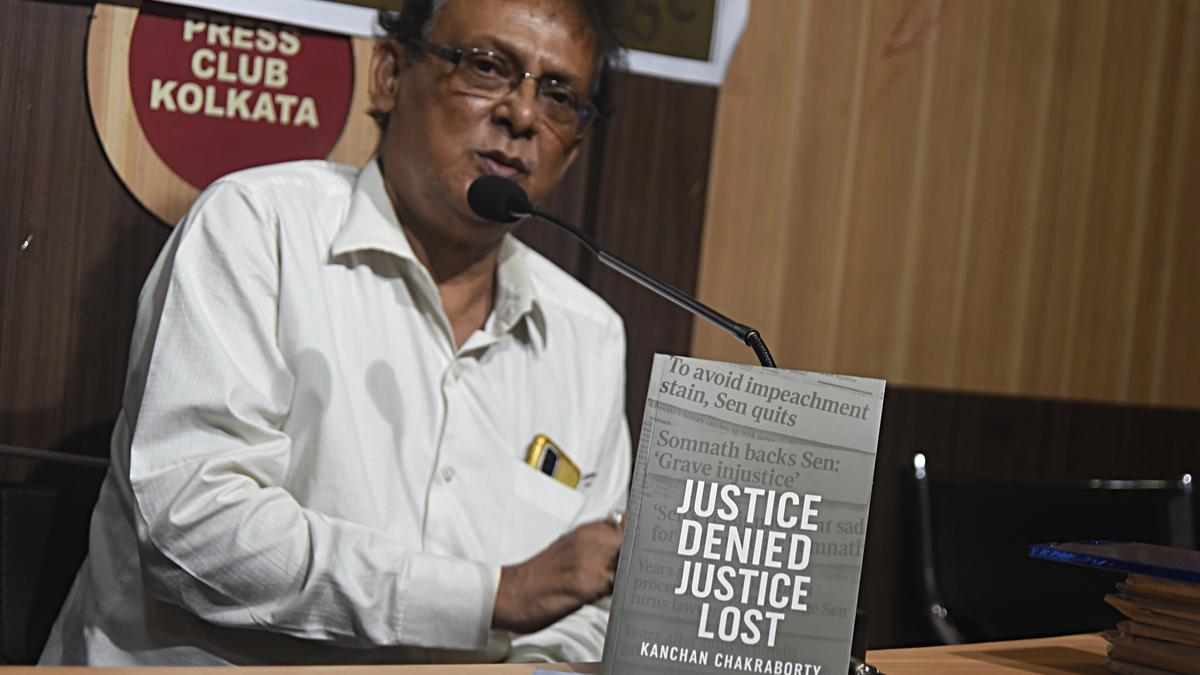
Author Kanchan Chakraborty at the launch of his book ‘Justice Denied Justice Lost’ in Kolkata on August 13.
| Photo Credit: Debasish Bhaduri
At a time when a motion has been admitted in Parliament to remove Allahabad High Court Judge Justice Yashwant Varma over corruption allegations, a recent publication dissects a past controversy surrounding an impeachment motion against a former Calcutta High Court judge over alleged misappropriation of funds.
In a book titled ‘Justice Denied Justice Lost’, released in Kolkata on August 13 this year, journalist-turned-author Kanchan Chakraborty raises questions on the role of the judiciary, particularly of the Supreme Court’s ‘in-house procedure’, in addressing complaints against sitting judges. The book takes a deep dive into the prolonged controversy surrounding corruption charges against former Calcutta High Court Judge Soumitra Sen from 2006, till his resignation in 2011.
“There are some constitutional questions to be raised in erstwhile Justice Sen’s case, especially at a time when another sitting High Court judge is facing the possibility of impeachment. The Calcutta High Court Division Bench in 2007 had pronounced him innocent, but the inquiry committee formed by the Parliament and the Supreme Court’s in-house report found him guilty. How both can co-exist in the eyes of law is the question,” the author, Mr. Chakraborty, told The Hindu.
For context, a single Judge Bench of the Calcutta High Court in 2006 had passed an order stating that erstwhile Justice Sen had misappropriated money worth ₹33.2 lakhs, which was deposited in his bank accounts as a receiver in an earlier civil suit while he was still an advocate. Mr. Sen could not contest the case on account of being a sitting Judge of the High Court at the time, Mr. Chakraborty recalled.
A Division Bench of the Calcutta High Court exonerated Mr. Sen of the charges in 2007. But in the following year, the in-house procedure conducted by the Supreme Court held that Mr. Sen had misappropriated funds and misled the division bench.
For context, the ‘in-house procedure’ was adopted by the Supreme Court in 1999 to examine complaints against sitting judges.
“Charges against a court-appointed receiver who was an advocate then, turned into accusations against a judge of the High Court. In Mr. Sen’s case, questions also arise in the involvement of the erstwhile Chief Justice of India in the removal process and whether that bypasses the Constitution,” Mr. Chakraborty said.
He referred to provisions under Article 124 and Article 217 of the Constitution that empower only the Parliament and the President of India to remove a High Court or a Supreme Court judge from office.
In February 2009, 58 MPs of the Rajya Sabha had moved a motion to impeach erstwhile Justice Sen. Consequently, he appeared before the Parliament and delivered a 90-minute long speech to defend himself, in an instance that Mr. Chakraborty described as historic.
“For the first time a member of the judiciary appeared before legislators to defend himself. While the latter presented their arguments afterwards, Justice Sen was not allowed a rebuttal. The motion to remove him passed in the Rajya Sabha with a thumping majority. He resigned in 2011, instead of appearing before the Lok Sabha,” the author said.
Notably, the original lawsuit against Mr. Sen was dismissed in September 2022.
Prasun Datta, an additional public prosecutor based in Kolkata and ‘a peer and colleague’ of erstwhile Justice Sen said the book raises pertinent questions on the impeachment of sitting judges especially in light of the current impeachment motion against Justice Varma.
The Supreme Court’s in-house inquiry indicted Justice Varma after large amounts of cash was found in the storeroom of his official Delhi residence following a fire on the premises earlier this year.
“There is a set process outlined in the Constitution for the impeachment of sitting judges. In Justice Varma’s case, questions remain over whether he was proven to be the owner of the recovered cash. There is provision for the Supreme Court’s in-house report to be challenged at the apex court, which Justice Varma did already,” Mr. Datta said.
It is worth noting that Justice Varma, represented by senior advocate Kapil Sibal, in his plea to the Supreme Court had argued that the apex court’s in-house procedure is an “extra-constitutional mechanism” and that only the Parliament is empowered by the Constitution to remove a judge.
However, the Supreme Court bench hearing the matter dismissed the plea on August 7 and held that the in-house committee undertakes a preliminary fact finding process and not a mechanism for the removal of a judge.
READ MORE
Published – August 22, 2025 06:48 am IST