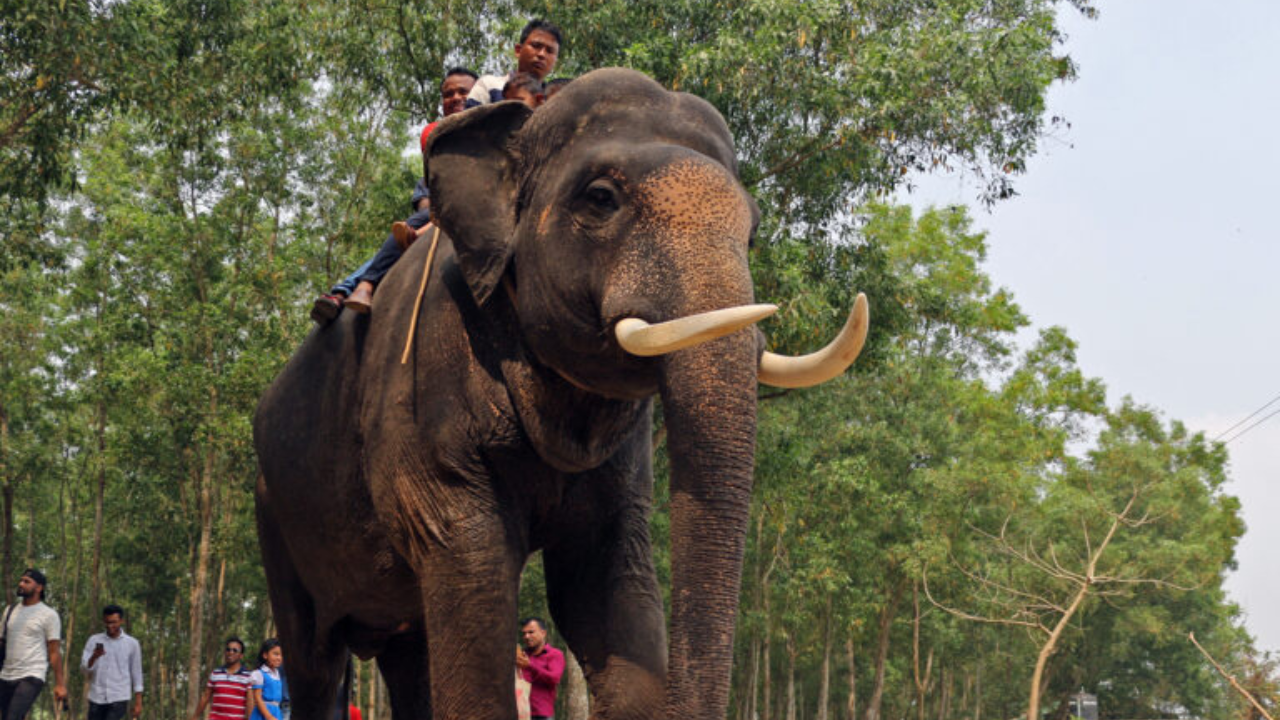
Guwahati: India had developed a detailed body of knowledge on elephants centuries before the emergence of modern wildlife science, with ancient texts documenting their behaviour, health, training and welfare, according to a new commentary published in the Journal of Wildlife Science.
The paper, “Gaja-sastra: India’s forgotten Elephant Science”, by Ramesh Kumar Pandey of the Ministry of Environment, Forest and Climate Change, traces the tradition to at least the 3rd century BC and examines five major texts — Gajasastra, Hastyayurveda, Matangalila, Manasollasa and Hastividyarnava.
Published on August 12 in a special issue marking 30 years of elephant conservation in India, the paper argues that the texts represent a proto-scientific tradition based on generations of observation and practical experience.
The knowledge covered a wide range of subjects, from identifying an elephant’s temperament and treating diseases to training, diet, behaviour and care.
The Gajasastra, for example, used physical features such as body proportions, gait, tusk shape, eye movement and vocalisation to assess elephants.
The Hastyayurveda dealt with elephant health and described diseases and treatments while stressing preventive care through diet, cleanliness, exercise, seasonal adjustments and rest. Illnesses were identified through observable changes such as loss of appetite, abnormal gait, swelling and behavioural changes.
The 12th-century Matangalila contained observations on elephant behaviour and emotional states, linking changes in posture, movement and vocalisation with fear, stress, fatigue, illness and aggression.
It also prohibited the capture of pregnant elephants and females accompanied by calves. Pandey notes that the principle has relevance to modern conservation because elephants have long gestation periods and relatively long intervals between births, making the loss of breeding females particularly damaging to populations.
Assam’s 18th-century elephant manual
The tradition also has a significant Assam connection through Hastividyarnava, an illustrated elephant treatise produced in 1734 under the patronage of the Ahom kings.
Written by Sukumar Barkaith, the work documented regional knowledge of elephant care, diseases and training. Its illustrations covered elephant anatomy, diseases, surgical instruments, harnesses and stable designs.
The text also recognised the importance of local conditions in elephant management, drawing on knowledge of the Brahmaputra landscape, including floodplains, marshy grasslands and shifting river channels. It incorporated local medicinal plants and forest-based practices.
Hastividyarnava also advocated non-violent training and long-term bonding between mahout and elephant, while warning against over-capture and neglect of breeding animals.
Not a romanticised past
The paper, however, does not portray ancient elephant management as uniformly humane.
Pandey points to Manasollasa, which contains advice on compassionate handling, diet, stable management and the mental well-being of elephants, but also describes elephant arena sports and methods of inducing musth for royal entertainment.
Such practices would not meet present-day animal-welfare standards.
The contradiction, the paper notes, reflects the fact that ancient elephant knowledge developed largely around the capture, training and use of elephants for warfare, transport, ceremonies and other royal purposes. Modern conservation has a fundamentally different objective — maintaining viable wild populations and protecting their habitats.
Pandey therefore cautions against directly transferring ancient practices into modern conservation.
Instead, the paper argues that the detailed observations contained in these texts could complement contemporary scientific understanding of elephant behaviour, health, stress and welfare.
The knowledge could be particularly relevant as India faces growing challenges from habitat fragmentation, human-elephant conflict, climate stress and concerns over the welfare of captive elephants.
The study’s broader argument is that India’s historical relationship with elephants extended beyond cultural and religious traditions. It also produced a substantial body of practical knowledge on understanding and managing the animal — a tradition that, the author suggests, deserves greater attention in contemporary conservation discussions.
Also Read: Who will speak Arunachal’s mother tongues when the elders are gone?
Roopak Goswami
Reporter, EastMojo
You just read a story that took days to report. Help us keep our reporters on the ground in the Northeast.
For Rs 83/month – less than a cup of coffee
Ad-free reading, support and keep important stories alive
Become a Member
OR
Support once (any amount)
₹199
Recommended ₹499
₹799
Other Amount
or
Scan to pay via UPI