Major protests have erupted across several countries in recent days, with demonstrations over rising living costs, education funding, housing, public spending and political dissatisfaction continuing to spread in some regions.
From France to Argentina, many of the protests are being driven by issues that have become increasingly common across countries — inflation, declining purchasing power, expensive housing, pressure on public services and anger against incumbent governments.
France and Albania are currently witnessing some of the most intense demonstrations, with repeated protests putting pressure on their respective governments.
In France, large-scale protests have broken out over two major issues: rising living costs ahead of the presidential election and a growing student-teacher movement demanding better school conditions and increased education funding.
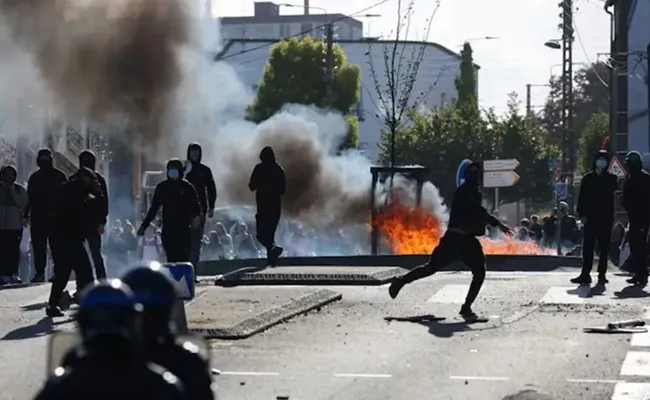
The education protests began last month as relatively small demonstrations by teachers and students in Paris before spreading to other parts of the country. Violent clashes have since been reported, while classes have been disrupted in several areas.
The protests have now expanded to include anger over fuel prices and the broader cost-of-living crisis.
French Interior Minister Laurent Nunez told France 24 that around 5.5 lakh people participated in demonstrations over declining purchasing power, including nearly 1.10 lakh protesters in Paris alone.
The upcoming presidential election will also mark the end of President Emmanuel Macron’s tenure, as French law prevents him from seeking another consecutive term.
In Belgium, rising household expenses and cuts in public spending have also triggered protests.
Students have opposed increases in education and university registration costs, and the demonstrations have gradually expanded into broader protests over the cost of living.
Clashes broke out between protesters and police in Brussels and Liege, prompting security forces to use water cannons.
Belgian Interior Minister Bernard Quintin described the violence as “pure and simple violence, organised and repeated to destabilise our society” and referred to those involved as “rioters.”
Portugal has witnessed similar demonstrations, with thousands of people marching through Lisbon over low wages, rising living costs and the growing difficulty of finding affordable housing.
Property prices in Lisbon and several other cities have more than doubled since 2017, while rents for new leases have also risen sharply.
The situation has placed younger workers and low-income households under growing pressure, with many arguing that the problem is no longer limited to buying a house, as even renting has become increasingly unaffordable.
Unlike some of the protests in France, demonstrations in Portugal have largely remained focused on wages, housing and household affordability.
Italy has also seen protests over similar concerns.
Demonstrators have complained about stagnant wages, inflation and declining purchasing power. Clashes were reported in Milan, although the scale of the protests has so far remained smaller than in France.
In Albania, university students have taken to the streets over poor conditions at educational institutions, high education costs, limited financial assistance and concerns about employment opportunities after graduation.
The protests turned violent outside the Education Ministry in Tirana on October 13, when some demonstrators threw bricks and concrete blocks at the building, prompting police action.
The demands later widened to include concerns over inequality, unemployment and the growing gap between rich and poor.
The protests have increased pressure on the government, particularly from young people worried about whether the country’s economy can provide adequate employment opportunities after graduation.
In India, opposition parties and a newly formed satirical political group called the Cockroach Janta Party (CJP) have organised protests over alleged irregularities in the revision of electoral rolls under the Special Intensive Revision (SIR) exercise.
The protesters have questioned the transparency of the process, while the Election Commission of India has denied allegations of wrongdoing.
The CJP had earlier participated in protests over the NEET examination paper leak controversy.
In the United States, rallies organised by the “No Kings” network, which opposes President Donald Trump, were held in cities and communities across the country.
The demonstrations sought to mobilise voters ahead of the midterm elections and build on nearly two years of protests by groups critical of Trump’s presidency.
Organisers described the events as non-partisan, although they were largely driven by opposition to Trump and his policies.
Argentina has also witnessed protests over education funding.
Earlier this week, demonstrators clashed with police in Buenos Aires during protests against President Javier Milei’s spending cuts affecting higher education.
Thousands of university students, staff members, trade unionists and opposition activists joined demonstrations outside parliament.
While the main protest remained peaceful, a smaller group of mostly hooded demonstrators broke away from the crowd and threw stones and other objects at police.
It was the fifth major protest over education funding since Milei took office in late 2023.
The demonstrations come amid legal disputes over a 2025 law requiring the government to increase funding for public universities.
Turkey has also witnessed demonstrations linked to economic hardship.
Retirees and labour groups protested last month against severe cost-of-living pressures and what they described as inadequate pension payments amid persistent inflation.
Pensioners gathered outside the Constitutional Court in Ankara, demanding what they called their constitutional right to live with dignity and meet basic household expenses.
During one demonstration, Ali Sekeroglu, a 60-year-old retired police officer, reportedly shot himself with his service weapon after speaking about his financial difficulties and the unemployment faced by his two sons.
The protests across different countries may differ in scale and political context, but many are being driven by similar concerns – economic insecurity, rising household expenses, pressure on public services and frustration over how governments are responding to those challenges.