Guwahati: A new study has raised fresh concerns over disease risks to Assam’s one-horned rhinoceros population after finding a high prevalence of gastrointestinal parasites in cattle grazing around Pobitora Wildlife Sanctuary.
Researchers from Assam found that nearly 73% of cattle samples collected from villages surrounding the sanctuary tested positive for parasites, many of which have also been reported in wild rhinos and other herbivores.
The study, published in Current Science, warns that increasing interaction between livestock and wildlife inside protected areas could facilitate the spread of infections to vulnerable species such as the greater one-horned rhinoceros. The study was conducted by Violina Hazarika, Debanjan Chamlagain, Himangshu Kalita, Saidul Islam and Narayan Sharma.
Cotton University researchers Violina Hazarika and Narayan Sharma said the findings highlight the need for closer monitoring of disease transmission risks at the wildlife-livestock interface.
Pobitora Wildlife Sanctuary, located about 50 km from Guwahati, is known for having one of the world’s highest densities of one-horned rhinos, with 107 rhinos recorded in 2022.
One major concern in the sanctuary is livestock grazing in many buffer zones of the protected area due to the presence of waterholes, rivers and wallowing ponds, which may lead to the transmission of diseases to rhinos and other wild animals.
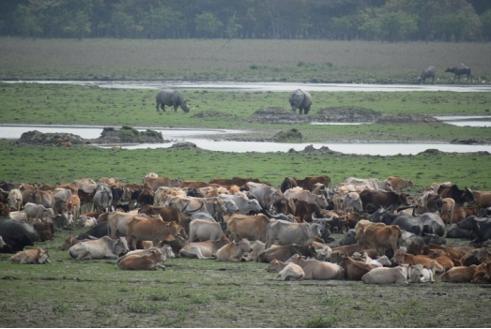
The researchers documented close co-grazing between cattle and rhinos in the sanctuary’s buffer zones, where water bodies and grazing grounds are shared.
Of 122 cattle faecal samples examined, 89 were infected with various gastrointestinal parasites, including eight helminth species and one coccidian parasite. The most dominant parasite detected was the Amphistome species, found in over 54% of samples, followed by Eimeria and Fasciola gigantica.
Researchers noted that several of these parasites have previously been reported in rhinos from Pobitora Wildlife Sanctuary, Kaziranga National Park and other protected areas, indicating possible cross-species transmission at the wildlife-livestock interface.
The study highlighted that cattle from fringe villages routinely enter the sanctuary for grazing, increasing the risk of contamination of grazing grounds and water sources used by wildlife.
“It is important to closely examine and monitor threatened wildlife populations, particularly in areas where they frequently come into contact with domestic animals, as such interactions may facilitate disease transmission between domestic and wild animals,” said Narayan Sharma of Cotton University.
The authors cautioned that heavy parasitic infections can weaken animals, reduce immunity, affect reproduction, and in severe cases even lead to death.
“Disease transmission between wildlife and livestock can undermine conservation efforts, either by challenging the viability of threatened species or by eroding public tolerance as it can become a source of infection for domestic animals too,” said Violina Hazarika of Cotton University.
Dear Reader,
Every day, our team at EastMojo travels through rain, rough roads, and remote hills to bring you stories that matter – stories from your town, your people, your Northeast.
We do this because we believe in truthful, independent journalism. No big corporate backing, no government pressure – just honest reporting by local journalists who live and breathe the same air you do.
But to keep doing this work, we need you. Your small contribution helps us pay our reporters fairly, reach places others ignore, and keep asking the tough questions.
If you believe the Northeast deserves its own fearless voice, stand with us.
Support independent journalism. Be a Member.
Thank you,
Karma Paljor
Editor-in-Chief, eastmojo.com
The paper also stressed that climate conditions such as flooding in Assam may further amplify the spread of parasites by dispersing contaminated faecal matter across forests and wetlands.
Calling for urgent long-term monitoring, the researchers said Assam currently lacks adequate baseline disease data on the greater one-horned rhinoceros, making it crucial to intensify surveillance of wildlife diseases in protected areas.
Also Read | Manipur: Protest continue demanding immediate rescue of six missing men
Roopak Goswami
Reporter, EastMojo
You just read a story that took days to report. Help us keep our reporters on the ground in the Northeast.
For Rs 83/month – less than a cup of coffee
Ad-free reading, support and keep important stories alive
Become a Member
OR
Support once (any amount)
or
Scan to pay via UPI