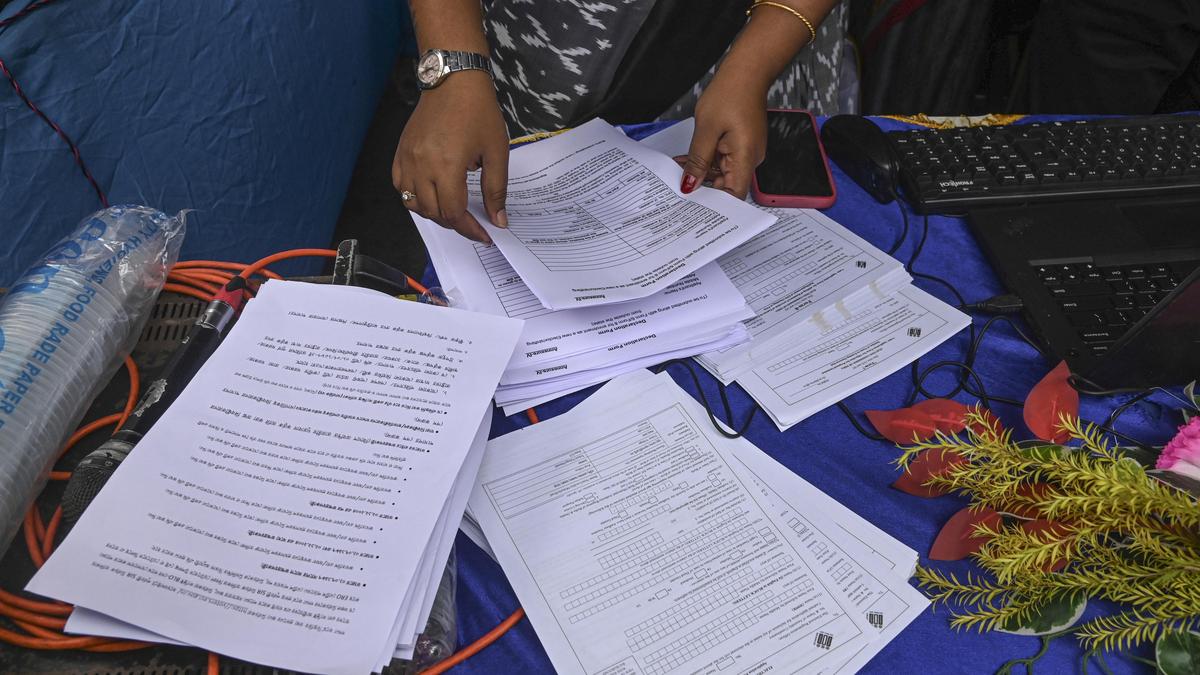
Election Commission officials assist voters at a help desk camp for the Special Intensive Revision (SIR) of Electoral Rolls-2026, in Sonagachi, Kolkata, on December 9, 2025.
| Photo Credit: PTI
Assembly constituencies in West Bengal with a higher percentage of Muslim population have a lower share of unmapped voters in the first phase of Special Intensive Revision (SIR) in West Bengal, a study by Kolkata-based SABAR Institute has found.
The Election Commission of India on Tuesday (December 16, 2025) published draft electoral rolls of West Bengal following the SIR, with names of 58 lakh electors deleted from the existing voter lists in the State.
The analysis found that 20 Assembly constituencies with the highest share of unmapped population have an average Muslim population of 13.75%, which is much lower than the State’s average Muslim population of 27% in the last Census.
West Bengal SIR’s latest status report shows a clear pattern: the share of unmapped voters actually declines as the Muslim population increases. This directly undermines the narrative of “Muslim infiltrators”
Instead, the highest concentration of unmapped voters is found in the… pic.twitter.com/Jqycgs1ioV
— SABAR Institute (@SabarInstitute_) December 15, 2025
The Assembly constituencies with a higher number of unmapped population are mostly located in Kolkata and adjoining districts such as North 24 Parganas and Howrah. In Kolkata, the Assembly constituencies are Kolkata Port, Bhabanipur, Rashbehari, and Kolkata Port. In North 24 Parganas, the constituencies are Bongaon Uttar, Ashoknagar, Jagatdal, Rajarhat Gopalpur, Bangaon Uttar Madhyamgram, Dum Dum Uttar and Panihati.
The researchers of SABAR Institute pointed out that, in contrast, the top 20 Assembly constituencies with the lowest share of unmapped population show a very different picture and have a significant number of Muslim voters.
These Assembly constituencies include Domkal (which has one of the highest Muslim populations in the State at about 85%), Suti, Hariharpara and Rejinagar – all four located in Murshidabad, a district where the Muslim population is about 70%; Ratua and Sujapur in Malda with a high Muslim population; Magrahat Purba, Magrahat Paschim, Patharpratima and Mandirbazar located in South 24 Parganas, and Moyna and Kanthi Uttar in Purba Medinipur district.
The researchers said that on an average, these constituencies have a Muslim population of around 40%, far above the State’s average of 27%, which suggests that constituencies with higher Muslim population have lower share of unmapped voters.
Ashin Chakraborty, researcher at the institute, said the data which has emerged from the first phase of the SIR challenge is a dominant political narrative. “For years, a section of big and influential leaders has claimed that Muslim infiltrators have entered West Bengal and are voting illegally. But this data-based evidence clearly shows that the reality is different,” he said.
Mr. Chakraborty suggested that Muslims are less likely to be affected by voter mapping issues because most have the required documents. “If the Special Intensive Revision leads to large-scale exclusion, it will not be Muslims who are hit the hardest. The data show that Matuas are likely to face the maximum exclusion, as they are disproportionately represented among unmapped voters,” he added.
The Matuas are a social group largely comprising Namashudras who have migrated from Bangladesh over the past several decades. The community of Hindu refugees, largely residing in North 24 Parganas and Nadia district, has been apprehensive of the SIR since they lack legacy data. Fears over the SIR have, over past few weeks, prompted the Matuas to apply for citizenship under the Citizenship (Amendment) Act 2019.
Published – December 17, 2025 09:31 pm IST