In most parts of rural India, a passbook is usually associated with a bank account and savings. But in some villages of Assam, there is a different kind of passbook. The entries recorded in it have nothing to do with money deposited or withdrawn. Instead, they document yarn purchased from a local yarn bank.
For women weavers, these passbooks are quietly changing the way they work. They help track purchases, offer small discounts on yarn, and simplify transactions. For Grameen Sahara, they provide valuable insights into buying patterns and demand.
A Rural Women Entrepreneur shows her yarn passbook.
For the weavers themselves, the savings may seem modest, but over time they contribute to making weaving a little more profitable and a lot more convenient.
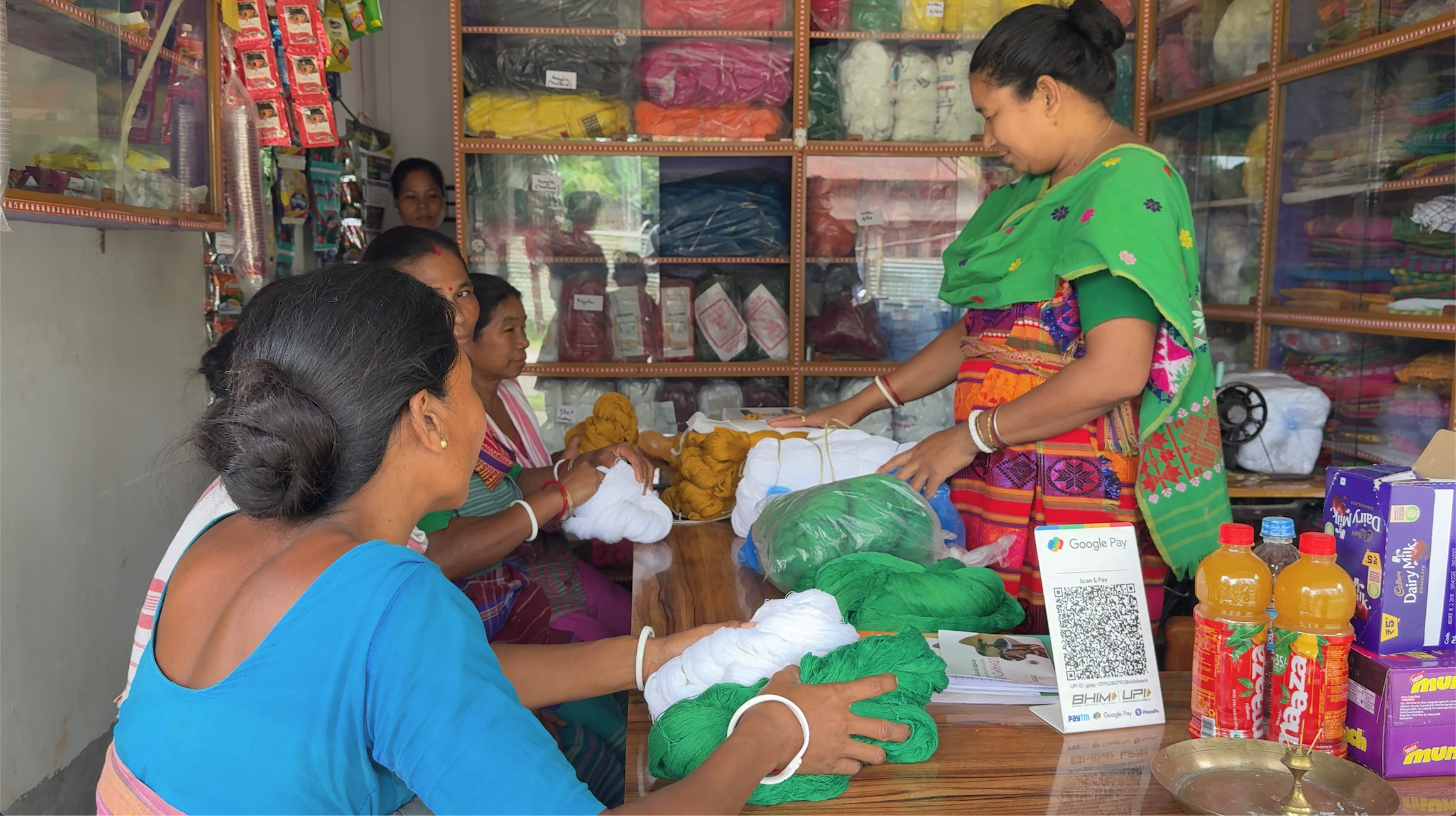
On a bright morning in Genderapara in Goalpara district, following a night of heavy rain, women from nearby villages gather outside a yarn bank run by Gulabi Rabha. Most belong to the Rabha community. They chat, laugh and discuss colours and materials as they decide which yarns to buy for their next weaving projects.
PREMIUM STORIES FROM EASTMOJO
2000+ readers have backed us to keep journalism free. You can too.
SUPPORT US
Just a few months ago, such a scene would have been impossible.
Until four months ago, there was no yarn bank in Genderapara, or anywhere else in Goalpara district.
Like thousands of rural weavers across Assam, women here had little choice but to travel to nearby towns and urban centres to purchase yarn. These trips often involved travelling in groups, spending significant amounts on transportation and losing valuable working hours. The costs extended beyond the price of yarn itself.
If a bundle turned out to be defective or unsuitable, the weavers faced an even bigger challenge. They could either spend more money travelling back to the seller and hope for a replacement or refund, or simply absorb the loss and move on.
Recognising this gap in the handloom value chain, Grameen Sahara decided to act.
A not-for-profit organisation dedicated to promoting sustainable livelihoods, Grameen Sahara partnered with Udyamini to establish community-based yarn banks in strategic locations across two districts in rural Assam, replicating a model first brought in by the National Handloom Development Corporation (NHDC).
Udyamini is a four-year collaborative initiative (2023–2027) that seeks to build a thriving ecosystem for rural women entrepreneurs across Assam and West Bengal. Through training, mentorship, financial support and market linkages, it aims to strengthen women-led enterprises and create digitally empowered communities.
For Nilav, Project Lead, Entrepreneurship & Handloom Value Chain at Grameen Sahara, the need for yarn banks was clear.
“While weavers are spread across villages, the same cannot be said about the yarn they use for weaving,” he explains. “Most weavers had to travel to urban areas to buy yarn, which meant spending money not only on the yarn itself but also on transportation. We wanted to create a system where high-quality yarn could be accessed locally.”
Under the Udyamini programme, Grameen Sahara has already established three yarn banks and plans to launch three more in the next phase.
“The idea was simple,” says Nilav. “Whether a weaver is associated with the Udyamini programme or not, she should be able to access quality yarn whenever she needs it.”
Turning that idea into reality required careful planning. Locations were selected based on concentrations of weavers and their accessibility to surrounding villages. Another important lesson emerged during the planning stage: a yarn bank needed enough transactions to remain financially sustainable.
“We quickly realised that simply stocking yarn would not be enough,” Nilav recalls. “A viable business model was equally important.”
The response from weavers has exceeded expectations.
“Women have repeatedly told us how helpful these yarn banks have been and have asked us to establish more,” he says.
Grameen Sahara also learned that weavers needed more than just yarn. Accessories used in the weaving process were equally important.
As a result, the yarn banks now stock a range of materials sourced from suppliers in Guwahati. While premium-quality yarn remains available, more affordable alternatives have also been introduced to ensure that the banks cater to a wider range of customers.
For Gulabi Rabha, who runs the Genderapara yarn bank, the impact is visible every day.
“We started this because there were so many weavers in the area but no local place to buy yarn,” she says. “Now women no longer need to travel to towns and spend extra time and money. They can get what they need close to home.”
Gulabi Rabha at her newly-opened yarn bank. She says local women prefer buying from her because they know her well and have immense trust in her.
The convenience has transformed the purchasing experience.
“The cost of yarn is only slightly lower than what people would pay in towns,” Gulabi explains. “But the real savings come from avoiding travel expenses. A trip to Agia may not seem far, but it can easily cost around ₹100 for a round journey. Also, it would be a round trip of about 3-5 hours depending on the weather, the traffic or even the time of the day. Here, many women can simply walk to the shop.”
Trust has become another important benefit.
“When people buy from someone they know, they feel more confident,” she says. “If there is any issue with the yarn, they can come back and talk to me directly. Earlier, returning defective material was often too expensive and inconvenient.”
Cotton yarn has emerged as one of the most popular products because of its versatility and widespread use among local weavers.
The yarn bank has also created a new source of livelihood for Gulabi herself. Supported by Udyamini, she received training on managing accounts, handling inventory and running a small enterprise.
“Right now, I earn around ₹6,000-₹7,000 a month,” she says. “It may not seem like a lot, but it is meaningful income. With continued support and more customers, I believe I can increase that to around ₹15,000 a month within a year.”
Stories like Gulabi’s highlight the broader impact of the yarn bank model. What began as a practical solution to a supply-chain challenge has evolved into something much bigger: a community-driven system that saves time, reduces costs, builds trust and creates new opportunities for rural women.
In villages where weaving has long been an important source of income and cultural identity, the arrival of a yarn bank may seem like a small change. Yet for hundreds of women, it represents something far more significant — easier access to resources, stronger local enterprises and a future where livelihoods are built closer to home.
Sometimes, meaningful transformation does not begin with a large factory or a major infrastructure project. Sometimes, it begins with a simple passbook, a bundle of yarn and a shop at the heart of a village.