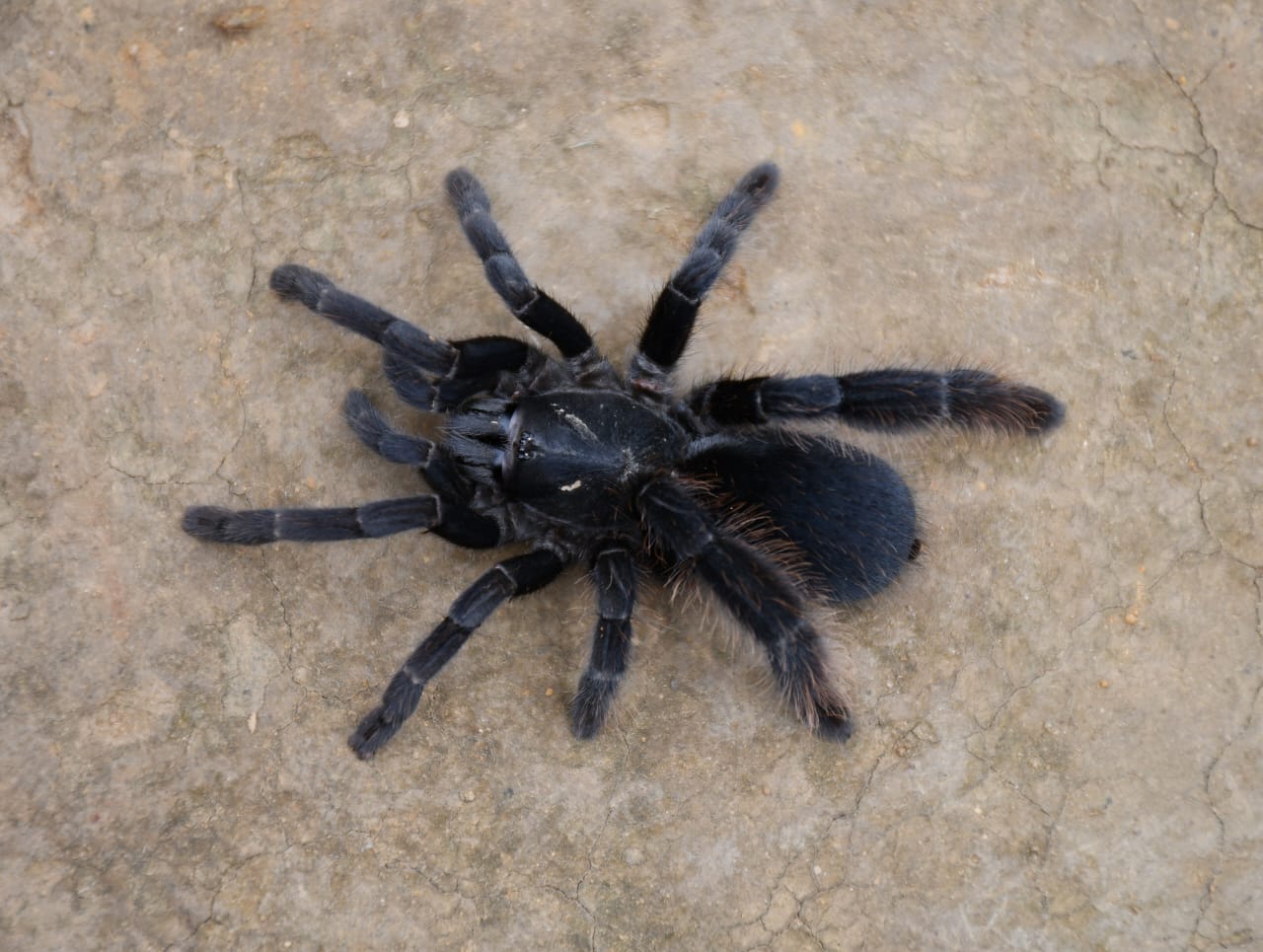
It may send a shiver down the spine of most people, but for the Rabha community in Assam’s Kamrup (Rural) district, the Indian Black Earth Tiger Spider is a seasonal delicacy.
A new study has documented, for the first time, the traditional consumption of the large, burrowing tarantula Lyrognathus crotalus by the Rabha community, adding an unusual chapter to Northeast India’s rich and largely undocumented food traditions.
The study, published in Proceedings of the Zoological Society on August 18, was authored by Jyotiprakash Boro, Kuldeep Bora, Chandramita Boro and Samir Terdalkar.
Boro is from the Department of Zoology, Fergusson College (Autonomous), Maharashtra; Bora is associated with Assam University’s Diphu campus; Chandramita Boro is from the Department of Zoology, Gurucharan University, Silchar; and Terdalkar is associated with DES Pune University.
Locally called “Bhaluk Makara”, the spider gets its name from its bear-like appearance—its relatively large body, black colour and dense hairs. Researchers recorded the practice in and around Mouman village in Kamrup (Rural), where the spiders are collected from burrows in forest-fringe habitats, particularly areas associated with sal forests.
The study is based on fieldwork carried out between April and June 2025. The researchers spoke to 34 members of the Rabha community, including elderly villagers and regular spider collectors, to document local knowledge of the species, harvesting practices and preparation methods.
From forest burrow to frying pan
The spiders are collected mainly during April and May, when villagers say they are seasonally abundant. Collection typically takes place for three to four days a month during the peak season, while outside this period it is occasional. A collection visit can yield roughly 20 to 30 spiders, depending on availability.
Getting the spider out of its burrow is part of the traditional practice. Collectors either carefully dig it out or insert a wooden stick into the burrow to encourage the spider to emerge.
The harvested spiders are washed and soaked repeatedly in hot water for several minutes before cooking.
The body hairs are not deliberately removed. The spiders are then fried in mustard oil for around seven to 10 minutes, with garlic powder and salt added according to taste. The finished spider is eaten whole and is traditionally accompanied by locally prepared rice beer.
According to the researchers, the preparation method has been passed down through generations and the spider is regarded locally as a nutritious seasonal food.
But the authors are careful not to overstate its nutritional value. No laboratory-based nutritional analysis of the Indian Black Earth Tiger Spider has yet been carried out, meaning claims about its protein or micronutrient content remain based on local perception rather than scientific nutritional testing.
A rare record of spider-eating in Northeast India
Eating spiders is not unknown globally. Species from several spider families are consumed in parts of Asia, Africa, Oceania and the Americas, usually after roasting, frying, drying or other forms of processing.
But scientific documentation of edible spiders in Northeast India is scarce. The authors found only a handful of earlier records involving species such as Nephila pilipes and Trichonephila clavata. Traditional consumption of an edible theraphosid spider, however, had remained poorly documented.
That makes the Rabha practice significant—not simply as an unusual food habit, but as a piece of indigenous knowledge tied closely to the forest landscape.
The researchers identified the spider as Lyrognathus crotalus by comparing its morphological features with established taxonomic descriptions. The species is endemic to Northeast India and is known from Assam. It constructs simple, tubular, funnel-like burrows using surrounding organic debris and vegetation.
Tradition meets conservation questions
The researchers say the Rabha community generally considers the local spider population stable because the species continues to be found in suitable habitats. But they caution that the study did not independently assess the spider’s population size or abundance.
That is important because tarantulas and other burrowing spiders can have slow growth, delayed maturity and restricted distributions. Increased harvesting could therefore have conservation implications, particularly if the practice expands beyond its traditional scale.
The study also found no reported medicinal or therapeutic use of the spider among the respondents.
For now, Boro, Bora, Boro and Terdalkar say the finding opens the door to further research into the taxonomy, nutrition, ecology, population dynamics and conservation status of the species, as well as its relationship with the local community.
“Bhaluk Makara” may look frightening to an outsider. In the Rabha villages of Kamrup, however, it is something quite different—a seasonal food gathered from the forest, prepared in a familiar way and passed down through generations.
The researchers’ work puts that little-known tradition on the scientific record for the first time.
Also Read: Why Assam’s riverine vulnerability can no longer be ignored
Roopak Goswami
Reporter, EastMojo
You just read a story that took days to report. Help us keep our reporters on the ground in the Northeast.
For Rs 83/month – less than a cup of coffee
Ad-free reading, support and keep important stories alive
Become a Member
OR
Support once (any amount)
₹199
Recommended ₹499
₹799
Other Amount
or
Scan to pay via UPI