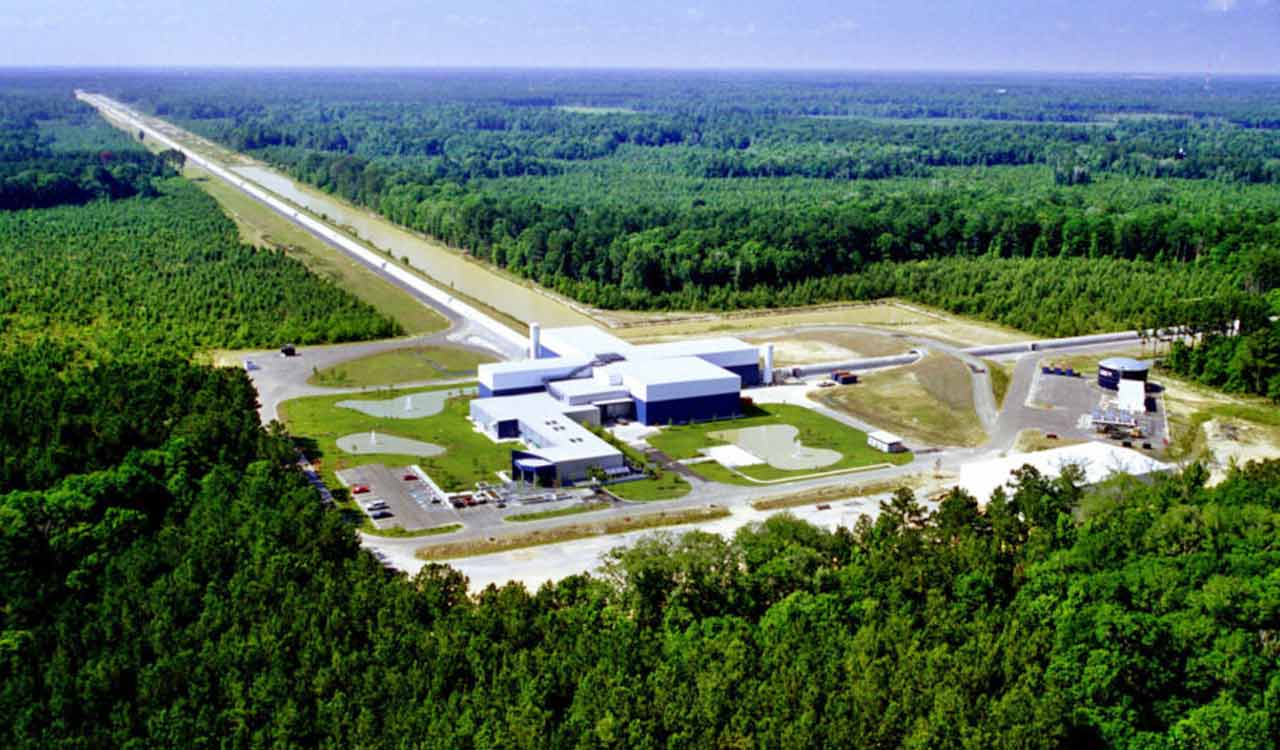
LIGO is designed to work in sync with two similar facilities in the United States to detect the ripples in spacetime produced by the movement of large celestial objects like stars and planets
Published Date – 14 March 2026, 12:40 AM
Courtsy: Ligo Us
When the Union Cabinet gave the nod nearly three years ago for building the Gravitational Wave Observatory—billed as one of India’s biggest scientific projects—, there was excitement among the scientific community. The LIGO (Laser Interferometer Gravitational-Wave Observatory) is no ordinary facility. It has the potential to change the country’s standing in the scientific world. However, a familiar set of factors appears to be delaying the prestigious project. Media reports, quoting the records accessed under the RTI Act, say that the Rs 1,600-crore work tender floated in April last year is yet to be awarded. It is unfortunate that the project continues to be in limbo despite the government’s announcement earlier that the works would commence in the second half of 2025. The tender has undergone multiple date extensions since then. The Centre’s financial approval of Rs 2,300 crore for LIGO-India was given in April 2023, two years before the Engineering, Procurement and Construction (EPC) tender was issued. LIGO is designed to work in sync with two similar facilities in the United States to detect the ripples in spacetime produced by the movement of large celestial objects like stars and planets. These ripples were first postulated nearly 100 years ago in Albert Einstein’s General Theory of Relativity, which encapsulates our current understanding of how gravitation works. The observatory’s ability to detect gravitational waves gives scientists a new vision to track cosmic events that light or other electromagnetic waves are not able to capture.
LIGO observatories have two 4-km-long arms built at 90 degrees to each other. These are vacuum chambers with reflective mirrors at their ends. Beams of lasers are reflected off these mirrors and are used to detect gravitational waves. The first such wave was detected in 2015, which was caused by the merger of two black holes 1.3 billion years ago. The measurement of these waves requires unprecedented accuracy as their effects are extremely small. The ultra-modern observatory will be located in Maharashtra’s Hingoli district, about 450 km from Mumbai, and is supposed to begin scientific runs from 2030 as per the original plan. India has never built a cutting-edge scientific facility on this scale on its soil, and LIGO can have huge spin-off benefits for the science and technology sector. The collaboration is an endorsement of the country’s scientific capabilities and possibilities. Besides the United States, such gravitational wave observatories are currently operational in Europe and Japan. India has been an active collaborator in a number of international science projects, including the Large Hadron Collider experiments, and ITER (International Thermonuclear Experimental Reactor), which is designed to enable controlled nuclear fusion reactions. At a time when India is becoming an active participant in a host of international collaborative projects, such bureaucratic delays holding up an important scientific initiative do not augur well for the country’s image.