KANPUR The orchard near the Lale Baba temple in Kanpur’s Rathi village was known for two things: the shade of its trees and crisp mobile phone reception. To most, that strong signal was merely a minor rural convenience. But to a syndicate of school dropouts, those invisible telecom waves were the lifeblood of a sprawling, multi-state criminal enterprise.
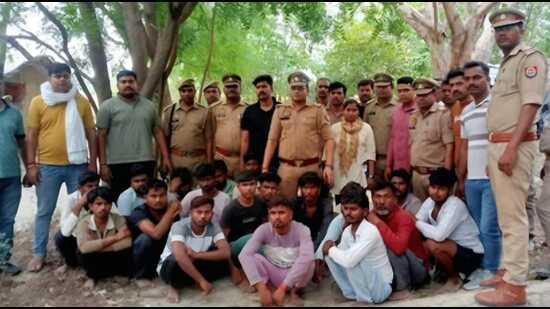
Over 200 personnel, guided by drones, encircled the orchard before anyone could move. (Sourced)
But on Tuesday evening, Kanpur police used this ‘better connectivity’ against them. Over 200 personnel, guided by drones, encircled the orchard before anyone could move. Inside, teenagers and youths aged 15 to 22, who had worked in cotton mills in Tamil Nadu’s Erode, were sitting in tents, calling strangers across five states and posing as government/police officials. They had allegedly defrauded more than 4,000 people across the country. Twenty were arrested on the spot while 17 others are still being traced. The police called it a “Mini Jamtara”.
Like many villages in the belt, Rathi has seen steady outward migration over the past decade, with young men leaving for textile work in Tamil Nadu, Maharashtra and Gujarat. For years, that was the village’s story. Over the last seven or eight years, however, a parallel economy took root. Those who returned from the mills, particularly from the Erode industrial area in TN, brought something other than savings. They had come into contact with cyber fraudsters while working there, learnt the trade and, on returning, began passing it on. Almost every unemployed youngster in the village was allegedly trained by someone who had made that journey.
By Wednesday, the village wore a different look. At the entrance, a few men discussed the raid in hushed tones. Most young men fell silent when approached. The lanes inside were quiet. In the fields, farmers were cutting wheat but claimed to know nothing. Two villagers, speaking on condition of anonymity, were less guarded. They said the youngsters had been at it for a long time, making calls from fields and orchards from morning to evening. Some had since quit and moved on, started businesses, settled elsewhere or put the money to other use.
That money was visible in the village in other ways. Senior members of the network, the ones who trained others, had built three-storey homes. Some had installed solar power plants costing ₹2 to 3 lakh. The younger recruits spent more conspicuously on expensive phones, branded clothes and meals at hotels and dhabas. Much of what they earned, villagers said, went on fashion and other indulgences. What they passed on to those below them was the craft itself, taught in orchards in small groups, out of sight.
Officers said some members of the network are over 50, suggesting the operation spans more than one generation of recruits. Most of the accused are educated only up to Class 10 or 12, and many are dropouts. But they were fluent in banking applications, e-payment platforms and the mechanics of opening accounts online, skills picked up not in any classroom but from one another. What struck investigators, officers said, was how effectively these young men could persuade senior officials, traders and professionals to transfer money within minutes of a call.
Despite being known across the district as a cyber fraud hub for nearly a decade, Rathi had seen little meaningful police action until Tuesday. The raid, locals said, has left the village rattled in a way previous interventions never did.
The operation itself was designed to leave no exit. The cyber crime branch and the special operations group moved in on Tuesday evening, deploying over 200 personnel across multiple positions. Drone footage mapped the orchard and tracked movement in real time. Technical surveillance had already established who was present and where. Ten of the accused had been assigned to make calls from separate corners of the orchard while others kept watch. When the cordon closed, there was nowhere to go. The suspects surrendered. All 20 were sent to jail.
Those arrested include Hari Kumar Chauhan, Neeraj Kumar Chauhan, Pradeep Singh Shankhwar, Narendra Shankhwar, Neeraj Kumar Shankhwar, Pranshu, Jagrup Singh Chauhan, Rohit Kumar Chauhan, Pushpendra Singh Chauhan, Ajit Kumar Chauhan, Kuldeep Naresh alias Shivnath Chauhan,
Gyan Prakash Yadav, Romi Shankhwar, Neeraj Kumar Shankhwar, Shailendra Kumar Shankhhwar, Dheeraj Kumar Shankhwar, Rahul Kumar Shankhwar, Shivkant Shankhwar and Paras Kumar – nine of them had worked in Erode mills.
Seventeen accused remain at large: Paras Kumar, Vijay Singh Chauhan, Bhola Chauhan, Madhur, Ram Vilas, Deepu alias Daroga, Tiger alias Jitendra, Sohit Sonkar, Malkhan, Khushwant, Pradhuman, Sohan, Pankaj Shankhwar, Anirudh Singh, Ashok Shankhwar, Sarvesh, Deepak Chauhan, Dilip Chauhan. Five teams are pursuing them.
Police commissioner Raghubir Lal said the village had functioned as a cyber fraud hub for close to a decade. “It functioned like a cottage industry. Young men trained each other and operated in groups from morning till late evening,” he said.
The gang ran two primary methods of fraud. In the first, callers posed as government officials offering enrolment under PM Awas, pension programmes or Ayushman Bharat, and asked victims to deposit registration or processing fees ranging from ₹1,100 to ₹11,000. In the second, callers impersonated police or ATS officers, telling recipients they had been found accessing obscene content online and that an arrest team was on its way. Victims paid between ₹11,000 and ₹1.5 lakh to avoid action.
To avoid detection, the accused used mule SIM cards and layered bank accounts, often opened using forged documents of relatives. Police are also examining the possible role of bank employees. Devices seized during the raid are being analysed to establish the full scale of the operation and its interstate links.
The village first appeared on the police radar through the national cybercrime reporting portal, which had received 25 complaints linked to the Reuna area since January this year. The cases were transferred to Kanpur Police, who found 289 suspicious mobile numbers connected to the village.
“This is the first time such a large number of cyber offenders have been arrested together,” said deputy commissioner of police (south) Deependra Nath Chaudhary. “When we pursued the complaints, we found the entire village was involved, on the lines of Jamtara.”
Complaints have surfaced from Uttar Pradesh, Madhya Pradesh, Bihar, Chhattisgarh and Haryana. Among the victims is a constable posted with the Unnao reserve police lines, who allegedly lost ₹2 lakh. One of the accused told investigators he had spent nearly ₹20 lakh on legal fees in connection with earlier cases, an indication of how long some in the network had been operating.
Of the 34 individuals identified as part of the wider network, 12 have prior FIRs registered in other states. Officers said similar inputs have been received from nearby villages, including Laxmanpur, Makhauli and Samaj Nagar, and further action is under way.