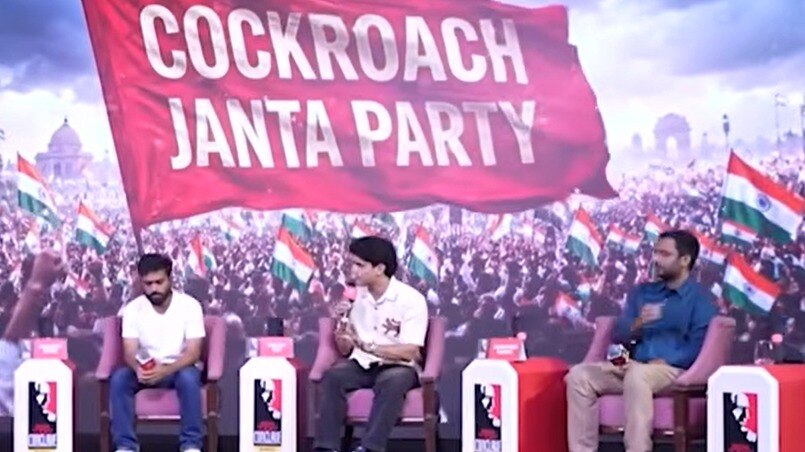
Cockroach Janta Party (CJP) leaders Abhijeet Dipke, Ashutosh Ranka and Saurav Das questioned curbs on their proposed October 10 protest at Delhi’s Jantar Mantar, asking why similar demonstrations were allowed in Mumbai and Bengaluru but not in the national capital.
Speaking at the India Today Conclave Mumbai 2026, Dipke asked: “If we can protest in Mumbai, if we can protest in Bangalore, then why can’t we do it in Delhi? Is Delhi running under some other constitution?”
Delhi Police denied permission for the protest demanding Chief Election Commissioner Gyanesh Kumar’s resignation, citing procedural requirements, previous law-and-order concerns and the potential disruption to security and traffic.
Police planned to deploy more than 20,000 security personnel across New Delhi, central Delhi and the capital’s borders, with multiple layers of barricading, surveillance cameras and 12 detention centres.
Dipke alleged that forces had been called from Jammu and Kashmir and Naxal-affected areas to protect Kumar. “He is a bureaucrat. He is not a minister. He is not the Prime Minister. He is not the President,” he said.
Invoking Article 19, Dipke pointed out that Jantar Mantar was a designated protest site. He criticised restrictions on roads, metro services and railways, saying: “Close the country. Close the election. Close the country.”
‘WE HAVE TO PROTEST TO PROTEST’
Ranka said the dispute over reaching Jantar Mantar had pushed the original protest demands into the background.
“Today the situation in this country has become such that we have to protest to protest at a designated protest site,” he said.
Citizens, he argued, should be able to express disagreement with the government through peaceful, democratic means. Instead, he said, the authorities’ focus had shifted to preventing protesters from reaching the venue.
“Our fight, our questions, our demands are related to the Election Commission,” he said.
Ranka alleged that the Commission was working for the BJP. He claimed that the party’s defence of Kumar and the detention and arrest of protesters in BJP-ruled states reinforced the organisers’ allegation that the two were working together.
The protest comes amid demands for Kumar’s resignation and allegations of electoral irregularities. An earlier CJP demonstration in Delhi in July had turned chaotic, with police using tear gas and lathicharges.
‘INFORMED POLICE, DID NOT SEEK PERMISSION’
Das said he had approached Delhi Police to formally inform them about the demonstration, rather than seek permission.
“I want to clarify that I did not go to ask for permission. I went to give information,” he said.
He said he submitted a letter on October 7 asserting the constitutional right to protest. Police acknowledged it with a stamp, he said, but did not tell him whether the demonstration would be allowed.
Das also alleged that no senior officer met him, unlike during preparations for the earlier protest, when he had held several rounds of discussions with senior officers.
He said the organisers had offered full cooperation and expected police to reciprocate. He described the lack of communication as a tactic to prevent democratic dissent and discourage young people from joining the protest.
Questioning the requirement to seek permission from the state to protest against it, Das invoked Mahatma Gandhi’s Dandi March. He asked whether Gandhi would have approached the British authorities for permission before beginning the march.
SECURITY, TRANSPORT RESTRICTIONS
The preparations extend beyond Jantar Mantar. Trains to two major Delhi railway stations have been cancelled, while 57 metro stations were scheduled to close from 9 pm on October 9. Restrictions on internet services and app-based cabs have also been reported.
More than 6,500 security personnel are set to be deployed within a roughly 1.5-km sensitive zone covering Jantar Mantar, Janpath, the Election Commission and Delhi Police headquarters. At least seven layers of barricading have been placed on roads leading to the protest site.
Police have installed more than 300 CCTV cameras with audio and video capabilities. Senior officers will use body cameras, while around 100 photographers and videographers have reportedly been engaged to record events and the police response.
Union Home Secretary Govind Mohan has asked police chiefs across states and Union Territories to coordinate with Delhi Police. His letter cited intelligence inputs suggesting that CJP members could attempt to enter the capital despite the restrictions.
Hotels, lodges and other accommodation facilities are also being checked. Operators have been advised to inform police about guests planning to participate in the protest.
Police sources said personnel had been instructed to exercise maximum restraint and not react to provocation. However, unauthorised gatherings would not be allowed, and people arriving to participate could be taken to designated detention centres.
– Ends