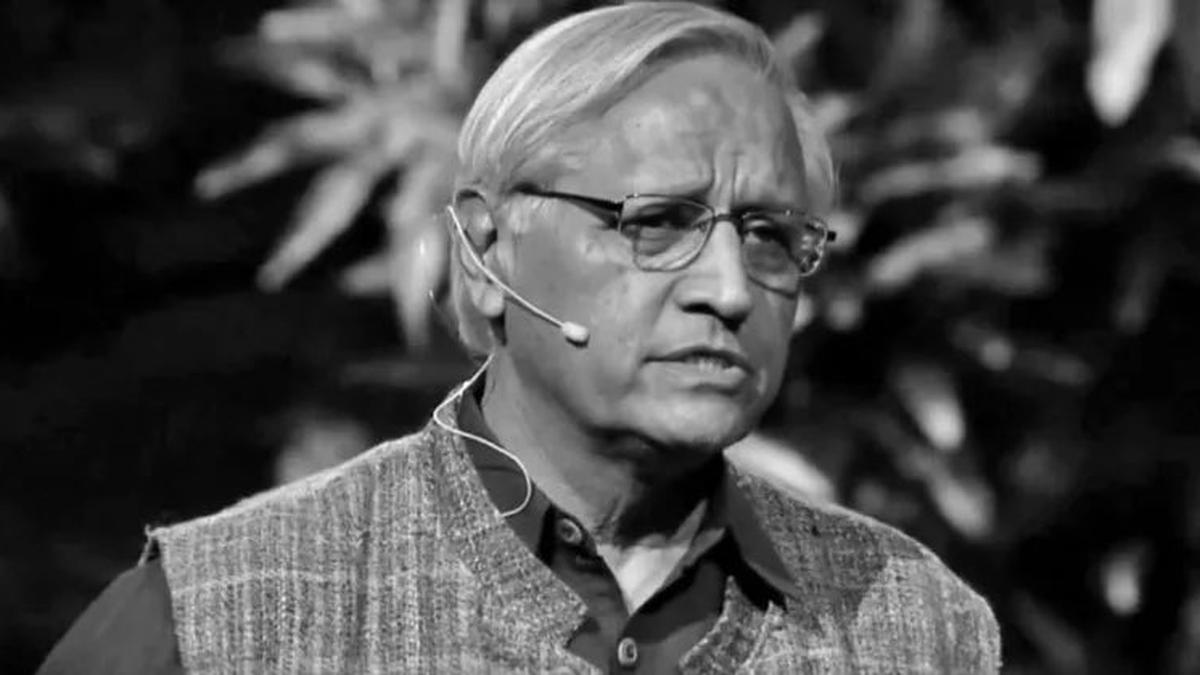
One of the foundational figures of modern civil society in India and the founder of Barefoot College, Sanjit “Bunker” Roy, died at his home in Tilonia, in Rajasthan’s Ajmer district, on Tuesday (November 10, 2026) morning. He was 81.
“He went peacefully as he wanted to in his own home in Tilonia, surrounded by Aruna and some of the countless people who loved and cared for him deeply, passionately,” said a statement issued by the Social Work and Research Centre (SWRC) – Barefoot College.
He was 21 years old when famine struck Bihar in 1966. Consecutive monsoons had failed. Seeing the horrors of extreme poverty, with people dropping dead of starvation, changed the course of his life, and he decided to spurn the “whole world laid out for him”.
Bunker Roy’s activism began at a time when social work was often viewed with disdain. His wife and prominent activist, Aruna Roy, recalls in her memoir, The Personal is Political, that when she was serving as a sub-divisional magistrate (SDM) in Delhi, a chief metropolitan magistrate reacted dismissively after learning that Bunker Roy was a social worker. “Kahin naukri nahin mili hogi (He must not have landed a job anywhere),” her colleague quipped. The magistrate’s attitude changed dramatically, however, when he later discovered that Bunker Roy was the national squash champion, and promptly sought Roy’s help in securing membership to the prestigious Delhi Gymkhana Club.
Early education and Barefoot College
Roy studied at the Doon School alongside future Prime Minister Rajiv Gandhi and attended St. Stephen’s College, Delhi, between 1962 and 1967. He won the national squash championship in 1965 and represented India in three world championships. In a TED Talk posted online 15 years ago, he described his elite education as “snobbish” and “expensive”, saying it had “almost destroyed” him.
In 1972, Roy founded the Social Work and Research Centre in Tilonia, Rajasthan, which later became widely known as Barefoot College. In the same TED Talk, he described it as “a place for cop-outs, drop-outs and wash-outs” and not for certificate chasers. It had a bottom-up approach, enabling the villagers to “identify their own challenges, develop local solutions and manage their resources independently”, working towards community-based water management and renewable energy initiatives.
Paying tribute, Congress MP Shashi Tharoor said Roy’s vision of training rural grandmothers as “Barefoot Solar Engineers” had helped bring electricity to thousands of off-grid homes across India and other developing countries, while advancing community empowerment and environmental stewardship.
‘Institution builder’
Congress general secretary (communication) Jairam Ramesh recalled Roy as a jovial figure whose love of chocolates earned opprobrium from Mr. Ramesh’s wife for polishing off an entire box without sharing. Mr. Ramesh said Roy believed that civil society “must cooperate where they can, collaborate where they should, and confront where they must”. Roy, he said, worked closely with the Rajiv Gandhi government in areas such as drinking water, immunisation, and adult literacy.
Sam Pitroda, who served as an adviser to Rajiv Gandhi and worked with Roy, remembered him as an “institution-builder” whose impact extended far beyond the communities he served.
Former Rajasthan Chief Minister Ashok Gehlot said Roy made significant contributions to rural self-reliance, education, and development while drawing inspiration from Mahatma Gandhi’s principles.
CPI general secretary D. Raja described Roy as a pioneering social activist and educationist whose work would continue to inspire those committed to equality, dignity, and social justice.
‘True hero’
Writer Amitav Ghosh noted that despite opportunities to pursue a distinguished career in diplomacy, the bureaucracy, or the corporate world, Roy chose instead to dedicate his life to addressing rural poverty, calling him “a true hero”.
Cockroach Janta Party leader Ashutosh Ranka said Roy’s contributions to education and social justice would be remembered for generations and described his death as a loss not only for Rajasthan but for the country as a whole.
Among the many honours Roy received were the Padma Shri in 1986, the Jamnalal Bajaj Award for Application of Science and Technology for Rural Development in 1985, the Tyler Prize for Environmental Achievement in 2004, the Skoll Award for Social Entrepreneurship in 2005, and the Blue Planet Prize in 2011. In 2010, TIME magazine named him among the world’s 100 most influential people. He received the Clinton Global Citizen Award in 2013.
Published – November 10, 2026 11:05 am IST