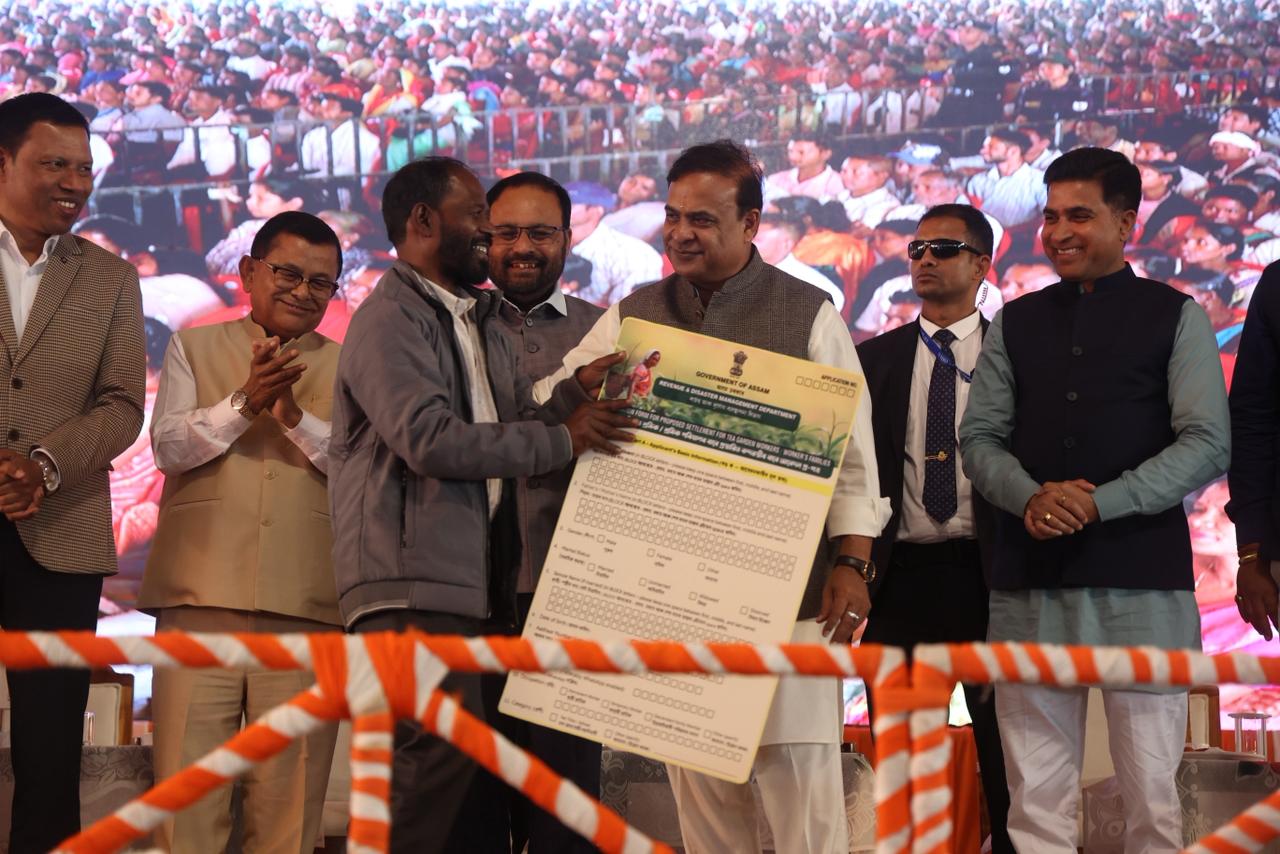
Guwahati: In what could mark a turning point in Assam’s 200-year-old tea history, Chief Minister Dr Himanta Biswa Sarma on Monday formally launched the distribution of land settlement application forms to tea garden workers, initiating a process aimed at granting ownership rights to over five lakh families across more than 800 tea estates.
Launching the drive at Dinjoy Tea Estate in Dibrugarh, the Chief Minister described the moment as “historic” for the tea community, stating that for the first time, ownership of houses and land in tea garden labour lines would vest with the workers themselves.
“For nearly two centuries, tea workers lived on land owned by garden management. Today, we are beginning the process of making them landowners,” he said.
The move follows the passage of a special law in the last Assembly session, under which the state amended the Ceiling Act and transferred ownership of labour line land and houses from tea garden authorities to the government, paving the way for redistribution among workers.
Pattas Before Poll Notification
From Monday, tea workers began receiving application forms for land pattas, in which they must specify the name of the beneficiary and provide correct details.
Simultaneously, land surveys are being fast-tracked. Surveys have already been completed in 103 tea gardens, while work in another 250 gardens commenced on Monday.
Sarma said the government aims to distribute pattas to at least a section of beneficiaries before the election notification is issued, though completing the entire process could take six to twelve months.
He clarified that although some tea garden owners have approached the High Court, there is no stay on the government’s initiative.
“We will distribute as many pattas as possible before the election announcement and make this arrangement permanent so that no future government can obstruct it,” he asserted.
A four-member committee has been formed in each tea garden to assist workers in filling out application forms.
Housing Grants and Welfare Package
Announcing a parallel housing push, the Chief Minister said families with existing homes will receive Rs. 1 lakh for repairs, while homeless families will be granted Rs. 3.60 lakh for the construction of new pucca houses.
All eligible tea worker families will be covered under the Pradhan Mantri Awas Yojana. With land ownership secured, workers will no longer require permission or a no-objection certificate from garden authorities to build or repair homes.
Sarma also announced an expanded welfare package, including free distribution of pulses, sugar and salt (currently supplied at Rs. 100), two litres of edible oil per family every month free of cost, and 100 per cent Aadhaar and ration card coverage in tea gardens.
The Rs. 1,250 monthly assistance under the Orunodoi scheme will continue, along with full coverage under the “Eti Koli Duti Paat” scheme.
He said that despite nearly two centuries of tea cultivation in Assam, tea workers were denied land ownership, while villagers elsewhere became landholders able to mortgage or sell property.
He noted that many students abandoned education out of fear of losing housing if they left garden work — a concern he said would now end.
3% Reservation in Class-I Jobs
In a significant policy expansion, Sarma announced that children of tea workers will now receive 3 per cent reservation in Class-I (Gazetted) state government jobs, including ACS and APS posts. Until now, the reservation applied only to Grade-III and Grade-IV positions.
“This will enable children from tea gardens to become magistrates and police officers,” he said.
With elections approaching, the timing of the rollout is likely to carry political significance. The Chief Minister thanked Prime Minister Narendra Modi for supporting the initiative and credited the state government for addressing what he called a “long-pending historical injustice”.
He also acknowledged Dinjoy Tea Estate management for voluntarily releasing land without objection.
Senior ministers Keshab Mahanta, Rupesh Gowala and Prashanta Phukan, along with MLAs and senior officials, were present at the event.
If fully implemented, the land rights initiative could redefine the socio-economic landscape of Assam’s tea belts, shifting lakhs of tea workers from long-term tenancy to ownership for the first time in the state’s plantation history.
Also Read: Ukhrul violence: Three years on, is Manipur on the brink again?
Related
Latest Stories