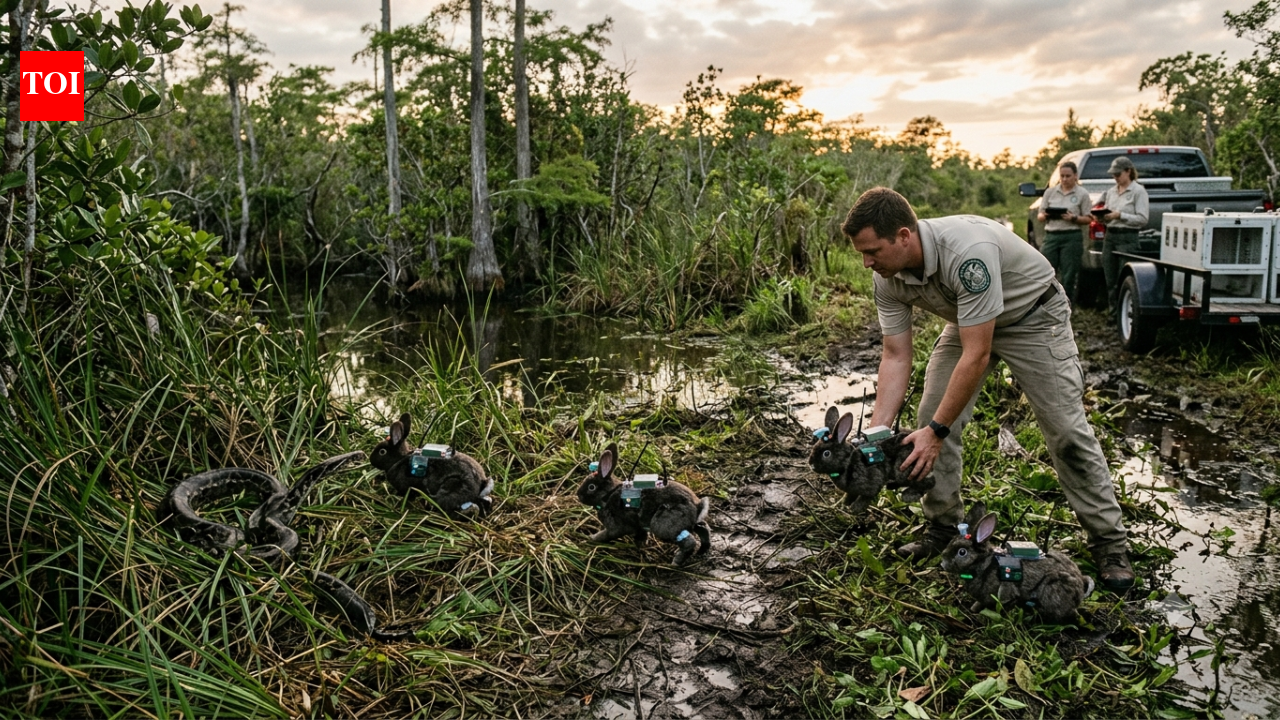
As Florida uses robot rabbits to eliminate growing population of Burmese pythons; study reveals when and how these python use trees In 2025, Florida introduced solar-powered robot rabbits to tackle its growing population of invasive Burmese pythons. Now, a new study has revealed when and how these snakes climb trees, giving wildlife officials another clue to help locate and remove them. Researchers tracked 346 Burmese pythons, including 188 adults and 158 juveniles, in Big Cypress National Preserve between 2017 and 2024. According to the US Geological Survey (USGS), the study recorded more than 4,000 habitat data points to understand how the snakes use their surroundings.The findings showed that Burmese pythons mostly stay on the ground, with less than 3% of all sightings involving tree climbing. However, around 17% of juvenile pythons and 14% of adult pythons were spotted climbing trees at least once during the study.
Why smaller Burmese pythons climb trees more often
Researchers found that juvenile pythons were more likely to climb trees than adults. Their smaller size and lighter weight may make it easier for them to move along branches. As a python grows heavier, its likelihood of climbing trees decreases. This means wildlife workers may need to look beyond the ground when searching for smaller invasive snakes.The findings could help improve python removal efforts because the snakes are already difficult to spot in Florida’s dense vegetation.
How Florida’s robot rabbits help detect Burmese pythons
In 2025, the South Florida Water Management District and the University of Florida introduced solar-powered robotic rabbit decoys to attract Burmese pythons. The robots mimic real prey by producing a heat signature and emitting a scent designed to attract snakes. They are also equipped with AI-powered cameras that monitor the surrounding area and alert officials when a python approaches. A trained removal agent can then be sent to capture the snake.“These innovative robots produce a heat signature and emit a smell designed to attract pythons. The robots are equipped with cameras that monitor for pythons and notify District officials when a snake is detected. Once notified, the District can dispatch a python removal agent to the area,” the district said.
How many Burmese pythons have been removed in Florida
Burmese pythons are not native to Florida and are found in and around the Everglades, where they prey on birds, mammals and other reptiles, according to the Florida Fish and Wildlife Conservation Commission (FWC). Florida also organises the annual Florida Python Challenge, a 10-day competition that brings together professional and amateur hunters to capture the invasive snakes. In the 2026 challenge, 907 participants from 30 states, as well as Vietnam and Canada, removed 280 Burmese pythons.Since 2017, contractors working with the FWC and South Florida Water Management District have removed more than 19,000 snakes.The latest study adds to these efforts by showing that although most Burmese pythons remain on the ground, smaller snakes are more likely to climb trees.