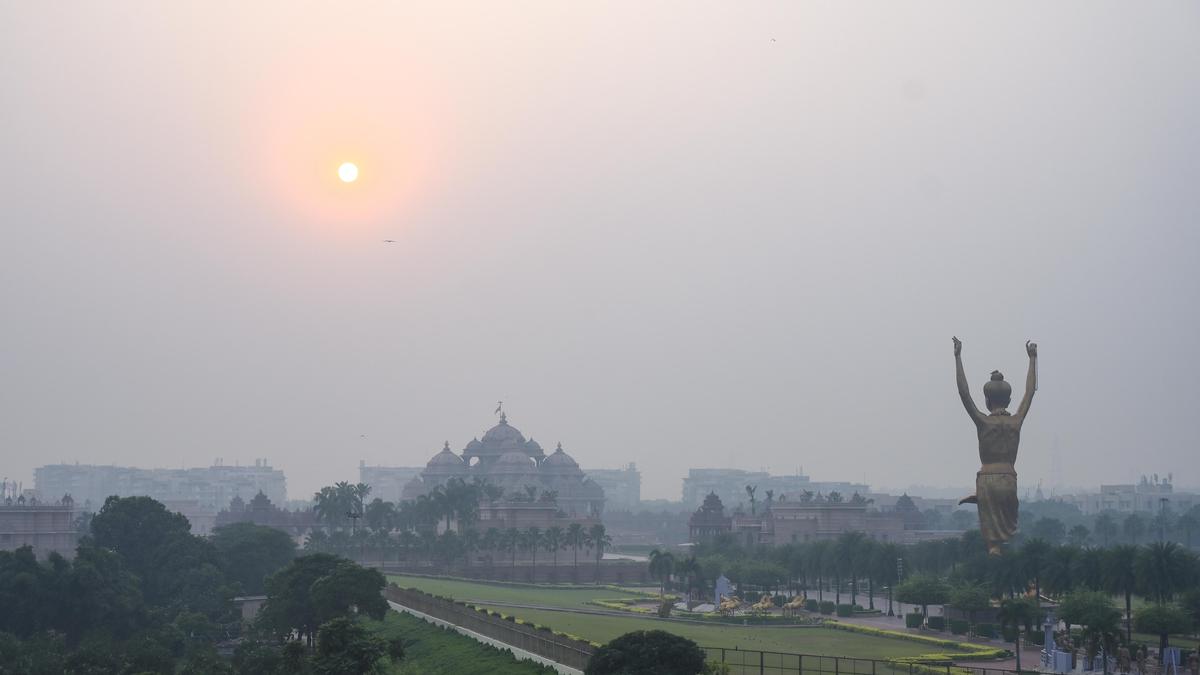
A thick layer of smog shrouds Akshardham Temple on November 2, 2026
| Photo Credit: PTI
As the air quality of the national capital deteriorated to the ‘very poor’ category for the first time this winter season, the Commission for Air Quality Management in NCR and adjoining areas (CAQM) on Monday (November 2, 2026) announced Stage 2 of the Graded Response Action Plan (GRAP).
The air quality is likely to be in the ‘very poor’ category for the next three days, as per the Central government’s Air Quality Early Warning System for Delhi. The last time Delhi’s air quality was in the ‘very poor’ category was on February 11 this year.
Stage 2 of the GRAP mandates NCR State governments to enhance vehicle parking fees to discourage use of private vehicles. The GNCTD (Delhi government) and NCR State governments also have to “stagger timings for public offices and municipal bodies in the National Capital Territory of Delhi and the districts of Gurugram, Faridabad, Ghaziabad and Gautam Buddha Nagar”.
Considering the restrictions on vehicles, the Delhi Metro Rail Corporation (DMRC) has decided to run additional trips on weekdays. While the DMRC was running 20 trips since October 28, when the GRAP-1 was enforced, 20 more trips will be run now. “This is to encourage people to use public transport rather than their private vehicles and help mitigate pollution,” said a senior Metro official.
Other directions to State governments include implementing existing measures to control air pollution, such as mechanical sweeping of roads or sprinkling water on roads, among others
The GRAP is a set of short-term emergency measures to reduce air pollution and is divided into four stages. The CAQM announces the different stages depending on the level of pollution recorded or forecast for the near future.
The 24-hour average Air Quality Index (AQI) of Delhi stood at 324 (very poor) at 4 p.m. on November 2, 2026, up from 261 (poor) a day earlier, as per the Central Pollution Control Board (CPCB)’s daily bulletin, which is treated as the day’s AQI. A higher AQI indicates worsening air quality.
‘Very poor’ levels of air pollution could lead to “respiratory illness on prolonged exposure”, as per the CPCB. On February 11, 2026, the AQI was 305 (very poor).
Every winter, air pollution spikes in the Delhi-NCR and many parts of the larger Indo-Gangetic Plains, mainly due to meteorological factors such as lower wind speeds and a drop in temperature. Pollution from stubble burning during October and November and bursting of firecrackers during the festive season also add to existing pollution from vehicles and dust, worsening the air quality.
Published – November 02, 2026 07:28 pm IST