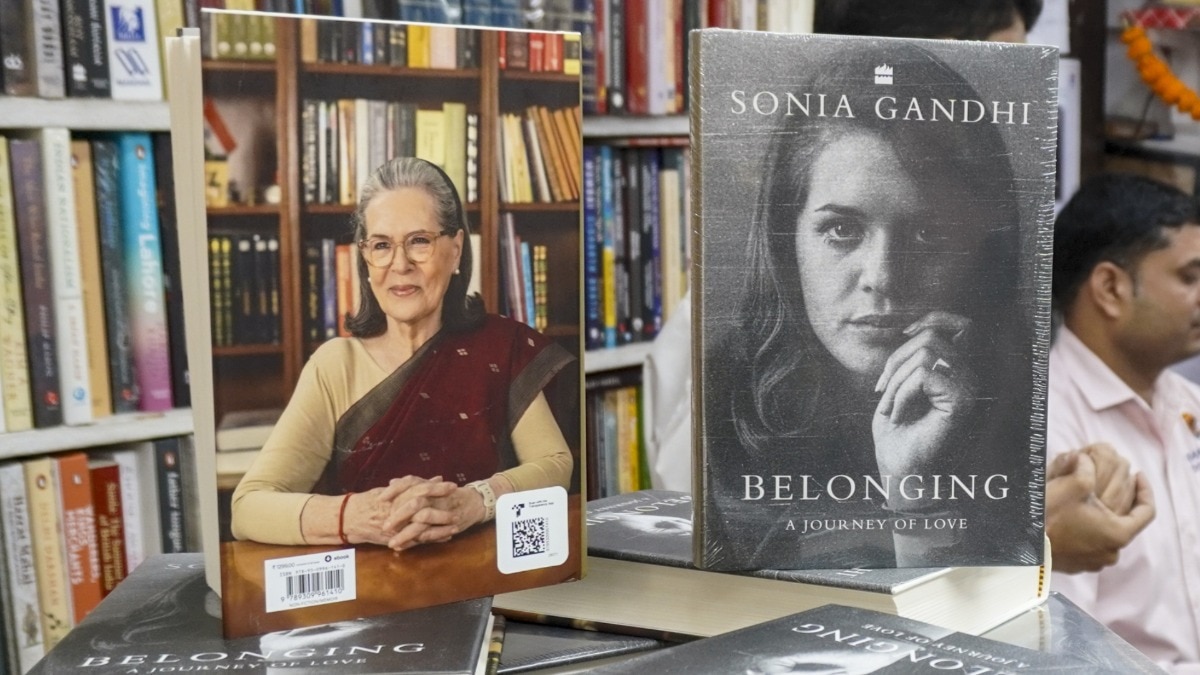
The longest-serving president of the Congress party, Sonia Gandhi, has remained a very private person, even as much has been written about her. It comes as no surprise that her book, Belonging: A Journey of Love, has created considerable buzz.
Sonia Gandhi’s memoir chronicles her journey from a young Italian student to the centre of Indian politics. Through personal recollections and political assessments, she revisits the Emergency, the Gandhi family’s internal conflicts, the UPA years and her equation with Prime Minister Narendra Modi.
Here are 12 major takeaways from the book.
1. LOVE AT FIRST SIGHT: SONIA’S CAMBRIDGE ROMANCE WITH RAJIV GANDHI
It was at the Varsity restaurant in Cambridge that a young Sonia Maino first noticed Rajiv Gandhi. She recalls being attracted to a handsome young man whose quiet demeanour stood out among his boisterous companions.
Their formal introduction came through a mutual friend, Christian von Stieglitz. Sonia describes the moment as un colpo di fulmine — a bolt of lightning. Her heart pounded and her hands trembled as Rajiv extended his hand.
Rajiv later confessed that he had experienced the same instant attraction. An excursion to Ely Cathedral followed, and the two began meeting regularly. Sonia subsequently discovered that Rajiv, then 21 and studying engineering at Trinity College, was Jawaharlal Nehru’s grandson.
Rajiv Gandhi in pictures from Sonia Gandhi’s newly released memoir. (Photo: PTI)
2. ENGAGEMENT NEWS REACHED SONIA’S PARENTS THROUGH THE RADIO
Sonia reveals that her engagement to Rajiv became public before she could inform her parents in Italy.
During her stay in India, Indira Gandhi suggested that the couple marry before Rajiv left for his training. Sonia was stunned, having expected more time to prepare her parents.
But the news leaked to the press. Her family first heard the engagement announcement on the radio while having a meal at home. Reporters and photographers soon surrounded their house in Orbassano.
Her father was particularly upset because Sonia had promised to return home before making a final decision. She subsequently wrote to her parents seeking forgiveness.
Meanwhile, Indira helped Sonia prepare for the engagement, gifting her jewellery and helping her choose a sari. Teji Bachchan was among those who helped her learn how to drape it.
3. EMERGENCY: RAJIV SUGGESTED RESIGNATION, SANJAY WANTED A CRACKDOWN
Sonia’s account of the events preceding the Emergency of June 1975 reveals differences within the Gandhi family over how Indira Gandhi should respond to the political crisis.
She writes that Indira was torn between stepping down and taking drastic action against opponents whom she believed threatened the country’s stability.
Sanjay strongly advocated confronting the Opposition, while Rajiv suggested that resignation could strengthen his mother’s political position in the long run.
Sonia recalls consultations involving Siddhartha Shankar Ray, Law Minister HR Gokhale and constitutional experts before the Emergency was proclaimed.
According to her, Indira regarded Jayaprakash Narayan’s June 25 call for government servants and security personnel to disobey wrongful orders as a dangerous challenge to constitutional authority.
The account offers a view of the Emergency through the political calculations and anxieties within Indira Gandhi’s household.
Sonia Gandhi’s memoir was released on Tuesday. (Photo: PTI)
4. SANJAY GANDHI: FEARLESS BUT RECKLESS, ADMITS SONIA
Sonia offers a mixed assessment of Sanjay Gandhi’s controversial role during the Emergency, describing him as courageous but reckless.
She acknowledges that Sanjay exercised considerable influence over decision-making despite lacking constitutional authority for several of his political interventions.
Her sharpest criticism concerns the family planning programme, which she describes as poorly conceived and callously implemented.
Government officials were offered incentives to meet sterilisation targets, while local authorities competed to demonstrate results. The pressure resulted in coercive measures, widespread resentment and reports of victimisation.
She also acknowledges the anger caused by slum clearance operations, particularly around Turkman Gate in Delhi, where police firing during protests led to deaths and injuries.
Yet she rejects portrayals of Sanjay as a coward driven by fear for his political future, arguing that his fearlessness sometimes bordered on recklessness.
5. MANEKA GANDHI’S POLITICAL AMBITIONS AND THE BITTER FAMILY SPLIT
Sonia provides a critical account of the tensions following Sanjay Gandhi’s death in 1980, particularly the estrangement between Indira Gandhi and her younger daughter-in-law, Maneka Gandhi.
According to Sonia, Sanjay’s supporters began promoting Maneka as his political successor. Indira, however, considered the 23-year-old Maneka too young and inexperienced for leadership.
Sonia writes that Indira was disturbed by Maneka’s eagerness to secure a political position and by the sale of Surya magazine to a person associated with the RSS.
The final confrontation followed Maneka’s participation in a Lucknow rally organised by Congress dissidents. Indira told her she could not remain in the household while engaging in political activities she considered disloyal.
Maneka subsequently left the family home. Sonia alleges that Maneka sought to portray Indira as responsible for the separation, although she acknowledges that she and Rajiv were not present during the confrontation.
Sonia Gandhi and Maneka Gandhi. (Photo: PTI)
6. FOREIGN-ORIGIN ATTACKS: SONIA RECALLS BEING CALLED A SPY
Sonia recalls facing relentless personal attacks over her foreign origin while leading the Congress against the BJP during the Vajpayee years.
She writes that opponents accused her of wanting to establish Rome Raj and subjected her to derogatory descriptions, including calling her a cabaret dancer, a spy and ‘Monica Lewinsky’.
Despite these attacks, Sonia says she continued campaigning because she was determined to defeat the BJP and RSS, whose politics she regarded as divisive.
She also recalls the widespread perception that the Congress lacked a leader capable of matching the popularity of Atal Bihari Vajpayee and L.K. Advani.
Sonia presents the contest as an ideological battle centred on secularism rather than merely an electoral struggle.
7. MEETING KALAM: SONIA REJECTS CLAIM THAT PRESIDENT BLOCKED HER PM BID
Sonia revisits the controversy surrounding her May 18, 2004, meeting with President APJ Abdul Kalam following the Congress-led alliance’s electoral victory.
She recalls visiting Rashtrapati Bhavan with Manmohan Singh to present the alliance’s numbers and stake a claim to form the government.
According to Sonia, the question of who would become Prime Minister did not arise because everyone assumed she would take the post.
She rejects claims that Kalam refused to swear her in because of her foreign birth.
Citing Kalam’s later account in Turning Points, Sonia notes that he had made it clear that, had she formally claimed the prime ministership, he would have sworn her in as the constitutionally tenable choice.
8. ‘ABSOLUTELY NOT’: SONIA DECIDED AGAINST PM POST BEFORE 2004 POLLS
In one of the memoir’s most significant revelations, Sonia discloses that she had decided against becoming Prime Minister months before the 2004 Lok Sabha elections.
She recalls discussing the possibility with Rahul and Priyanka, who opposed her taking the post because of the assassinations of their grandmother, Indira Gandhi, and father, Rajiv Gandhi.
When asked whether she would accept the position if the Congress won, Sonia replied emphatically: “Absolutely not!”
She kept her decision secret even from her closest colleagues, fearing that an early announcement could trigger a leadership struggle within the Congress.
Even Manmohan Singh, who accompanied her to Rashtrapati Bhavan, was unaware of her intentions.
After meeting Kalam, Sonia became anxious about how to tell party workers and allies that she had led the Congress to victory while knowing she would refuse to head the government.
She eventually confided in Ahmed Patel, asking him to gauge the reaction of senior party leaders.
9. ‘THEEK HAI’: HOW SONIA ALMOST YIELDED TO PRESSURE BEFORE RAHUL INTERVENED
Sonia reveals that she momentarily yielded to pressure from alliance leaders to become Prime Minister, only to reaffirm her refusal following an emotional confrontation with Rahul and Priyanka.
She recalls that alliance leaders spent more than an hour urging her to accept the position. When she refused, they surrounded her, insisting they would not accept no for an answer.
Overwhelmed, Sonia murmured “Theek hai”, prompting the leaders to begin congratulating her.
But Priyanka, distressed and in tears, informed Rahul, who confronted their mother.
“You said yes?” Rahul demanded.
Sonia explained that she had been pressurised. Rahul reacted angrily, while Priyanka urged her to stand by her convictions.
That night, Sonia struggled between her obligations to Congress workers and her determination to stay out of government. As she drifted towards sleep, she recalls telling herself: “Sonia, be true to yourself.”
The following morning, she told Rahul she would stand by her original decision. He embraced her, reassuring her that she had made the right choice.
Rahul Gandhi with mother Sonia Gandhi. (Photo: PTI)
10. UPA’S DUAL POWER CENTRE: SONIA DENIES ACCESSING PMO FILES
The Congress leader strongly rejects allegations that she functioned as a parallel power centre during the UPA government or interfered in administrative decisions.
Referring to a book by a former aide to Manmohan Singh, she dismisses claims that she accessed confidential PMO files or influenced key appointments.
She says the accusation that she examined official government files particularly distressed her, pointing out that the PMO had categorically denied showing her such documents.
Sonia describes an “unspoken division of responsibility” between herself and Manmohan Singh: the Prime Minister ran the government, while she managed the Congress.
A core group comprising Pranab Mukherjee, Arjun Singh, AK Antony and Ahmed Patel met weekly with the Prime Minister to coordinate between the government and the party.
She maintains that her relationship with Manmohan Singh was based on mutual trust and respect rather than interference.
Sonia Gandhi and Manmohan Singh. (Photo: PTI)
11. PRANAB MUKHERJEE’S PM AMBITIONS: ‘TIME FOR A CHANGE AT THE TOP’
In another significant political revelation, Sonia writes that Pranab Mukherjee harboured a long-standing ambition to become Prime Minister and had suggested a change in leadership during the UPA years.
She recalls a conversation in which Mukherjee, after expressing frustration over serious differences with then Finance Minister P. Chidambaram, suggested that perhaps it was time for a change at the top.
Sonia interpreted the remark as an indication of his desire to replace Manmohan Singh.
She says she gently changed the subject. Although Mukherjee may have been disappointed, he never made her feel that he held the decision against her.
The Congress subsequently nominated Mukherjee as the UPA’s presidential candidate in 2012, and he was elected President.
Sonia writes that she continued to visit him regularly, valuing his political experience and knowledge.
Pranab Mukherjee with Sonia Gandhi. (Photo: PTI)
12. ‘MODI AVOIDS EYE CONTACT’: SONIA ON HER EQUATION WITH PM
Sonia offers a candid account of her equation with Prime Minister Narendra Modi, revealing that despite more than a decade of his leadership, the two have had practically no personal interaction.
She writes that their encounters are largely confined to parliamentary gatherings, where they exchange formal namastes.
Sonia observes that Modi tends to look away, avoiding eye contact. Occasionally, he has enquired about her health following hospitalisation, and the two have exchanged birthday and New Year greetings, but they have never had a substantive conversation.
Sonia Gandhi says she shares no personal rapport with PM Modi. (Photo: PTI)
She attributes the distance to fundamentally different ideological worldviews.
Sonia describes Modi’s vision of India as shaped by the RSS, with hierarchy and control at its centre, while positioning her own beliefs around secularism, inclusiveness and social justice.
Interestingly, she acknowledges Modi’s rise from a relatively underprivileged background, although she questions how his humble origins have been projected by his public relations machinery.
She also criticises his parliamentary speeches, accusing him of using coarse language and repeatedly attacking the Opposition, particularly Jawaharlal Nehru.
Yet Sonia insists their differences are ideological rather than personal, offering a rare glimpse into the distant relationship between two of India’s most prominent political adversaries.
– Ends