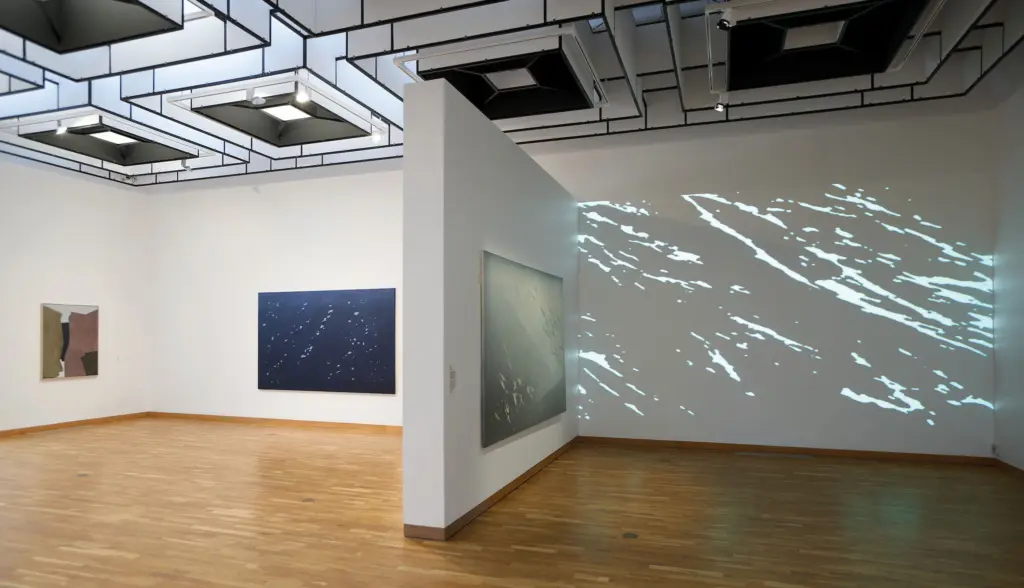
The best landscapes resist description. They draw you back to be in their presence again. Guðrún Kristjandóttir’s paintings summon vast landscapes from almost nothing, and I found I couldn’t leave them alone.
At the show Traces by Guðrún Kristjánsdóttir at the Reykjavik Art Museum, Kjarvalsstaðir, I experienced a rare pleasure — of being the last person to have seen the show, which closed on June 7, 2026. I stood alone in the room, in awe, seconds before the museum closed. I was lucky to have spent an entire day in the presence of her wonderful work. I went there the morning of the last day, left, and then came back because these were works that I couldn’t get enough of. In fact, the more time I spent in the museum, the more the exhibition revealed to me. Like a painting that was done on the expansive glass walls of Kjarvalsstaðir called “Weathering.” Or the pieces that spilled into the café walls. I would have never discovered all that had I not returned during the later part of the day.
Minimalist landscapes
Guðrún’s paintings bestow a serenity upon the viewer. I felt this the second I walked into the museum and stood across from her painting “From the West I.” The feeling grew stronger as I moved to the next piece that called out to me: “Hillside,” painted in 2000. If it weren’t for the titles, perhaps we wouldn’t know what we were looking at, but we understand the language they are speaking. What the title leads us to believe is that a landscape is in fact closer to some of the French painter Henri Michaux’s hallucinatory, psychedelic-induced mark-making, albeit on a much grander scale. Several paintings share titles: “Thaw,” “Snow,” “Weathering,” and “Hillside” repeat throughout the show, often accompanied by numbers, to show a progression in their chronology. The “Hillside I” from 1994 is bright red. Another “Hillside” emerges from 2003. These paintings are landscapes one revisits repeatedly, though the landscapes they represent are skeletal, minimal. The unfolding of their meaning takes time.
These paintings are landscapes one revisits repeatedly.
The most striking piece in the show is the one most difficult to describe. Part sculpture, part video work, synced up with a stunning soundtrack, “Water” was striking in its simplicity but so utterly mesmerising that even two toddlers sat down, transfixed. It reminded me of a line of poetry by Lyn Hejinian, “It is hard to turn away from moving water.” I didn’t know beforehand that even a drop of water creating ripples would suffice, one didn’t need a river or an ocean. I joined the children and watched drops of water hit a shallow basin, exactly at the centre. Each drop created a ripple that was then made visible on the wall behind the installation. Rings of light danced on the wall as music from a stone harp played in the background, mixed sometimes with the chant coming from an installation, “Weathersong,” at the other end of the museum. But sometimes the museum fell so quiet that you could hear each drop of water, which was incredible. It became a part of the musical score accompanying this piece. The children wondered how the ripples of water from the basin translated into the image they were seeing on the wall, and so did I. After a minute or so, a little girl couldn’t resist. She dipped a finger into the basin of water.
Weather as/and water
“Weathersong,” projected on the wall opposite of “Water,” was both an oil painting on linen and a video that moved at the pace of a human walking, chanting as they traversed a vast landscape. Such chanting melodies, we learned, are common amongst those traversing Iceland’s vast landscapes, and are often ascribed to children, who carry the tune with them for the rest of their lives. The haunting tune was inescapable as one walked through the music; it mixed with the music from the stone harp accompanying “Water” and created an accidental soundtrack to my experience, one that I wish I could record and keep with me as a souvenir.
Juxtaposed with this vastness were three short videos. My favourite amongst the three was the shortest, in which a blade of grass emerged from a hole in a sheet of ice. You could see the water moving deep inside. It echoed a series of three photographs titled “Thaw (I, II, and III)”. For an artist interested in the vastness of the environment around her, these minute details and tiny observations formed a nice counterpoint to her abstract landscapes in which just a few marks unfold infinite space within their frame and beyond. As the last person at the show, I took a deep breath. Suddenly, the museum had become immense. There was no one around. I walked around the room again, noticing how the paintings spanned more than 30 years of practice. I revisited the two paintings titled “My Environment (I & II)” which reminded me of the works of Etel Adnan, though the colours here were much more subdued. Though initially I wasn’t too fond of some of the landscapes with lines and angles that punctuated the paintings with the repeating titles, which I felt were doing the most emotional work, in the end I had realised their importance. Guðrún has more than one way of seeing the same landscape — they are completely different approaches, in fact.
Making nothing visible
There was a painting titled “Esjan,” from 2012, which is the same mountain I am looking at as I write. Though still in the realm of the abstract, that painting made the mountain instantly recognisable, but I felt that perhaps all the paintings I had just seen and fallen in love with were of Esjan. Who is to say? Or maybe it didn’t matter. These are paintings that make visible what we have all seen before but never recognised: the emptiness of space, its vastness. Guðrún’s paintings capture both space and time. They are an ode to the impermanence of the physical world, its transient beauty, which we must return to repeatedly in our lives. Which is perhaps why I returned to the museum again that afternoon, to see these works one last time. I wanted to be the last one to be enveloped in this vastness, this beauty. But I know it won’t be the last time I see her work.