
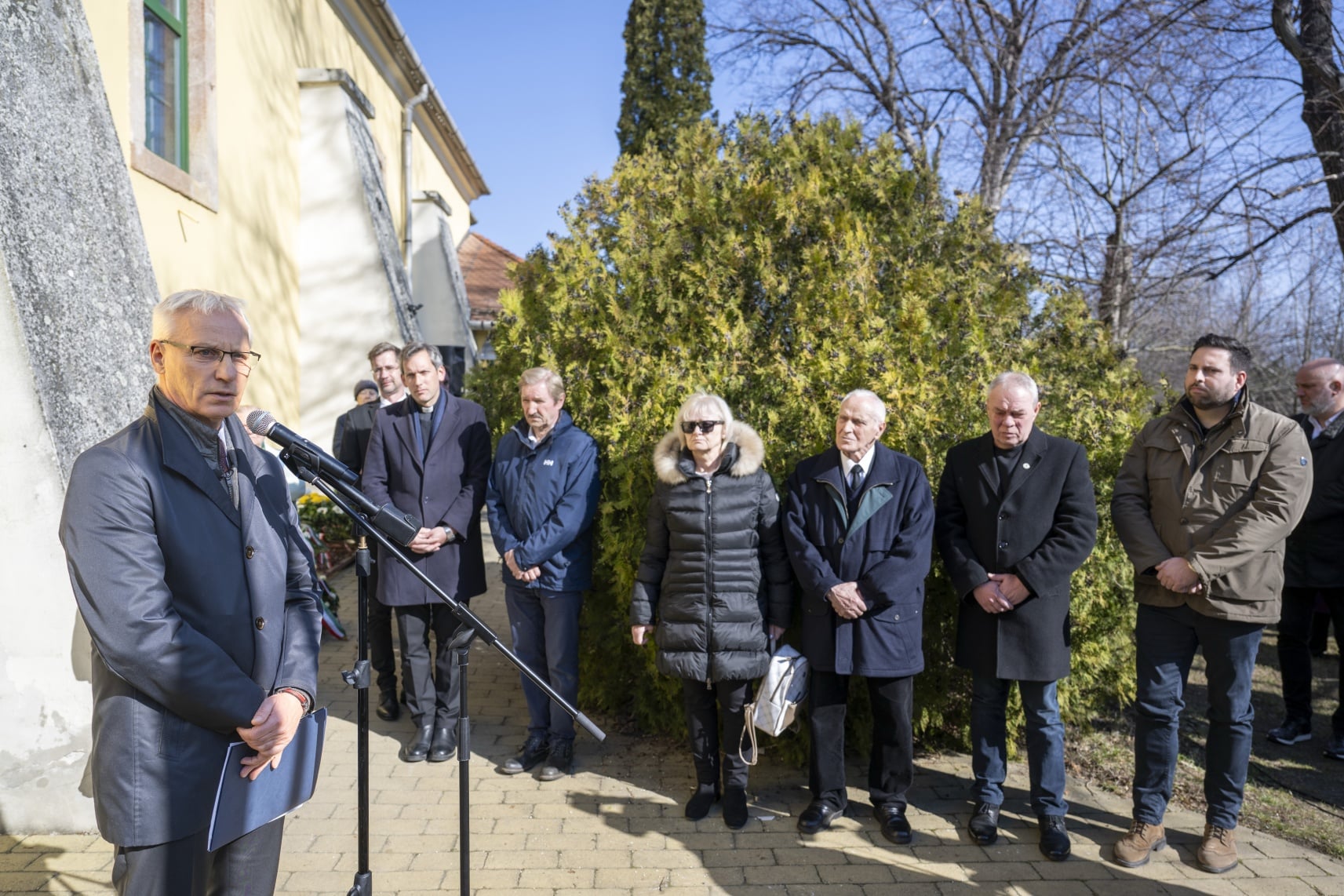
The expulsion of the Swabians made the country poorer and the nation poorer, said the State Secretary for Church and National Relations in the Prime Minister’s Office on Sunday in Békásmegyer (a district of Budapest) at a memorial service with Holy Mass commemorating the expulsion of the German-speaking population.
In his speech, Miklós Soltész recalled that 220,000 Swabians were expelled from Hungary after World War II. “A great loss, the absence of which we still feel today,” he emphasized, adding that the knowledge, culture, and diligence of the Germans who lived here are still missing.
He explained that a total of 12,000 people were deported from Békásmegyer and Óbuda and hundreds of families were expelled simply because they were German. “60,000 Swabians were taken away for forced labor, and almost a third of them never returned. May God give them peace,” he added.
According to the state secretary, the German-speaking people distinguished themselves from the outset through their diligence, played an important role in agriculture, and brought the destroyed, neglected soil “into a wonderful condition.” Their faith was demonstrated and strengthened by the fact that they built a church, continued Soltész, who believes that the Germans living here could not come to terms with one thing: the shame of eighty years ago.
In this context, the state secretary warned: “We have a task (..)
We must not only remember the Swabians who were expelled from Hungary, but also preserve and pass on their traditions,”
he clarified.
Memorial plaque at the church in Békásmegyer. Photo: commons.wikimedia.org/Fekist
In his speech, he also mentioned that the building of St. Joseph’s Parish, where the memorial service took place, is being renovated with a grant of 90 million forints (237,000 euros). He also noted that it was a joy to see so many young children at Holy Mass. “This shows that the community is strong,” he emphasized.
At the end of the ceremony, the Secretary of State laid a wreath on behalf of the Prime Minister at the memorial plaque dedicated to the expelled Swabians.
Related article
The Flagship of Remembrance: Interview with the Director of the Danube Swabian Central Museum
Tamás Szalay on commemorating 80 years since the expulsion of the Hungarian Germans and the universal power of personal life stories.Continue reading
Via MTI; Featured image: MTI/Kovács Márton


