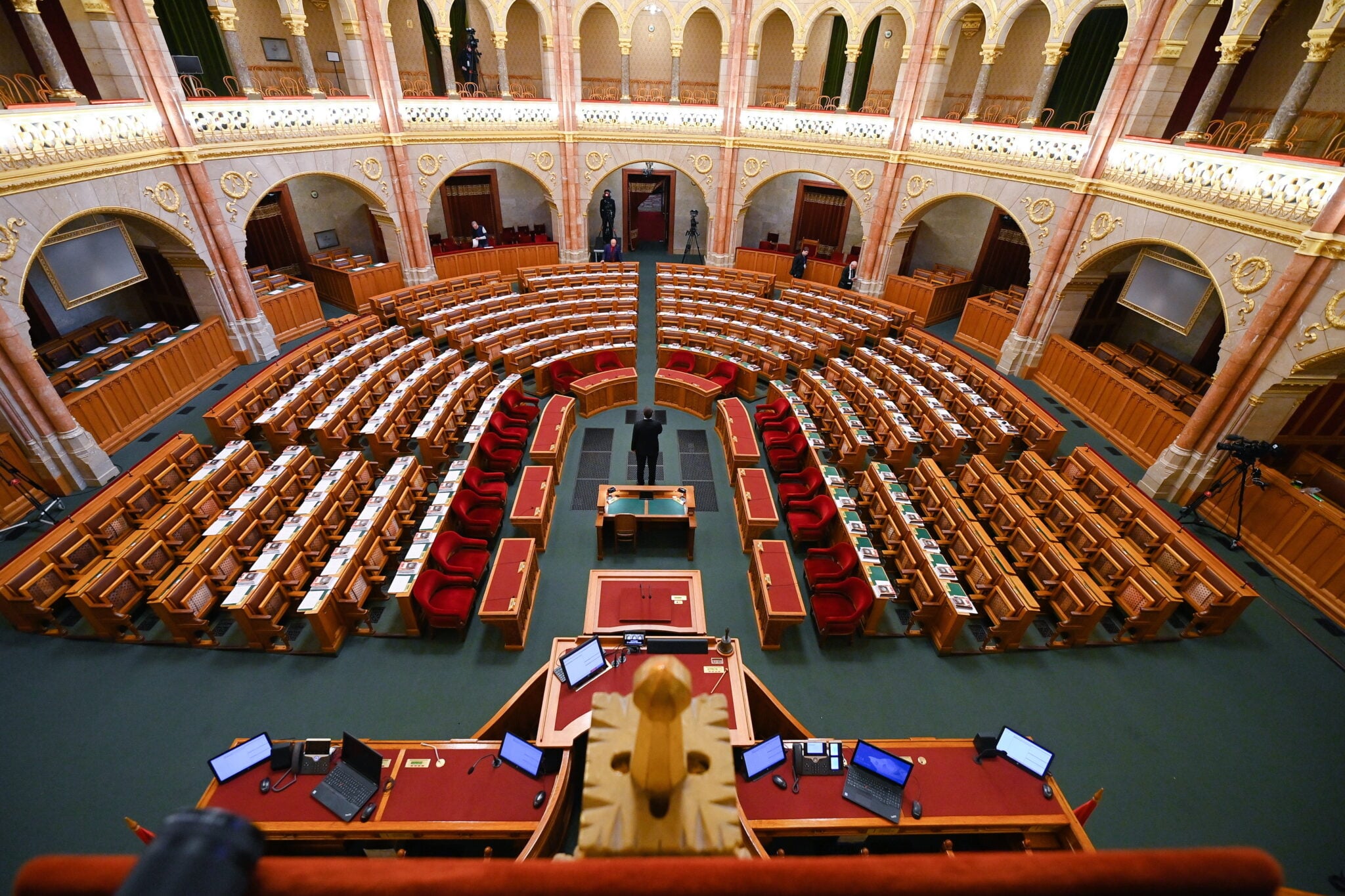
Today, Monday, July 27, the Hungarian Parliament convenes for a two-day extraordinary session that has already sparked political tensions. At the center of the debate is a bill to establish the National Asset Recovery and Asset Protection Office (NVVH).
As the TISZA government’s explanatory memorandum states, the new institution is intended to ensure “that the unlawful management of public assets does not go unpunished.” The goal is to identify, secure, and recover state assets that have been illegally sold, as well as to initiate the necessary administrative and judicial proceedings. However, the bill introduced by the TISZA government under Péter Magyar is facing resistance.
The main criticism is that this would create a “super-agency” unprecedented in the Hungarian legal system.
Since the agency is to be granted hybrid powers—combining administrative, investigative, and prosecutorial (prosecutor’s office) authorities—the proposal is facing sharp criticism from multiple quarters.
János Bóka, the FIDESZ parliamentary group leader, had particularly harsh words. “If you think you can turn to another authority to challenge the arbitrariness or abuses of the National Asset Recovery and Asset Protection Office, you are sorely mistaken. The agency can take over any proceeding at any time, and there is no legal remedy against this decision,” the politician warned.
János Bóka drew a historical comparison to the notorious communist state security agency, the ÁVH. Even that agency, he said, did not possess “as much power on paper” as is now being granted to the new agency.
Since this is not formally a classic administrative proceeding, those affected have neither the right to an attorney nor to general judicial protection,
said the FIDESZ politician.
Legal experts and constitutional analysts also expressed concerns regarding the rule of law. The broad, horizontal powers of the agency were particularly criticized. The fact that the agency may, in certain cases, replace the regular public prosecutor’s office and bring charges independently undermines the principle of the separation of powers and violates the public prosecutor’s traditional monopoly on prosecution.
In addition, experts point out that
Hungarian criminal and civil procedure law already provides all the necessary tools for asset recovery.
Success, they argue, does not depend on a new institution, but rather on the political will to consistently apply existing laws.
Members of Parliament from the former governing parties, Fidesz and KDNP (Christian Democrats), view the office as a purely politically motivated tool for political warfare. They criticize the rushed legislative process, which lacked sufficient public consultation.
The planned framework conditions for the office’s leadership are adding fuel to the fire. The plan calls for extensive immunity as well as top salaries reaching millions of forints, amounting to several times the base salary of a judge.
The opposition accuses the government of misusing the office for targeted political reprisals and for arbitrarily scrutinizing former government and ownership structures.
Unrest is also growing in the business community. The draft bill stipulates that companies generating at least 75 percent of their revenue from public tenders can be automatically audited and placed under state supervision. Market participants view this as a direct attack on the protection of private property and warn against disproportionate state intervention. Although the TISZA government emphasizes that this does not constitute expropriation, the strict data reporting requirements—failure to comply with which could result in fines of up to 5 billion forints (14 million euros)—are viewed by the business sector as drastic overregulation.
The next two days in Parliament should reveal whether the TISZA government is willing to revise the bill in light of the criticism. The debate has long since shifted away from the protection of public assets per se to the question of how much power a single government agency may wield in a democratic state governed by the rule of law.
Related article
Panic Grips the Human Rights Industry as Rogue Magyar Goes off Script
The Asset Recovery Office would have “unusually broad powers”, thinks the Helsinki Committee.Continue reading
Via MTI, Portfolio; Featured image: MTI/Szigetváry Zsolt