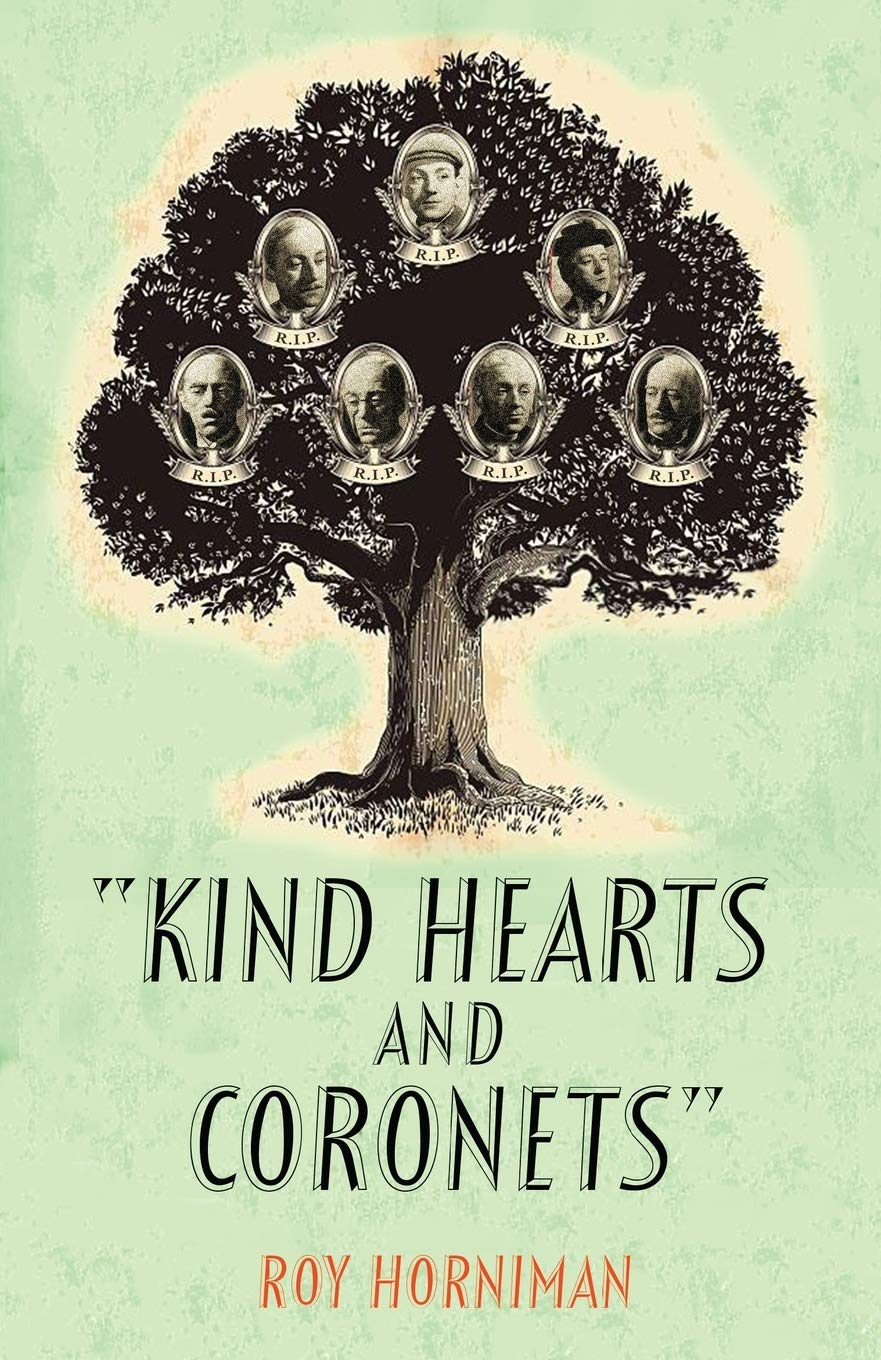
Young Israel Rank and his parents live in a nondescript semi-detached in depressing Ursula Grove in the shabby London suburb Clapham. Israel’s mother’s great-grandfather was Lord George Gasoyne but her father’s family had drifted away from this aristocratic branch. Israel, poor and dissatisfied with life, comes to realise that if six people on the family tree were to die he would become Earl Gascoyne – an extremely remote possibility, but perhaps not…
If it sounds like a familiar scenario, readers may well be reminded of Britain’s celebrated Ealing Studios film “Kind Hearts and Coronets” from 1949. But serendipitously, one piece of art can lead to another, and if we’d looked more carefully at the opening credits of Robert Hamer’s film when we watched it once or twice back around the 1980s, we’d have noticed the statement ”Based on a novel by Roy Horniman”.
Only we didn’t, though if we had we might well have been intrigued by the prospect of this novel. It turns out that it was actually published way back in 1907 and with the original title “Israel Rank, The Autobiography of a Criminal”. Whether it was still in print around the 1980s we don’t know, however since 2020 the book has been reissued by Dean Street Press, a publisher that concentrates on worthwhile revivals.
The change of title to “Kind Hearts and Coronets” does make sense, considering the ongoing status of the film. So, at The Budapest Times, not having been around in 1907, having overlooked the film’s credit in the 1980s and then having been unaware of the book’s reappearance in the 2020s, we have finally caught up in 2026. It proves, as we say, that one piece of art can lead to another. It may take a few decades but you can get there in the end.
There are those “book or the film?” and “film or the book?” debates as to which is the better, but this article isn’t one of them. The film stands on its own merits and now we find, belatedly, that the source material is enjoyable in its own way. (One change we will mention, though. In the book Israel Rank is half-Jewish and does away with six Gascoynes, but in the film Dennis Price is half-Italian and murders eight Ascoyne D’Ascoynes to succeed to the dukedom. Post-World War Two sensitivity was at play, and besides, we aren’t going to start quibbling about being short-changed a couple of murders or other little differences.)
Here, then, is a rewarding read for those who like their humour on the dark satirical side, from appreciative Edwardians of 1907 to catch-up readers today. The prose style is more modern than 19th-century writers Charles Dickens and the later Thomas Hardy, for instance, and some readers apparently detect a wry Wildean influence. Or, for this reader, the novel brings to mind and compares favourably with three other humorous accounts of this earlier period: R. S. Surtees’ “Mr. Sponge’s Sporting Tour” from 1852, Jerome K. Jerome’s “Three Men in a Boat”, 1889, and George and Weedon Grossmith’s “Diary of a Nobody”, 1892.
Being of his time, Israel Rank visits the Crystal Palace, which, as history knows, burned down in 1936, and he hears a horse-drawn fire wagon on Piccadilly. When the law catches him (he is writing from a condemned cell), he faces the noose, a punishment finally ended in 1969.
We wondered, when the word “coxcombry” popped up, what it means and if it is still in use. The Oxford English Dictionary gives five meanings dated to the early 1600s, three of them labelled obsolete. We were happy to learn that it means conceited or foppish behaviour or manner, and is from the noun “coxcomb”, describing a vain or arrogant man. Perhaps we should have known and hopefully it is still in use, occasionally. Some “verily”s appear too.
“Kind Hearts and Coronets” has a short biography stating that Robert (Roy) Horniman was born in Southsea, Hampshire, in 1868 to a distinguished sailor and Paymaster-in-Chief of Britain’s Royal Navy, and an aristocratic Greek mother. He was educated abroad and then at Southsea Grammar School, Hampshire. At age 19 he went on the stage and for a time was tenant and manager of the Criterion Theatre in London’s West End, writing many plays and adaptations of his own and others’ novels. In World War One he served in the Artists Rifles.
Horniman devoted much time and energy to various causes, especially anti-vivisection and about which he spoke eloquently in public. A contemporary characterised him as a “well-to-do bachelor who knew what did and what did not suit him, marriage being in the latter category, the social round in the former”. He also wrote and adapted for the screen.
Sad to say, as can be the artist’s lot, he died in London in 1930 at age 62 and thus missed the accolade of “Israel Rank, The Autobiography of a Criminal” becoming the successful basis of what is ranked as one of the best British films, the much-loved “Kind Hearts and Coronets”.
In the book, Rank’s father was a commercial traveller often away from home for a week at a time and his wife was regarded as having married beneath her, and to a Jew. For her maiden name was Gascoyne, but beyond two ancestral portraits, one of Lord George Gasoyne, her great-grandfather, and the other of that spendthrift’s wife, there was no visible evidence that the family was in any way of superior social extraction to their modest suburban environs.
Unlike most other peerages, the noble line could descend through female as well as male heirs, and so with his mother shunned for marrying a Jewish commoner, Rank, a lowly stockbroker’s clerk, set his sights on avenging her by killing everyone between him and his unlikely inheritance of the Gascoyne earldom, seated at Hammerton Castle in Hampshire.
The ambitious protagonist offers several justifications for his murderous path, including that “In looking back at the development of my character, I am not conscious of a natural wickedness staining and perverting all my actions. My career has been simply the result of an immense desire to be somebody of importance”. His only real regret is having been caught.
But first, with increasing carelessness and diminishing finesse, Rank does kill his way to the title and estate. Collateral damage does not trouble him, should an innocent woman be poisoned alongside her man or an infant killed by carefully infecting it with scarlet fever.
Rank’s anonymous note to a man courting a village girl revealing her trysts with a Gascoyne leads to the latter being beaten insensible. When Rank finds the stunned man he finishes him off by strangling him, and the death is blamed, flimsily, on a kick from a horse. Later, that horse-drawn fire wagon is on its way because Rank is burning to death a sleeping Gascoyne.
Rank tells no lies about himself, and apart from the matter of being a serial killer he is a snob, a fraud and a sexist. “It is a fact… ” he informs, “which a wise woman learns early, that a man’s infidelities need not in any way affect his supreme devotion to a particular female”. This is simply his “plurality of disposition”. A woman should never have such privileges.
Rank is secretly involved with three women. As for his victims, “I could not help reflecting how very much those whom it was my unfortunate duty to remove seemed to like me.” He often harps on the fact that people judge and undervalue him because of his Jewish blood, and he refers to the “traits” of “his people”, his dark semitic appearance and “oriental tastes”. Readers can consider where Horniman stood on the tricky issue of semitism.
As they can judge also on the issues of class prejudice, inherited rank and wealth, social advancement and more in this pitch-black but light-hearted tale blending fully drawn and vivid characters with calculated crimes. “There are few who would be willing to risk the fury of mankind by giving an accurate description of their lives and actions,” writes Rank from his prison cell. Murder will out? Not necessarily, he says. Then, get ready for a surprise ending.