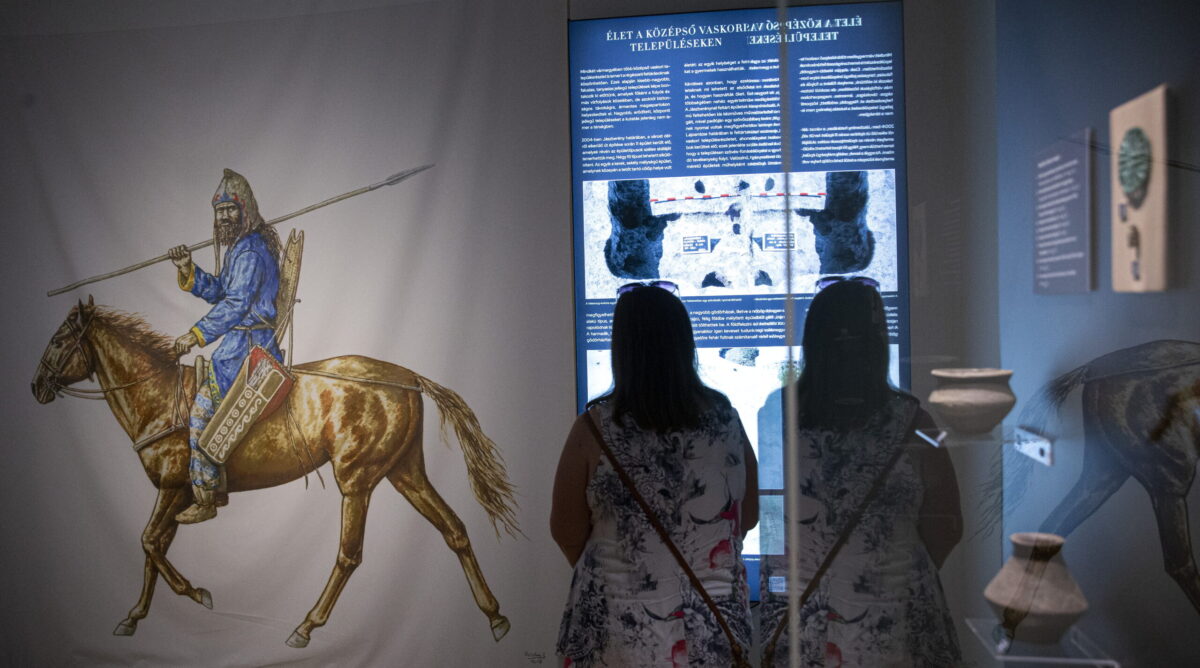
A new exhibition, which opened on Friday at the Cifra Palace in Kecskemét, sheds light on the age of the Scythians through a rich collection of archaeological finds from Bács-Kiskun and Jász-Nagykun-Szolnok counties, dating from the 8th to the 4th century BC.
At the exhibition’s opening, Attila Gyucha, Professor of Archaeology at the University of Georgia, stated that there had not been a Hungarian exhibition of this scale for about 25 years. As such, the current exhibition is a worthy successor to the country’s largest previous Scythian exhibition, held in 2001.
Speaking about the Scythian period in the Carpathian Basin, which lasted from the 7th to the 4th century BC, the professor emphasized that the three defining phenomena of the era—migration, innovation, and globalization—can help explain certain processes in later historical periods and even in the present day.
Regarding migration, he explained that the population groups arriving from the eastern steppes were relatively small in number.
Essentially, only a limited warrior elite and ruling class appeared in the Carpathian Basin, yet their cultural influence proved to be enormous.
On the subject of innovation, Gyucha noted that the Scythian-origin groups that appeared at the end of the 7th century BC brought about a fundamental technological transformation in horse harnesses and warfare. The effects of these innovations can be traced as far as northern Italy and Greece. Initially, the local elites of neighboring peoples adopted these new technologies as imported prestige items, but over time they adapted them to their own needs and eventually produced them themselves.
Photo: MTI/Bús Csaba
As an example of Iron Age globalization, the archaeologist pointed to a network stretching from the Altai Mountains to the Great Hungarian Plain, through which goods and ideas circulated for centuries. He suggested that
the Great Hungarian Plain may have served as an important center for breeding horses used in Greek chariot racing, with the animals reaching Greece via northern Italy.
The exhibition presents Scythian finds dating from the 8th to the 4th century BC. Among the highlights are artifacts from the largest known Scythian cemetery between the Danube and Tisza rivers, located at Szabadszállás, which was discovered in 1960.
The exhibition was inspired by excavations carried out in Kecskemét in 2023, during which archaeologists uncovered thirty Scythian-era graves in the Katonatelep district. In one of them, they found the remains of a Scythian warhorse.
In her opening address, Anikó Szabóné Bognár, deputy director of the Katona József Museum in Kecskemét, emphasized that the exhibition was made possible through exemplary professional cooperation between the institutions in Szolnok and Kecskemét.
The exhibition features weapons, jewelry, everyday objects, and artifacts illustrating Scythian burial customs, including numerous works of art being displayed publicly for the first time.
Among the most remarkable finds from Jász-Nagykun-Szolnok County are vessels, weapons, and jewelry recovered from graves, as well as objects uncovered during joint archaeological excavations, including a bronze mirror with a handle ending in the shape of a predator’s head.
The exhibited artifacts also provide insight into Scythian connections extending beyond the Carpathian Basin to the Alps, the Baltic region, and the Lower Danube. The exhibition is complemented by richly illustrated reconstruction drawings, object replicas, and interactive displays. A dedicated children’s play area ensures that exploring the past becomes an engaging adventure for younger visitors.
The exhibition “The Age of the Scythians in the Heart of the Great Hungarian Plain” will be on display at the Cifra Palace in Kecskemét until October 11.
Related article
New Exhibition Brings Faces of Ancient Romans Back to Life
The collection features sixteen facial reconstructions alongside numerous other archaeological discoveries, including a mummy.Continue reading
Via MTI, Featured image: MTI/Bús Csaba