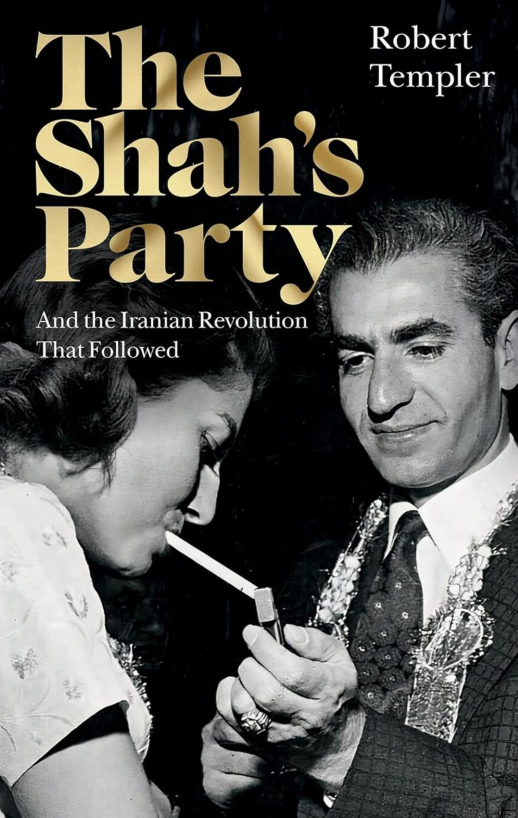
Iranians mostly speak Persian and their word for king is shāh. A ruling monarch such as Mohammad Reza Pahlavi, Shah of Iran from 1941 to 1979, headed the dynasty and state, being successor to a 2500-year line of royalty stretching to the original Persian Empire of Cyrus the Great. In 1967 he adopted the title Shāhanshāh, denoting “king of kings”, then in 1971 he decided to throw a party to show the world his true greatness.
For the Shah, whose other titles included Light of the Aryans and Shadow of God on Earth, it would not be any ordinary party but such a party as had never been seen anywhere. Before it had even begun, newspapers declared it the Party of the Century, the most expensive such event ever. Its pharaonic expense would contribute to the exile of the Shah eight years later, and his replacement by the corrupt clerics who still have the country in their iron grip today.
More than 60 world leaders and heads of state were invited to the three-day extravaganza In a specially built lavish tent city in the desert in the shadows of the ancient ruins of Persepolis, the ceremonial capital of the ancient Achaemenids, the dynasty that founded the Persian Empire, the world’s biggest at the time, and ruled it for 220 years.
As well as commemorating Persian imperial history, the celebration would be a coming-out party for an Iran emerging into modernity and for its king of kings. The Shah and his glamorous third wife, Farah Diba, would welcome one of the largest gatherings of royalty and political leaders since the Congress of Vienna in 1814. Two emperors, six reigning kings, 19 presidents, an array of crown princes, a prince of the Church, a bevy of prime ministers and others would spend their time in heat and dust 800 kilometres from today’s capital, Tehran.
However, the Shah’s taste for the grandiose proved to be wrong on many levels, becoming a focal point of internal opposition and external criticism. The elite feasted while much of rural Iran was impoverished. Food was supplied by the world-famous French restaurant Maxim’s, including a five-course banquet with rare wines and the best caviar served by Swiss waiters.
The guest tents were furnished with designs from Paris-based interior decorator Maison Jansen, and the court members were dressed in uniforms by Lanvin, the French luxury fashion house. The latter stood out in the age of blue-jeans and leather jackets as either laughably pretentious or obscenely wasteful, depending on your point of view, Templer states. Trees were planted and birds imported but there were no everyday Iranians in sight.
“A celebration that began with the aim of making the world aware of Iran’s rich culture and history led to a backlash that eroded the status of a royal family that craved respect above all else,” the author writes. “ Excess and decadence combined with vanity, hubris, and tragedy. Something that was supposed to be joyous turned very sour.”
The guests flew in to Shiraz, kilometres away, where close-mouthed doctors were dealing with some 200 cases of smallpox, the disease having spread across the unprepared country. Fleets of new Mercedes limousines and buses drove the VIPs to the parched and isolated site of 50 tents. The Shah and his family arrived by helicopter.
Some of the oddest figures of the 20th century attended. There were great national heroes who had forged their nations and then held them together by force of will, for instance Marshal Tito of the Socialist Federal Republic of Yugoslavia. Some were truly awful despots such as Nicolaeu Ceausescu, whose totalitarian vision would ruin Romanians’ lives.
Mobutu Sese Seko, the murderous and obscenely corrupt ruler of Zaire, mingled with the gruff President of apartheid South Africa. The guest of honour, Ethiopia’s Haile Selassie, turned up with a huge entourage. Queen Elizabeth II of the United Kingdom sent her husband, Prince Philip and their daughter, Princess Anne. United States President Richard Nixon sent his Vice-President, Spiro Agnew. Imelda Marcos, First Lady of the Philippines, was there, in keeping with her own lavish lifestyle. Few guests were truly top drawer.
“It was perhaps the most cynical and corrupt crowd ever to gather in history. In subsequent years, almost all would be tarnished by scandal, be overthrown, or die in disgrace,” says Templer. They were treated to a dazzling array of performances, including a military pageant with thousands of soldiers in traditional Persian attire. There was a grand “son et lumière”.
Visitors and observers found distasteful the heavy-handed security involving the regime’s feared secret police force the SAVAK, who were becoming an object of special abhorrence in the West. Templer, who looks at the bigger picture throughout, weighs the Shah’s sins against those of other governments that supported much more brutal regimes themselves.
Nonetheless, the author finds SAVAK’s brutality inexcusable, and a particularly harrowing section of the book explores the torture at the Evin Prison in Tehran, a place so feared it was dangerous to mention it. Again, giving context, Templer observes that criticism of the Shah’s autocratic regime was swelling at a time when the issue of human rights took centre-stage in world politics. Amnesty International, the human rights group, was founded in 1961.
Likewise, the even-handed author compares the cost of security at the Shah’s party with the ballooning cost of today’s G7 gatherings and finds it was rather modest. But he deplores “the Pahlavi vision of the State and the Emperor as a leader who handed down rights to his subjects. They were not seen as intrinsic to the individual but as something that his people enjoyed because the Shah granted them.”
And so, the party became a symbol of the Shah’s loss of touch with reality. The stark contrast between his opulent life and the poverty and inequality plaguing much of the country served to exacerbate tensions and galvanise opposition. When the growing disdain finally boiled over into revolution Shah Mohammad Reza Pahlavi would flee Iran on January 16, 1979.
Just two weeks later a million-plus crowd welcomed back the black-eyed conservative cleric Ayatollah Ruhollah Khomeini, forced into exile 15 years earlier after his harsh criticism of the Shah’s modernisation reforms, named the White Revolution. These included land reform and women’s suffrage, seen by Khomeini as a threat to Islamic values and his own ambitions. A skilled populist, he relentlessly tapped into the growing resentments.
Templer: “What had seemed like a country charging into the future took a shocking turn to the past… Having once appeared as a sunny and forward-looking place, it now seemed to be populated by scowling men with raised fists.” He argues that “Almost every positive aspect of life in Iran today can be traced back to the fifty-four years of Pahlavi rule,” and “Khomeini’s Iran… has delivered little in the way of improved living standards for its people.” The brutal clerical regime, using SAVAK and the prisons set up by the Shah, “is willing to kill a limitless number of people to stay in power, something the Shah found impossible”.
Much more than a book on the legendary celebration, mind-boggling as that was, Templer offers vivid insight into the influences and personalities around the waning monarchy and the political miscalculations that have led to today’s war by the United States and Israel against a country cowed by a hugely corrupt leader killing protestors and developing a nuclear bomb.
Templer’s detail is impressive. Two facts that stand out – items supplied to party guests included 400 pairs of fake eyelashes at USD 10 each, and the Iranian Supreme Leader today controls an organisation that has amassed real estate and other assets worth USD 95 billion.