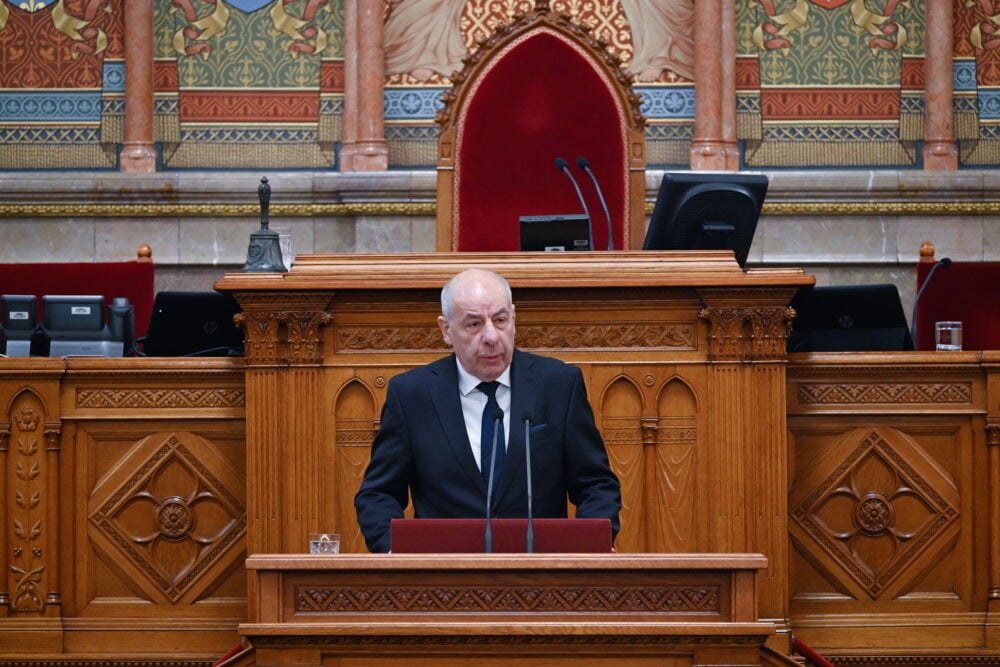
Hungary is heading toward a constitutional confrontation over a controversial amendment proposed by the TISZA Party, which would prematurely end the mandate of President Tamás Sulyok. The president responded indirectly on social media, stressing the fundamental importance and inviolability of the rule of law.
Speaking at an event organized by the National Council of Judges to mark “Day of the Courts,” Tamás Sulyok described the occasion as a “celebration of the fundamental values of our legal order,” highlighting the importance of institutional respect for the judiciary. In an apparent message directed at his political opponents, the president stated:
The rule of law is not a matter of political interpretation, but, like mathematics, an objective matter of fact; it means the supremacy of the law.”
The rule of law, he said, is a functioning system built on respect for legal principles and has served as an unquestionable foundation since the establishment of modern, civic Hungary. He emphasized that genuine rule of law cannot exist without independent courts.
The Hungarian president’s remarks have taken on particular significance amid the escalating dispute.
On Monday, TISZA’s parliamentary majority approved the 17th amendment to Hungary’s Fundamental Law. Among other provisions, the amendment would immediately terminate Tamás Sulyok’s presidential mandate.
The move has created an unusual legal dilemma: under the constitution, the amendment can only take effect after it has been signed and promulgated by the sitting president. This means that Tamás Sulyok would have to sign a document that effectively ends his own term in office.
MPs vote on the bill concerning the 17th amendment to Hungary’s Fundamental Law during an extraordinary parliamentary session on July 13, 2026. Photo: MTI/Hegedüs Róbert
Since a voluntary signature from the president appears highly unlikely, the dispute could enter its next phase. Prime Minister Péter Magyar said at a press conference that refusing to sign the amendment would constitute a violation of the law. In such a case, he said, impeachment proceedings against President Sulyok would be launched immediately.
Following the parliamentary vote, the president’s office issued a statement calling for adherence to constitutional principles.
The statement warned against the “arbitrary exercise of public power” and against attempts to use a two-thirds parliamentary majority without constitutional limits or safeguards.
Constitutional lawyer Zoltán Lomnici Jr. told Magyar Nemzet that the president’s legal options are extremely limited. Under the constitution, once the president receives a parliamentary decision, he generally has only five days to sign the amendment and order its promulgation.
Lomnici said substantive objections — including the argument that the law is clearly designed specifically against Sulyok personally — do not provide grounds for refusing to sign it. The president’s only possible course would be to appeal to the Constitutional Court. However, he may do so only by challenging formal procedural issues in the adoption of the legislation. If the court rejects such a challenge, the president would be required to sign the amendment without delay.
If the Constitutional Court were to identify procedural violations or determine that the amendment was not constitutionally valid, parliament would have to reconsider the proposal from the beginning.
Constitutional lawyer Zoltán Lomnici Jr. Photo: MTI/Kocsis Zoltán
To remove a president unwilling to sign the amendment, the TISZA Party could potentially rely on more drastic constitutional mechanisms. Zoltán Lomnici Jr. outlined two possible scenarios:
- Impeachment proceedings: One-fifth of MPs may initiate impeachment proceedings against the president for an intentional violation of the Fundamental Law. Approval requires a two-thirds majority in a secret parliamentary vote. From the moment parliament approves the proceedings until their conclusion, the president’s powers are suspended. During this period, the speaker of parliament assumes presidential duties and could sign and promulgate the constitutional amendment herself. The president’s mandate could then end the following day — before the Constitutional Court has even reached a decision. However, Zoltán Lomnici Jr. stressed that Sulyok has not committed any wrongdoing since taking office and that such proceedings would have no legal foundation.
- Declaration of “temporary incapacity”: Another possibility would be a declaration that the president is temporarily unable to perform his duties. This requires only a simple parliamentary majority and may be initiated by the government or individual MPs. In this scenario, presidential powers would immediately pass to the speaker of parliament, who could then rapidly promulgate the amendment. Constitutional experts have described such a move as politically extreme and legally questionable.
The dispute has already taken on a European dimension.
As an EU member state, Hungary is bound by the fundamental values enshrined in the EU treaties, including democracy and the rule of law.
In this context, Zoltán Lomnici Jr. referred to the Venice Commission of the Council of Europe. The commission has repeatedly stressed in the past that constitutional amendments must be carried out transparently and in accordance with the principle of legal certainty. In particular, it has traditionally warned against the targeted removal of individuals from public offices through tailor-made transitional provisions.
Under Hungary’s Fundamental Law, the president is elected for a fixed five-year term in order to guarantee stability and political impartiality. The proposed constitutional amendment would deliberately undermine this protection of the presidential mandate. For the constitutional expert, it is therefore clear that TISZA’s move is not aimed at fostering political trust, but rather represents a deliberate and dangerous circumvention of the constitution.
Related article
“Day of Mourning” for Hungary, as Péter Magyar Rams through Controversial Constitutional Amendments
Today, Hungary has become a hybrid authoritarian, semi-constitutional system.Continue reading
Via MTI, Magyar Nemzet; Featured image: MTI/Koszticsák Szilárd