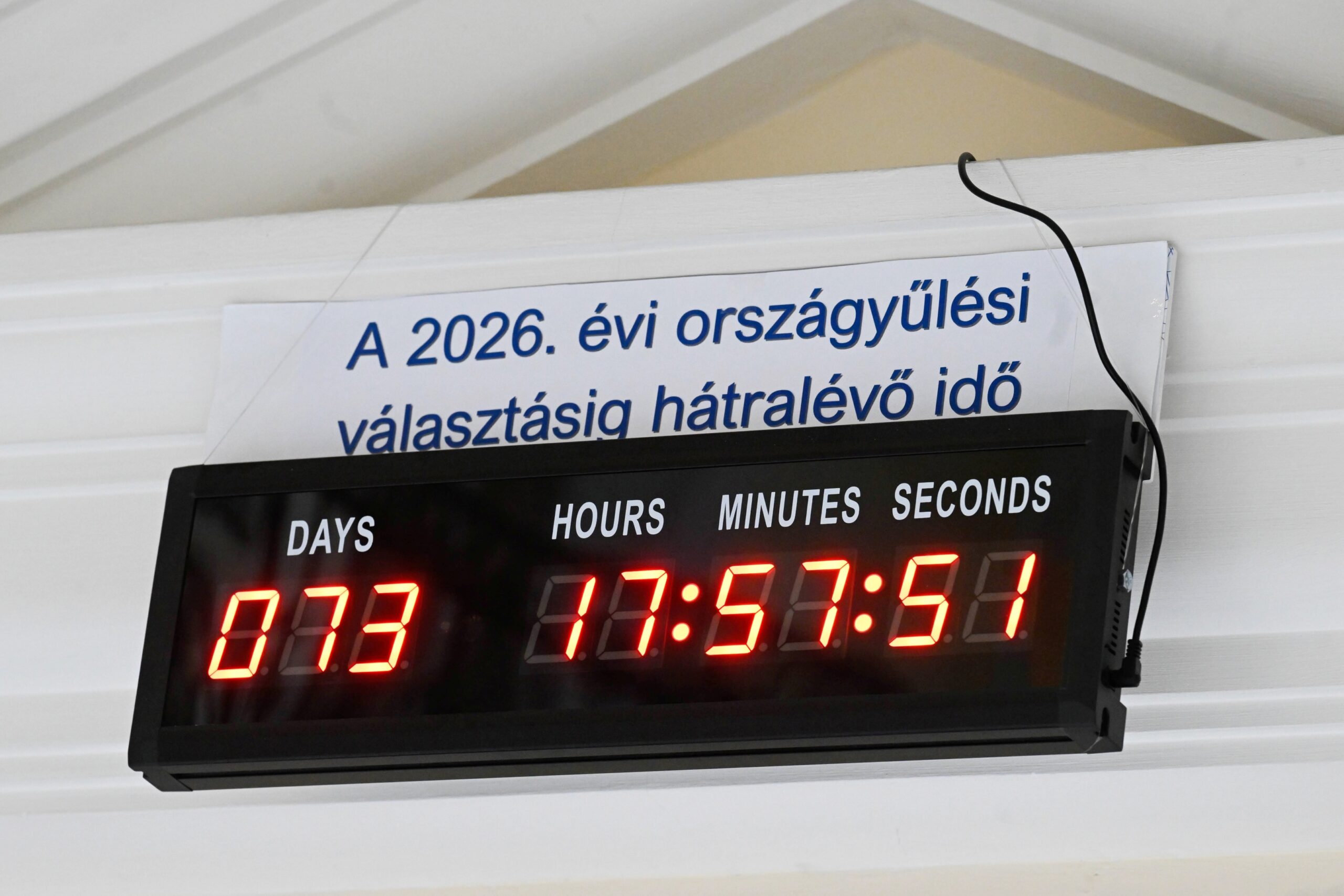
A countdown clock showing the time remaining until the 2026 parliamentary election at the National Election Office building in Budapest on January 28, 2026
In response to an inquiry from MTI, the National Judicial Office (OBH) reported that approximately 170 parties will be eligible to run in the parliamentary elections on April 12. Four years ago, 267 registered parties were eligible to run.
The Office stated that on January 13, the day the parliamentary elections were announced, there were 168 legally registered parties listed in the registry of civil organizations. Last year, 15 parties were registered, while this year none were. Since 2022, 43 parties have been registered in the courts and 83 have been deleted, based on the OBH registry.
In several cases, the former party initiated proceedings in court to continue its activities in the form of an association, thus they were not formally deleted, but they are no longer listed in the register of parties.
In addition, the public prosecutor’s office could also initiate the declaration of a former party as an association if the party did not field candidates in two consecutive general parliamentary elections.
A notice announcing Hungary’s April 12, 2026 parliamentary election displayed at the National Election Office building in Budapest on January 28, 2026. Photo: MTI/Bruzák Noémi
In the four years leading up to the 2022 parliamentary elections, 172 parties were registered, 116 were founded between 2014 and 2018, and 51 between 2010 and 2014.
Fact
Although most of the parties formed in the first half of the 1990s have ceased to exist, based on the OBH’s records, six of them are still active today. Of the current parliamentary parties, the Hungarian Socialist Party was registered with the court in November 1989, the Christian Democratic People’s Party (known as KDNP) in December 1989, and the Alliance of Young Democrats (known as Fidesz-Hungarian Civic Alliance) in February 1990.
For parties running in the parliamentary elections, nominating candidates is important not only because of the possibility of entering parliament, but also because social organizations registered as parties can only continue to operate as parties if they are able to run in the elections, if their candidates are included on the ballot.
The 1989 law on the functioning and management of parties states that, at the request of the public prosecutor’s office, the court shall declare the party to be dissolved, without affecting its continued existence as an association, if the party does not field candidates in two consecutive general parliamentary elections.
Fact
A new poll conducted by the Hungarian Institute for Social Research (Magyar Társadalomkutató) confirms that the ruling parties remain comfortably in the lead with 51% support among active voters. The TISZA party (main opposition party – editor’s note) is in second place with 41% of the vote, still ten percentage points behind the governing parties.
Graphic: Hungarian Institute for Social Research (Magyar Társadalomkutató)
Although support for the party has changed somewhat, according to the institute’s statement, the moderate increase was not at the expense of Fidesz-KDNP, but mainly at the expense of other opposition parties, the Democratic Coalition and the Two-Tailed Dog Party. According to the poll, apart from these parties, only Mi Hazánk Mozgalom (Our Homeland Movement) would exceed the five percent threshold, which has been stable at over five percent for several months.
Related article
Socialist Leader Pushes Bill to Strip Voting Rights from Hungarians Living Abroad
The Democratic Coalition (DK) wants to abolish postal voting, redraw electoral districts, and restore a proportional system. Continue reading
Via MTI; Featured photo: MTI/Bruzák Noémi