Overview:
A Haitian fan argues FIFA’s referee assignment policies create perceptions of bias that undermine trust in the World Cup. He suggests some ways the organization can prevent such bias and perceptions.
OTTAWA — Soccer is a universal language, a symbol of equality, where every nation, regardless of its size or economic power, has the chance to prove its worth on the field. Despite its ongoing dire situation, Haiti proved that universality by returning to the 2026 World Cup for the first time since 1974.
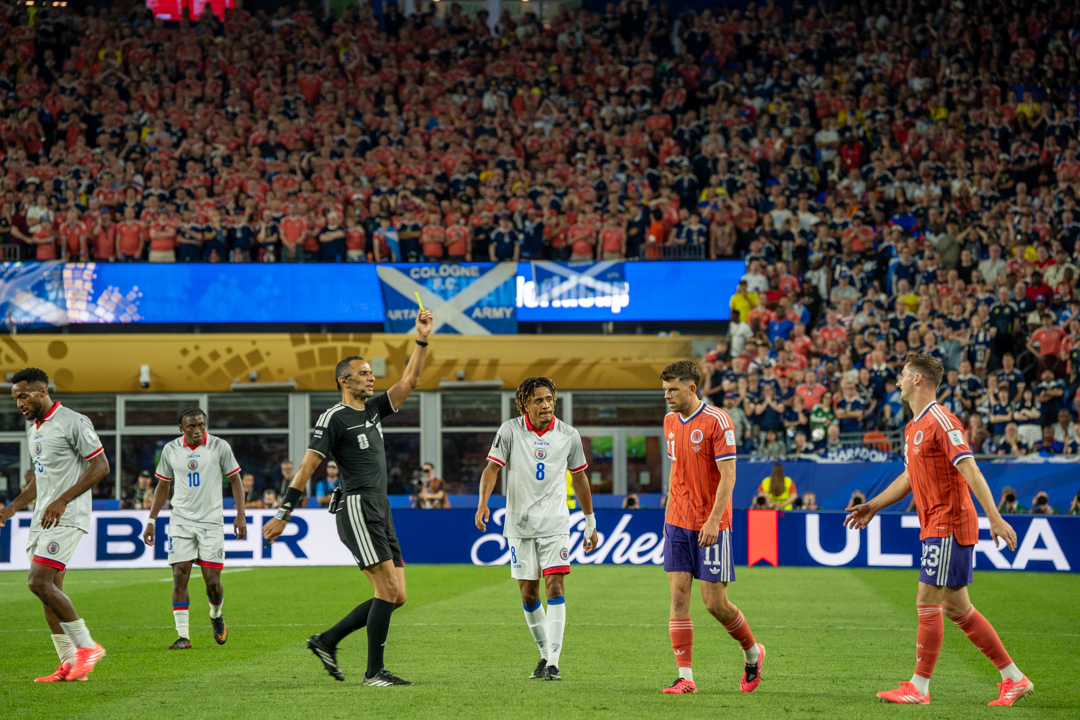
Right out of the gate, during the first game against Scotland, a couple of arbitrating issues surfaced . Specifically, two tangible penalty shouts were ignored: a handball and a reckless tackle in the box. The Video Assistant Referee (VAR) remained silent despite the main referee’s possible misjudgments. The perceived conflict of interest came into question, fuelling an already strong mistrust of FIFA.
Now, there are petitions on social media asking FIFA to “investigate referee Mustapha Ghorbal & VAR for robbing Haiti vs Scotland World Cup game.” I have seen one in English and another in French.
From my perspective, there is no point in requesting a FIFA investigation on this matter. FIFA is the organization that triggers the situation due to its lack of judgment. The three officials should not have been put in this situation to begin with. While FIFA could justify assigning referees from the same nation to ensure better on-field communication, that does not hold anymore.
All this highlights FIFA’s ethics problems, how biases come into play on the field and a few ways the organization can handle them to earn fans’ faith in the game so universally loved.
- Haiti-Scotland head referee Mustapha Ghorbal (in black) during the June 13, 2026, match at Gillette Stadium in Foxborough, Mass. Many Haiti fans have called for an investigation after calls he made in that game they said favored Scotland. Photo by Fred Cayemitte / The Haitian Times
- Haiti-Scotland head referee Mustapha Ghorbal (in black) during the June 13, 2026, match at Gillette Stadium in Foxborough, Mass. Many Haiti fans have called for an investigation after calls he made in that game they said favored Scotland. Photo by Fred Cayemitte / The Haitian Times
Weighing conflicts of interest
The FIFA Code of Ethics mandates that all officials proactively disclose any personal, financial or familial interests. The code identifies related party and potential source of interest conflict at the household level (micro), institution level (meso) and country level (macro). The latter is an obvious reason FIFA avoids assigning referees to matches involving their own country or confederation.
However, fellow-citizen conflicts of interest can also exist within the trio, even if no actual bias occurs. In fact, ethics frameworks treat appearance as equally important as actual bias. Shared nationality creates an apparent conflict for several reasons, including.
- In-group bias — Humans unconsciously favor people from their own group, including nationality. This is one of the most replicated findings in psychology.
- Crew alignment pressure — Officials from the same country often share communication norms, trust patterns and decision-making habits, which can create internal conformity. The two assistant referees tend to support the main referee’s decisions out of a sense of fellow-citizen solidarity.
- Authority gradients — Assistants may defer more readily to a referee from their own country, amplifying one official’s influence.
These mechanisms are documented in the fields of psychology and organizational behavior, and they apply directly to officiating. It seems they align with the FIFA’s former practice to mix and match referees and assistant referees from different nations to prevent bias or to give perception of neutrality. However, FIFA changed this policy about 20 years ago and started assigning a same-country trio — a policy where the central referee and their two assistant referees belong to the same country — entrenching it fully by the 2006 World Cup. Supposedly, this new approach helps to ensure better on-field communication, crew-chemistry and consistency.
Haiti-Scotland head referee Mustapha Ghorbal (in black) during the June 13, 2026, match at Gillette Stadium in Foxborough, Mass. Many Haiti fans have called for an investigation after calls he made in that game they said favored Scotland. Photo by Fred Cayemitte / The Haitian Times
Using on-field communication to prevent bias
Two decades later, fans are losing trust more and more in officiants and frustrations with referees are laid bare for all the world to see in the online petitions. Therefore, FIFA should take measures.
First, FIFA could leverage recent significant developments in AI language translation to improve on-field communication between referees of different languages.
Second, if it wishes to avoid language translation applications, another solution is to assign officials, based not on the same country, but on the same language. This would help to find a balance between better on-field communication and bias prevention.
Finally, FIFA could easily avoid this perceived conflict of interest by implementing VAR. It was created for a reason, after all. Why not use it? Not activating VAR during key or controversial periods of a game is not an effective implementation of this tool.
Between the extortionate ticket pricing strategies and heavy logistical and labor rights concerns, the lack of trust of FIFA will only worsen unless it prioritizes bias prevention on the field. Failure to address this issue will ultimately sour fans on the tournament in years to come.