Overview:
Protests erupted in Port-au-Prince Monday after the government raised fuel prices by up to 38%, with burning barricades blocking key roads in Delmas and Pétion-Ville. The unrest underscores mounting frustration in a country already grappling with rampant insecurity, growing inflation and worsening humanitarian crisis.
PORT-AU-PRINCE — Protests over rising fuel prices brought parts of Haiti’s capital to a standstill Monday, as burning tire barricades blocked major roads and disrupted public transportation across Delmas and Pétion-Ville.
From early morning, motorcycle taxi drivers, tap-tap operators and bus drivers erected roadblocks along key routes, including the Delmas corridor, forcing many commuters to walk long distances. In several areas, protesters stopped vehicles still operating and ordered passengers to disembark.
The unrest follows a government decision that took effect April 2, raising fuel prices sharply: gasoline to 725 gourdes (about $5.58) per gallon, diesel to 850 gourdes (about $6.54) and kerosene to 845 gourdes (about $6.50). The increases are roughly between 30% and 38%.
Transport workers say the hikes are unsustainable in a country where most households already struggle with soaring living costs and limited income.
“The increase in gasoline prices is too high for an already vulnerable population. This situation risks triggering a chain rise in the cost of living, directly affecting public transportation, goods, and services.”
Duclos Benissoit, coordinator of the Unified Movement of Haitian Transporters (MUTH)
“The announced increase in gasoline prices is too high for an already vulnerable population,” said Duclos Benissoit, coordinator of the Unified Movement of Haitian Transporters (MUTH). “This risks triggering a chain reaction in the cost of living.”
Despite government-set fares, drivers have widely raised prices by up to 50% more to offset fuel costs. On the Delmas 33–Siloe route, for instance, fares set at 50 gourdes have climbed to 75 gourdes. Trips to Gérald Bataille now cost between 50 and 75 gourdes, up from an official 30 gourdes, while rides from Delmas to Pétion-Ville, about three miles, have risen from 75 to about 100 gourdes.
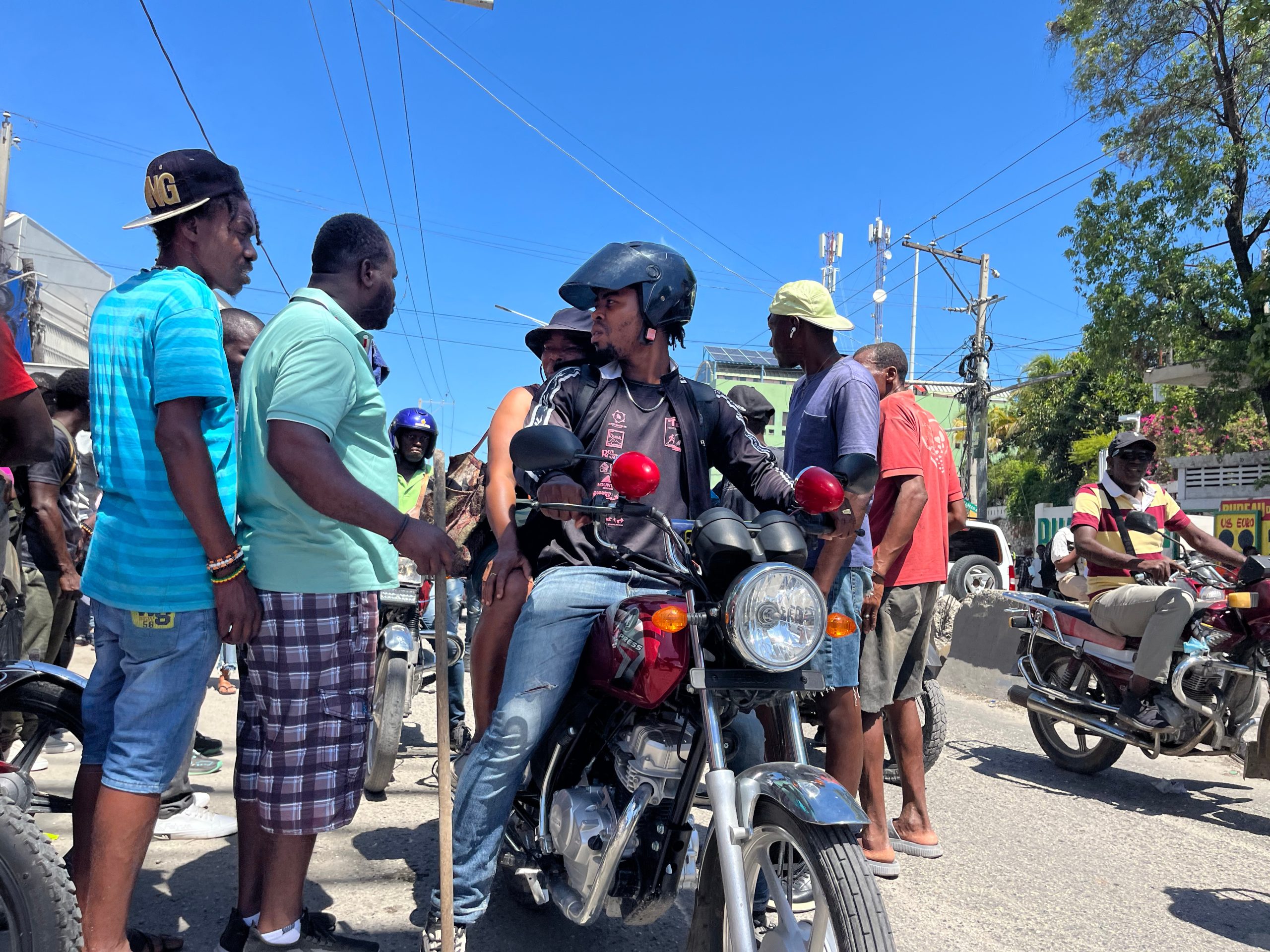
- Two passengers in the Delmas 48 area discuss the fare with a motorcycle taxi driver to take them to Pétion-Ville, due to road blockages affecting transportation, on Monday, April 6, 2026. Photo by Juhakenson Blaise / The Haitian Times.
- Protesters block drivers who attempt to ignore the protests in the Haitian capital on Monday, April 6, 2026. Photo by Juhakenson Blaise/The Haitian Times.
- Officers from the Intervention Corps for Maintaining Order (CIMO) of the Haitian National Police are trying to extinguish a fire involving burning tires on the Delmas 32 road on Monday, April 6, 2026. Photo by Juhakenson Blaise / The Haitian Times.
- One of the protesters raises his arms to instruct a motorcycle taxi driver to stop and unload passengers in the Delmas 37 area, as a show of support for the protest against the fuel price hike on Monday, April 6, 2026. Photo by Juhakenson Blaise / The Haitian Times.
- Scene at one of the gas stations closed on Monday, April 6, 2026, as protesters and public transportation drivers demonstrated against the new fuel prices. Photo by Juhakenson Blaise / The Haitian Times.
Crisis deepens economic strain, a city on edge
The protests reflect broader frustration in Haiti, where overlapping crises—gang violence, political instability and economic decline—continue to strain daily life.
Fuel price increases historically trigger unrest in Haiti because they directly affect transportation, food distribution and basic goods. With supply chains already disrupted by insecurity, higher fuel costs risk accelerating inflation and deepening hardship for low-income families.
The latest hike also comes amid persistent concerns over fuel availability and market manipulation, with authorities previously warning against speculation and black-market resale.
By midday, several major arteries remained blocked, with police units, including officers from the Intervention Corps for Maintaining Order (CIMO), attempting to clear burning barricades.
Some gas stations stayed closed as tensions persisted.
While protests eased in some areas later in the day, the demonstrations underscored the fragile balance in the capital, where economic decisions quickly intersect with security risks and public anger.
With additional price pressures expected, transport unions and observers warn that further unrest is likely if no relief measures are introduced.
Like this:
Like Loading…